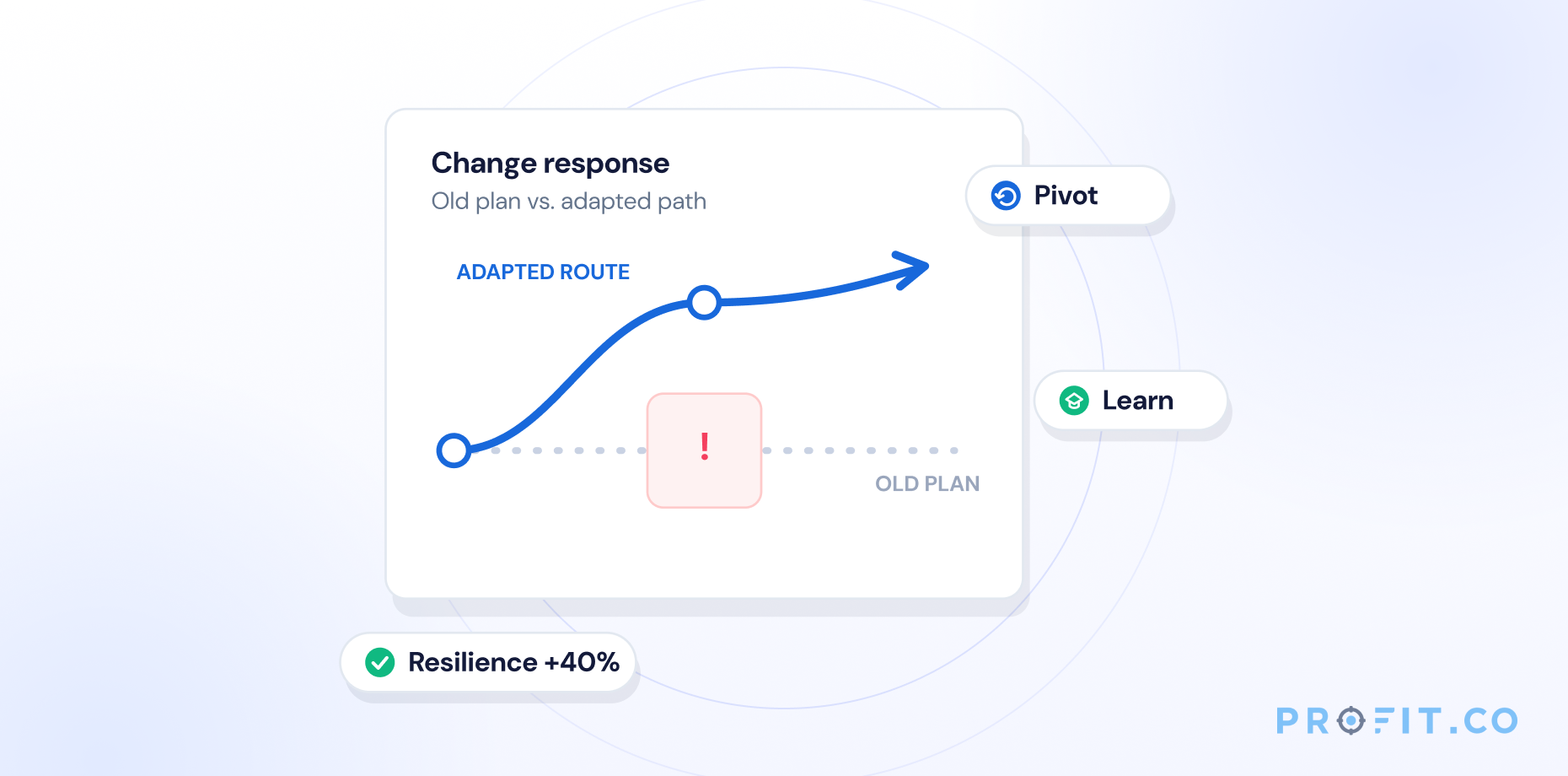
Workplace adaptability is the ability to adjust thinking, behaviour, and approach in response to changing conditions – without losing effectiveness or requiring external pressure to act. It is not a personality trait. It is a set of learned behaviours that can be defined, practised, and formally assessed in a performance review.
In this guide
- What Is Adaptability in the Workplace?
- Why Does Adaptability Matter for Team and Business Performance?
- 8 Tips for Improving Adaptability in the Workplace
- Adaptability Examples in the Workplace
- Build Adaptability Into Your Performance Review Process with Profit.co
- How Do Managers Assess Adaptability in Their Teams?
- What Does Adaptability Look Like Across Different Work Contexts?
- What the Right Platform Does for Developing Workplace Adaptability
- Make Adaptability a Measurable Performance Competency with Profit.co
- Workplace Adaptability Best Practices
- Workplace Adaptability Questions and Answers
TL;DR – Adaptability is the performance competency most commonly cited by managers as a gap – and least commonly defined in performance frameworks. Teams that develop adaptability deliberately – through structured reflection, cross-functional exposure, and formal development goals – outperform reactive teams in every change scenario studied. This guide covers what adaptability actually looks like as a behaviour (not a trait), 8 specific practices that build it, five real workplace examples across functions, and how managers can assess and score it in a formal review.
What Is Adaptability in the Workplace?
Workplace adaptability is a performance competency – a cluster of observable behaviours that enable an individual or team to maintain effectiveness when priorities shift, structures change, or conditions become unpredictable. It is distinct from resilience (which is about recovery after difficulty) and from flexibility (which is about willingness to change). Adaptability is about the quality of adjustment: how quickly, how deliberately, and how effectively someone changes their approach when the situation demands it. For a full practical guide on developing it, see 6 ways to develop adaptability at the workplace and manage change.
Three behaviours define adaptability in a professional context:
Cognitive Flexibility
The ability to hold multiple interpretations of a situation simultaneously and switch between them as new information arrives. An employee who can only see a problem one way is not necessarily incompetent – they may be highly skilled within that frame. But they are not adaptable.
Proactive Adjustment
Making changes before external pressure forces them. Reactive adjustment is a survival skill. Proactive adjustment is the competency that separates high-performing individuals from effective ones.
Learning Orientation
Treating change as a source of information rather than a source of disruption. Adaptable employees document what they learn when conditions shift. Non-adaptable employees treat each disruption as an isolated event with no carry-forward lessons.
Adaptability is not a personality trait – it is a set of learned behaviours that can be defined, practised, and assessed in a performance review. Teams that treat it as innate never develop it. Teams that treat it as a skill always do.
Why Does Adaptability Matter for Team and Business Performance?
Adaptability has a direct, measurable impact on three business outcomes that matter to every leadership team. For context on how these outcomes connect to performance management more broadly, the full guide covers the infrastructure that makes competency development systematic.
1. Speed of Execution During Change
Teams with high adaptability scores execute strategic pivots in roughly half the time of teams with low scores – not because they work harder, but because they spend less time in the resistance and recalibration phases that low-adaptability teams cycle through repeatedly. Every strategic priority shift, restructure, or product pivot is faster and cheaper when the team executing it adapts rather than resists.
2. Retention During Uncertainty
Employees who score high on adaptability assessments report significantly higher job satisfaction during periods of organisational change than their low-adaptability peers – because they experience change as a challenge to navigate rather than a threat to survive. Adaptability reduces the voluntary attrition that typically spikes in the 90 days after a major restructure or leadership change.
3. Quality of Individual Performance Reviews
Adaptability is now a formal competency in the performance frameworks of the majority of Fortune 500 companies. Employees who cannot demonstrate adaptable behaviour in their review narratives – with specific examples, not general claims – score lower on competency ratings regardless of their output performance. A high-output employee with no adaptability evidence on record is a flight risk and a succession gap simultaneously. For how performance appraisal competencies are structured and scored, the full guide covers all twelve core competency types.
| Business Context | Impact of High Team Adaptability | Impact of Low Team Adaptability |
|---|---|---|
| Strategic pivot | Fast execution, low rework | Slow start, high resistance cost |
| Leadership change | Stable performance within 30 days | Performance dip lasting 60-120 days |
| Market disruption | Proactive response before competitors | Reactive catch-up after competitors |
| Process improvement | Adoption complete within one sprint | Adoption incomplete after two quarters |
| Remote / hybrid shift | Output maintained or improved | Output reduction, cultural erosion |
8 Tips for Improving Adaptability in the Workplace
Develop a Growth Mindset Toward Feedback
The fastest way to improve adaptability is to change the relationship with feedback. Employees who treat critical feedback as information – to be processed and acted on – update their behaviour faster than those who treat it as a judgment. The practical habit: after each piece of significant feedback, write down one behaviour it implies you should change, and one situation in the next two weeks where you can test the change.
Real Example
James Okafor at Apex Digital introduced a personal feedback log in Q2 – a running document where he recorded every piece of developmental feedback received and the specific action he took in response. At his quarterly review, he referenced six documented changes. His manager’s assessment noted this as the strongest demonstration of adaptability in the team.
Build Situational Awareness Before Responding to Change
The most common adaptability failure is reacting to the surface change rather than understanding the underlying shift. When a priority changes, a process is redesigned, or a target is revised, the adaptive response begins with two questions: “What drove this change?” and “What stays the same even though this changed?” Answering both before acting prevents the overcorrection that wastes the first two weeks of any change cycle.
Real Example
When Vantage Logistics restructured its regional operations in Q1, Marcus Webb spent the first three days in conversations with the leadership team and his direct reports before changing any process or communication. The result: his region was the first to reach steady-state output after the restructure – four weeks ahead of the two other regions.
Strengthen Your Problem-Solving Process
Adaptability under pressure requires a repeatable problem-solving process that works regardless of the specific problem. Employees who rely on domain expertise alone become brittle when the problem moves outside their domain. Employees with a domain-agnostic problem-solving approach – define the problem precisely, separate the symptom from the cause, generate options, test the cheapest option first – maintain effectiveness across problem types.
Real Example
Diana Torres at Harrow & Associates faced a 40% drop in organic traffic following an algorithm update in Q2 – outside her area of expertise. Rather than waiting for an SEO specialist, she applied her content performance framework: diagnosed the change by page type, identified the pattern, formed a hypothesis, and published a test batch within two weeks. Traffic recovered to 85% of pre-update levels before the specialist was brought in.
Practise Cognitive Flexibility in Daily Decisions
Cognitive flexibility – the ability to switch between mental frameworks when the situation demands it – is a muscle built through deliberate daily practice, not through occasional big-change events. The practical exercise: once per week, take a problem you have already solved and argue the opposite position. Not to change your answer – but to test whether your reasoning holds against a different frame.
Real Example
Kavya Nair at Meridian Software introduced a standing item in her weekly 1:1s – “the other side of the argument” – where she and her manager would spend five minutes steelmanning the position they had decided against. In Q2, this practice surfaced a risk in her pricing strategy that her original analysis had missed, leading to a modification that protected two enterprise accounts from churning in Q3.
Build Cross-Functional Relationships Before You Need Them
Adaptability in an organisational context is partly relational. Employees who have invested in relationships across functions before a change arrives can access information, resources, and support faster than those who only hold deep relationships within their own team. The practical target: one meaningful cross-functional interaction per month – a 1:1 with someone outside your direct team, a working session on a cross-functional problem, or a contribution to a project outside your primary scope.
Real Example
Priya Sharma at Clearfield Group built working relationships with Finance, Legal, and the three Engineering managers in her first six months as HR Business Partner. When a regulatory compliance requirement landed with a 30-day implementation window in Q2, she was able to move from briefing to execution in four days – because every stakeholder she needed already knew her and trusted her process.
Document What You Learn When Things Go Wrong
The gap between an adaptable team and a reactive one is not how often they face disruption – it is what they do with it afterward. Adaptable teams run structured retrospectives when a process fails, a project misses, or a market condition changes – and they use those retrospectives to update their operating assumptions before the next change arrives. The output is not a lessons-learned document nobody reads. It is one updated process, one revised checklist, or one changed assumption – documented and accessible to the whole team.
Real Example
After a Q1 delivery failure, Marcus Webb’s team at Vantage Logistics ran a 90-minute retrospective that produced three process changes and two updated checklists. In Q2, when a similar disruption occurred, the resolution time was 40% shorter – because the team had already updated their response protocol.
Separate the Emotional Response From the Practical Response
Change triggers an emotional response before it triggers a practical one – and in most workplaces, the emotional response is never separated from the practical one, which means both suffer. The adaptive practice: when a change is announced, give the emotional response a defined window (a conversation with a peer, a written reflection, a walk) and then close it before moving to the practical assessment. This is not suppression – it is sequencing. The emotional response is valid. It simply cannot be the first draft of the practical plan.
Real Example
When Harrow & Associates announced a restructure that affected Diana Torres’s team size, she took two hours to process the news with a peer before the leadership debrief. In the debrief, she was one of three people out of eleven who arrived with specific questions about the new structure rather than reactions to the announcement. She was asked to lead the transition planning for her function within the week.
Set Adaptability Goals in Your Development Plan
The most direct way to improve adaptability is to make it a formal development goal – with a defined behaviour, a specific context, and a measurable expected outcome – in your performance development plan. “Be more adaptable” is not a development goal. “By Q3 end, demonstrate proactive adjustment to at least two strategic priority changes – documented in my 1:1 log with the specific change, my response, and the outcome” is a development goal. For templates and examples of how to write strong employee self-evaluations that include development commitments, the full guide covers every section of the form.
Real Example
Following her Q1 review, Priya Sharma at Clearfield Group set a formal adaptability development goal for Q2: lead at least one cross-functional initiative outside her primary HR scope, with a documented debrief at the end. She led the onboarding redesign project with Product and Engineering. At her Q2 review, her manager cited it as the strongest evidence of adaptability development in the team.
The most adaptable employees are not the ones who adjust most easily. They are the ones who adjust most deliberately – understanding why the change is happening before deciding how to respond.
Adaptability Examples in the Workplace
The following examples show what each of the five adaptability behaviours looks like when applied in a real role context. For more workplace behaviour examples across all competencies, see 50 employee evaluation comments that boost performance.
| Employee | Situation | Adaptive Behaviour | Outcome |
|---|---|---|---|
| Kavya Nair, Sales, Meridian Software | Competitor launched a directly competing product mid-Q2 | Used OODA loop to assess impact, repositioned pitch narrative within 5 days, identified 3 at-risk accounts before they raised concerns | Zero churn in the at-risk accounts; two expanded |
| James Okafor, Engineering, Apex Digital | Platform architecture decision reversed after 3 weeks of sprint work | Ran a 2-hour retrospective, extracted 4 reusable code components from the cancelled work, updated sprint planning template to add architecture sign-off gate | Sprint 8 velocity unaffected; new gate added to all future sprints |
| Priya Sharma, HR, Clearfield Group | New CHRO joined mid-Q2 with a different performance review philosophy | Requested a 1:1 within the first week, mapped the differences between the existing and new approach, presented a transition plan that preserved the current cycle without requiring a restart | Review cycle completed on time; CHRO cited the transition plan in her first all-hands |
| Marcus Webb, Operations, Vantage Logistics | Fuel cost spike of 18% in Week 3 of Q2 | Immediately ran a Pareto analysis on route costs, renegotiated the top 3 supplier contracts, implemented idle-time monitoring within 10 days | Cost per shipment reduced from $8.40 to $7.83 by Q2 end |
| Diana Torres, Marketing, Harrow & Associates | Marketing budget cut 20% in Week 6 of Q2 | Ran a content ROI analysis within 48 hours, identified the 4 highest-performing content types, reallocated 80% of remaining budget to those 4 types | MQL volume dropped 8% vs. the 25% reduction that budget-proportional scaling would have produced |
Build Adaptability Into Your Performance Review Process with Profit.co
How Do Managers Assess Adaptability in Their Teams?
Adaptability is one of the most commonly cited performance competencies and one of the most poorly assessed. The reason: most managers assess adaptability retrospectively and holistically – “does this person seem adaptable?” – rather than behaviourally and specifically. The result is a rating that reflects the manager’s general impression rather than documented evidence, which fails in calibration and means nothing to the employee as a development signal. For guidance on structuring competency scoring and employee evaluations for maximum impact, the full guide covers how to build a fair and consistent rating framework.
A structured adaptability assessment uses four observable criteria:
| Assessment Criterion | What It Measures | Evidence to Look For |
|---|---|---|
| Speed of adjustment | How quickly the employee changes approach when conditions shift | Time from change announcement to updated plan or behaviour |
| Proactive vs. reactive pattern | Whether the employee adjusts before or after external pressure | Did they raise the need to adjust, or respond when directed? |
| Learning extraction | Whether the employee captures and applies lessons from disruption | Documented retrospectives, updated processes, referenced in future decisions |
| Cross-functional effectiveness | Whether adaptability holds outside the employee’s primary domain | Performance on cross-functional projects, response to unfamiliar problem types |
Adaptability rating scale for performance reviews:
Level 1 – Developing
Requires external direction to adjust approach when conditions change. Adjustment is reactive and slow. Rarely extracts learning from disruptions.
Level 2 – Meets Expectations
Adjusts approach within an acceptable timeframe when directed. Shows willingness to change without consistent proactivity. Occasionally extracts and applies learning.
Level 3 – Exceeds Expectations
Adjusts proactively in most situations – identifying the need to change before external direction arrives. Consistently documents and applies learning from disruptions. Maintains effectiveness across most change scenarios.
Level 4 – Distinguished
Adjusts proactively and helps others adjust. Actively builds cross-functional relationships and knowledge before change arrives. Serves as a stabilising resource for the team during periods of significant disruption.
Manager Assessment Note Format
When scoring an employee on adaptability, the comment field must reference at least one specific instance from the review period – named change event, observed behaviour, and documented outcome.
Not assessable: “Shows good adaptability.”
Assessable: “When the Q2 pricing model was revised in Week 4, Kavya updated her pitch narrative without direction and had it in active use within five days – the fastest adjustment in the team.”
What Does Adaptability Look Like Across Different Work Contexts?
| Work Context | Low Adaptability Indicator | High Adaptability Indicator |
|---|---|---|
| Strategic pivot | Continues executing the original plan until formally redirected | Identifies the implication for their work before the all-hands ends |
| Leadership change | Waits to understand the new leader’s style before adjusting behaviour | Requests a 1:1 in week one to understand priorities and working preferences |
| Process redesign | Reverts to the old process under pressure | Documents the new process and trains peers before rollout is complete |
| Rapid growth phase | Protects existing scope during expansion | Proactively expands scope to cover emerging gaps before they become crises |
| Remote or hybrid shift | Recreates in-person habits in a digital context | Redesigns communication and collaboration habits specifically for the new context |
| Budget reduction | Scales all activities down proportionally | Runs an ROI analysis and concentrates resources on the highest-return activities |
| New technology adoption | Uses the minimum required features to maintain output | Explores the full tool set within the first sprint and identifies two workflow improvements |
What the Right Platform Does for Developing Workplace Adaptability
The most common reason adaptability development fails is not lack of intention – it is lack of infrastructure. Employees set informal goals to “be more adaptable,” receive no structured feedback during the review period, and arrive at their annual review unable to demonstrate the competency with evidence. Managers rate them on general impression. Calibration produces inconsistent scores. Development plans produce no change. For how OKRs and performance reviews work together to make competency development systematic, the full guide covers the integration model.
A connected performance platform closes that gap. Five capabilities it must provide:
| Capability | What It Prevents |
|---|---|
| Competency framework with adaptability defined | Managers assessing adaptability by general impression rather than observable behaviour |
| 1:1 and check-in records connected to the review | Adaptability evidence that exists only in memory rather than in a documented evidence trail |
| Structured development plans with tracking | Development goals agreed in a review and never followed through before the next one |
| OKR or goal integration | Adaptability development disconnected from the business priorities that actually require it |
| Calibration workflow | Inconsistent adaptability scores across managers that reflect different definitions, not different performance levels |
Make Adaptability a Measurable Performance Competency with Profit.co
Profit.co connects performance reviews, development plans, and OKRs in one platform – so adaptability moves from a general impression to a scored, evidenced competency that employees can develop and managers can assess with consistency.
- →
Competency-based performance reviews – structured review templates with defined adaptability behaviours at each rating level, so every manager assesses the same competency the same way.
- →
Development plans with milestone tracking – adaptability development goals tracked to completion, connected to the next review period, and visible to both the employee and their manager throughout the quarter.
- →
1:1 records as a continuous evidence log – every coaching conversation, feedback moment, and observed behaviour logged in the same system as the review, so evidence is accumulated continuously rather than recalled at review time.
- →
Calibration workflows – cross-manager adaptability rating consistency reviewed in a structured session, so scores reflect actual performance differences rather than different managers’ definitions of the competency.
- →
OKR-connected goal setting – adaptability development goals tied to active Key Results, so development is never disconnected from the priorities that actually require it.
Workplace Adaptability Best Practices
- ✓
Define adaptability as a behaviour in your performance framework – not as a trait. Name the specific observable actions that earn each rating level.
- ✓
Set adaptability as a formal development goal – with a specific context, a measurable outcome, and a review date – not as a general aspiration.
- ✓
Separate the emotional response from the practical response when change arrives – give the emotional response a window, then close it before building the action plan.
- ✓
Build cross-functional relationships before you need them – adaptability in an organisational context is partly relational.
- ✓
Document what you learn from each disruption – one updated process, one revised assumption, one changed checklist – before the next change arrives.
- ✓
Managers: assess adaptability with named behavioural evidence from the review period – not with a general impression. One specific instance is worth more than ten adjectives.
- ✓
Connect adaptability development to active OKRs – development disconnected from business priority is the first thing abandoned under pressure.
- ✓
Run a structured retrospective within two weeks of every significant disruption – the learning from one disruption is the preparation for the next.
Turn Adaptability Into a Team Capability With Profit.co
Workplace Adaptability Questions and Answers
Workplace adaptability is the ability to adjust thinking, behaviour, and approach in response to changing conditions without losing effectiveness. It is a performance competency – observable, teachable, and assessable – not a fixed personality trait. It includes cognitive flexibility, proactive adjustment, and learning orientation as its three core behavioural components.
Adaptability skills are the specific, observable behaviours that constitute the adaptability competency: cognitive flexibility (switching between mental frameworks as conditions change), proactive adjustment (changing approach before external pressure requires it), learning orientation (extracting and applying lessons from disruption), and cross-functional effectiveness (maintaining performance outside the primary domain). They are learnable and assessable in a formal performance review competency framework – not fixed personality traits.
The eight most effective practices are: developing a growth mindset toward feedback, building situational awareness before responding to change, strengthening a repeatable problem-solving process, practising cognitive flexibility in daily decisions, and building cross-functional relationships before they are needed. The remaining three are: documenting learning when things go wrong, separating the emotional response from the practical response, and setting adaptability as a formal development goal with a measurable outcome.
Adaptability examples include: updating a sales pitch within five days of a competitor launch without being directed; running a retrospective after a cancelled sprint and extracting reusable components; requesting a 1:1 with a new leader in their first week; renegotiating supplier contracts within 10 days of a cost spike; and reallocating a reduced budget to highest-ROI activities within 48 hours of a budget cut.
Adaptability is now a formal competency in most enterprise performance frameworks because it directly predicts performance during change – the condition most organisations are in most of the time. Employees who cannot demonstrate adaptability with specific evidence in their review narratives score lower on competency ratings regardless of output performance, and they represent a succession risk in roles that require navigating uncertainty. See how OKRs and performance reviews work together to make competency development systematic.
Managers assess adaptability using four observable criteria: speed of adjustment, proactive versus reactive pattern, learning extraction, and cross-functional effectiveness. Each criterion requires a specific behavioural example from the review period – naming the change event, the observed response, and the documented outcome. General impressions and adjectives are not assessable in calibration and carry no weight as development signals.
Resilience is the ability to recover from difficulty – to return to baseline after disruption. Adaptability is the ability to adjust effectively during change – to reach a new baseline faster and more deliberately than the alternative. Resilient employees recover well; adaptable employees anticipate, adjust, and build capability from each change event – high performers typically demonstrate both, but adaptability predicts proactive performance while resilience predicts recovery from setbacks.