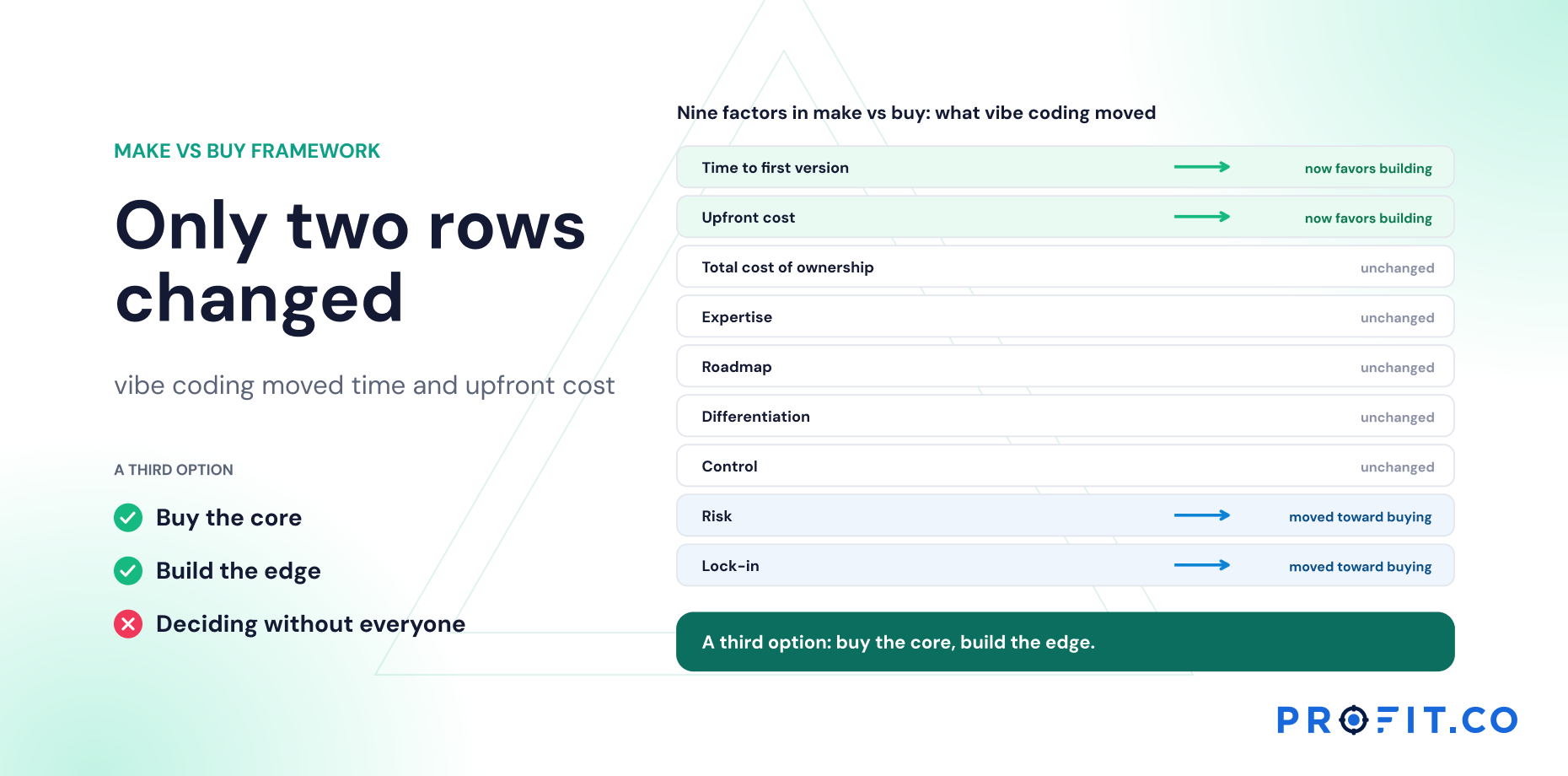
A subscription buys a share in a roadmap far larger than one company could fund alone.
In this guide
- Standing Still Is the Most Expensive Option
- What Does a Strategy Software Roadmap Have to Absorb?
- The Arithmetic of Shared Investment
- Urgent Work Always Beats Important Work
- You Benefit From Requests You Never Made
- Why the Gap Compounds
- AI Makes the Roadmap Move Faster, Not Slower
- Questions to Ask Before You Commit to Funding It
- Frequently Asked Questions
Key Takeaways
- →Maintenance keeps an app running. It does not keep it useful. An app that only receives maintenance declines relative to everything else people use.
- →The decline is invisible from the inside. The dashboard still loads while goal updates thin out and side spreadsheets quietly appear.
- →A credible roadmap carries eight permanent streams, none of which has an end date. Costing a build as a one-off ignores all of them.
- →Urgent beats important every quarter, so roadmap work starves while the backlog grows.
- →The gap compounds. After a few years, closing it means a rebuild, with sunk costs, bespoke data and users who have run out of patience.
Standing Still Is the Most Expensive Option
A software roadmap is the ongoing cost of keeping an application useful rather than merely running. Maintenance fixes what breaks; the roadmap adds what users come to expect. Built internally, one organization funds all of it. Bought, the cost is shared across every customer.
When organizations estimate the cost of an internal strategy app, they usually think about keeping it running: fixing bugs, applying patches, answering access requests. That is maintenance, and it is real. But it is only half of what software needs to stay useful.
The other half is evolution. The world around a strategy app keeps changing, and an app that does not change with it falls steadily behind what users expect. Someone has to decide what to build next, build it, and keep doing that every quarter for as long as the app exists. That is a roadmap, and roadmaps are expensive.
An app that only receives maintenance does not stay at the same level of usefulness. It declines. Users compare it, often without realizing, with the other software they use every day. As those tools add AI assistants, better mobile experiences, smarter notifications, and smoother integrations, an app that has not changed starts to feel old, then awkward, then like a burden.
Adoption declines with it. People update less often, leaders trust the data less, and the strategy process that depends on the app weakens. The organization pays the full cost of maintaining a system that is delivering less and less value.
This decline is easy to miss from the inside. The engineers maintaining the app see it working every day. Leaders see a dashboard that still loads. What they do not see is the gradual drop in how often people update their goals, the side spreadsheets that appear in different teams, or the quiet return to slides for quarterly reviews. By the time the decline is obvious, the habits that made the strategy process work have already weakened.
What Does a Strategy Software Roadmap Have to Absorb?
It is worth listing what a credible roadmap for strategy software involves today. AI capabilities that help people draft better goals, summarize progress, spot risks, and prepare reviews. Integrations with the HR, project, CRM, and collaboration tools the organization already uses, each of which changes its own interfaces over time. Mobile access that works well enough for busy managers to use between meetings.
Add support for more languages and regions as the organization grows, accessibility for employees with disabilities, reporting that leadership teams actually want to read, and the gradual evolution of strategy methods themselves. Then add scale, security, and performance improvements as usage grows. Each of these is a stream of work, not a single project.
Eight Streams a Roadmap Has to Carry
| Workstream | What it covers | Why it never finishes |
|---|---|---|
| AI capabilities | Drafting better goals, summarizing progress, spotting risks, preparing reviews | What counted as remarkable last year is becoming standard |
| Integrations | HR, project, CRM and collaboration tools the organization already runs | Every connected vendor changes its own interfaces on its own schedule |
| Mobile | Access good enough for busy managers to use between meetings | Device and platform expectations keep moving |
| Languages and regions | New markets as the organization grows | Each expansion adds locales, formats and local conventions |
| Accessibility | Usability for employees with disabilities | Standards tighten and obligations widen |
| Reporting | Output leadership teams actually want to read | Every new leader wants a different view |
| Strategy methods | The gradual evolution of the methods themselves | Practice keeps developing, and organizations combine methods in new ways |
| Scale, security, performance | Holding up as usage grows | Growth, new vulnerabilities and audit cycles all recur |
Not one of these rows is a project with an end date. Costing a build as a one-off is really a decision to fund eight permanent streams with whatever capacity is left after the bugs are fixed.
Where Profit.co’s Roadmap Already Runs
Six of those streams already have work behind them at Profit.co, funded once and delivered to every customer. Ask about the other two in a demo.
| Workstream | What Profit.co ships today |
|---|---|
| AI capabilities | Athena AI agents that draft OKRs and scorecards, score goal quality, pull progress from connected tools and summarize check-ins |
| Integrations | 100+ integrations, plus Profit.co MCP for connecting ChatGPT, Claude and other MCP-compatible AI tools |
| Mobile | A mobile app for updates and check-ins between meetings |
| Reporting | Live dashboards and one-click stakeholder summaries built from goal data |
| Strategy methods | OKRs, Balanced Scorecard, Hoshin Kanri and Strategy Roadmaps in one platform |
| Scale, security, performance | Annual SOC 2 Type II audits and ISO 27001 certification |
The Arithmetic of Shared Investment
A specialist vendor funds this work from the subscriptions of all its customers. Its product and engineering teams build each capability once, and every customer benefits. A customer paying a modest subscription is effectively buying a share in a roadmap many times larger than it could afford to build for itself.
An organization that builds has no one to share with. Every AI feature, integration, and improvement is paid for entirely by one company. With a team of two engineers who also handle maintenance, the realistic pace of evolution is slow, and the gap between the internal app and specialist platforms widens every year.
That two-engineer figure is itself optimistic once every cost is counted, which is the subject of an earlier article in this series.
Compare a Shared Roadmap With Funding Your Own
Urgent Work Always Beats Important Work
Small internal teams face a predictable problem. Their time is consumed by urgent requests: a bug before a review, an access problem for a new executive, a report someone needs by Friday. These are reasonable demands, and they always arrive before the roadmap work does.
The result is roadmap starvation. Important but not urgent work, such as preparing for a new strategy method, improving the AI experience, or rebuilding a fragile part of the system, never quite gets started. Each quarter the backlog grows, and each quarter the app falls a little further behind what users need.
You Benefit From Requests You Never Made
One of the less obvious advantages of a shared roadmap is that other customers’ needs improve your product. A vendor serving organizations across industries and regions receives a constant flow of requests, problems, and ideas. Many of them anticipate needs your organization will have next year but has not yet recognized.
When a vendor builds a capability for one group of customers, it is often exactly what another group needed without knowing it. An internal app only ever learns from one organization. A shared platform learns from all of them, and passes the lessons on.
Vendors also have formal ways of turning that experience into product. Customer advisory groups, usage analysis across many organizations, implementation teams who see what works in practice, and support teams who see what fails. An internal team has its own users and its own inbox, which is valuable, but it is a much narrower window on what a strategy platform should become.
Why the Gap Compounds
The difference between a well-funded roadmap and a starved one does not stay constant. It compounds. Each year, the specialist platform adds capabilities that build on the previous year’s work, while the internal app spends most of its effort keeping up with basic needs.
After a few years, closing the gap would require a major investment, often a rebuild. At that point, the organization faces the same build-or-buy decision it made originally, but with sunk costs, accumulated data in a bespoke format, and users who have lost patience with the internal tool.
AI Makes the Roadmap Move Faster, Not Slower
It might seem that AI coding tools would help internal teams keep pace. They do speed up building individual features. But AI is also accelerating what users expect from software. Capabilities that were remarkable a year ago are quickly becoming standard.
That raises the bar for every strategy app at once. A specialist vendor responds by investing in these capabilities across its whole platform, informed by how customers actually use them. An internal team must interpret each new development itself, decide whether it matters, and build it alone, all while keeping the existing app running.
Questions to Ask Before You Commit to Funding It
Before deciding to keep an internal strategy app, ask how much engineering capacity will go to new capabilities, not maintenance, over the next three years. Ask who will decide what those capabilities should be and how they will keep track of developments in strategy practice and AI. Ask what the app will look like next to specialist platforms in three years’ time.
If the honest answer is that most capacity will go to keeping the lights on, the organization is not really choosing to build a strategy platform. It is choosing to own one that slowly falls behind.
Software that people rely on needs a future, not just a present. Building gives an organization complete control of that future, along with the complete bill for it. For most organizations, a strategy platform is not where they want to spend that money, and a shared roadmap delivers far more than they could fund alone.
One part of every roadmap is not optional at all. The next article turns to the rules an app has to keep up with whether anyone plans for them or not.
Buy a Future, Not Just a Present
Frequently Asked Questions
Maintenance keeps an application running: fixing bugs, applying patches, answering access requests. A roadmap keeps it useful by adding what users come to expect. Maintenance alone does not hold an app steady, because the software around it keeps improving.
Because usefulness is relative. As other tools add AI assistants, better mobile and smoother integrations, an unchanged app feels old, then awkward, then like a burden. You pay full maintenance cost for a system delivering less and less value.
Eight continuing streams: AI capabilities, integrations, mobile, languages and regions, accessibility, reporting, the evolution of strategy methods themselves, and scale, security and performance. None is a project with an end date; each is permanent work.
When urgent requests consume all of a small team’s capacity, so important but non-urgent work never starts. A bug before a review or a report needed by Friday always arrives ahead of roadmap work, and each quarter the backlog grows.
It speeds up building individual features, but it also raises what users expect. Capabilities that were remarkable a year ago are becoming standard, which lifts the bar for every app at once. A vendor invests across its whole platform; an internal team interprets and builds each development alone.
How much engineering capacity will go to new capabilities rather than maintenance over three years, who decides what those capabilities are and how they track developments in strategy practice and AI, and what the app will look like beside specialist platforms in three years.