












- Plan backwards from the first review
- The 12-week calendar
- Why catchball gets four weeks
- The eight-week version
- Calendar risks to plan for
- A worked example: dates for a January 2027 start
- What the calendar needs from the software
- What a planning season costs to run
- Running the calendar in Profit.co
- Questions this article answers
- →The fixed point is the first monthly review of the new year, not the offsite. Build backwards from it.
- →Twelve weeks for a group with a few divisions or sites. For a January plan, that means starting in early October.
- →Catchball gets four weeks, the largest single share. Dated rounds running in parallel are what keep it there.
- →Cut the offsite before you cut the reflection. Everything later builds on the reflection.
- →Lock before the December break. A plan that locks in January loses most of January to finishing itself.
- →The eight-week version only works when the record already exists. That is a software question, not a scheduling one.
- Rounds are dated. Round one closes on a fixed day, round two on another. Late responses roll into the next round rather than holding up everyone.
- Rounds run in parallel. Every objective is negotiated at once, not in sequence.
- Status is visible. The planning lead can see, at any moment, which negotiations are open, which agreed and which stuck.
- Budget timing. If the budget is set before catchball ends, targets get agreed against resources that are already fixed. Align the two calendars; see Linking the hoshin plan to the budget.
- Holiday season. In many regions weeks 11 and 12 fall in December. Lock before the break, deploy in the first week back.
- Executive availability. Book week 3, the offsite and week 11 in July. They are the three dates that can’t move.

Most hoshin planning seasons run late for the same reason: catchball is given whatever time is left. Build the calendar backwards from the first review of the year, and give catchball the most room.
In this guide
Key Takeaways
Plan backwards from the first review
The fixed point in a planning calendar isn’t the offsite. It’s the first monthly review of the new year. If the plan isn’t locked and deployed by then, January runs on last year’s matrix or on nothing. The cost compounds through the first quarter.
So start from that date and work back. For a plan that begins in January, with a first review in late January, twelve weeks puts the start of planning in early October. Organizations with a fiscal year starting elsewhere shift the whole calendar accordingly.
The 12-week calendar
| Weeks | Stage | Who | Output |
|---|---|---|---|
| 1 to 2 | Reflect | Strategy lead with each priority and KPI owner | Reflection summary |
| 3 | Re-examine breakthroughs | Executive team | Confirmed breakthroughs with end-of-year positions |
| 4 to 5 | Planning offsite and follow-up | Executive team, division heads | Draft annual objectives, vital few, stop-doing list, draft X-matrix |
| 6 to 9 | Catchball, two or three rounds | Each level with the level below | Agreed targets with reasoning |
| 10 | Cascade | Division, site and team leads | Site and team plans connected to the group plan |
| 11 | Lock gate | Executive team | Locked matrix |
| 12 | Deploy | All owners | Phased plan values, cadence set, first check-ins due |
For a January start, begin in early October.
Each row is a stage of the hoshin kanri planning cycle, placed on a calendar. The stage definitions matter more than the week numbers: shorten a stage if you must, but don’t merge two of them into one week and call it a stage.
Why catchball gets four weeks
Catchball is where calendars slip, and it’s easy to see why. Each round involves every objective owner proposing, every receiving level responding, and revisions traveling back. If rounds run one objective at a time, or wait for the slowest responder before starting the next, four weeks becomes eight.
Three rules keep it inside four weeks:
Stuck negotiations after round two go to the executive team for a decision in week 9, rather than a fourth round. More in Running catchball rounds during planning.
What those four weeks leave behind matters as much as how long they take. Catchball in software: turning negotiation into a record covers the reasoning that next year’s week 1 will want to read.
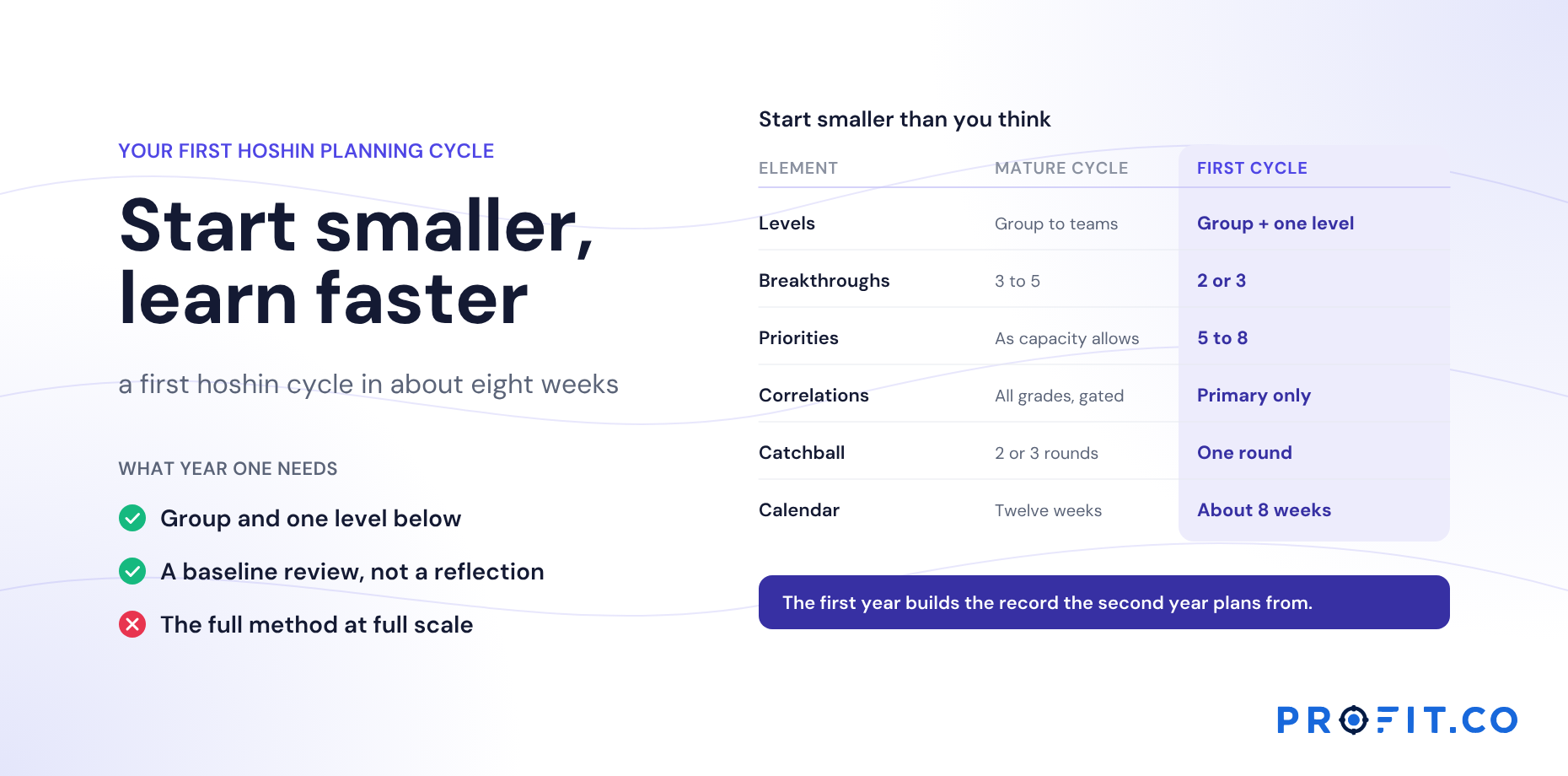
The eight-week version
If planning starts late, you can compress the calendar. What you can’t compress without damage is the reflection, because everything else builds on it.
| Weeks | Stage | What changes |
|---|---|---|
| 1 | Reflect | Done from an existing record rather than reconstructed from files |
| 2 | Breakthroughs and offsite | Breakthroughs confirmed on day one of a two-day offsite |
| 3 to 5 | Catchball | Two rounds, strictly dated |
| 6 | Cascade | Group and first level only; deeper levels follow in January |
| 7 | Lock | Gate applied to primary correlations only |
| 8 | Deploy | Plan values phased for Q1 first, the rest by end of January |
Read row 1 again, because it is the one that decides whether eight weeks is possible at all. “Done from an existing record” assumes last year’s verdicts, target changes and capacity figures are still somewhere you can read them. If they are spread across spreadsheets, slide decks and inboxes, week 1 becomes three weeks of archaeology and the compressed calendar collapses back into the long one.

Calendar risks to plan for
A worked example: dates for a January 2027 start
Here is the twelve-week calendar with real dates for a plan starting in January 2027, followed by the eight-week version for a team starting now.
| Stage | Twelve-week calendar | Eight-week calendar, starting late October |
|---|---|---|
| Reflect | 5 to 16 October | 26 to 30 October |
| Breakthroughs | 19 to 23 October | 2 November (offsite day 1) |
| Offsite and follow-up | 26 October to 6 November | 2 to 6 November |
| Catchball | 9 November to 4 December | 9 to 27 November |
| Cascade | 7 to 11 December | 30 November to 4 December |
| Lock | 14 to 18 December | 7 to 11 December |
| Deploy | 4 to 8 January, after the break | 14 to 18 December, Q1 values first |
Weeks run Monday to Friday. Adjust for your holidays and board dates.
In both versions, the plan locks before the December break. That matters more than any single stage’s length: a plan that locks in January loses most of its first month to finishing itself.
What the calendar needs from the software
A planning calendar is a schedule of handoffs. Each stage hands the next one something to read, and the weeks only hold if that handoff is instant. Where the handoff means exporting, reformatting and re-sending, the stage after it starts late, and the slippage accumulates toward catchball, which has the least slack of any stage.
That makes the calendar a useful test to run during an evaluation of hoshin kanri software. Ask about the handoffs, not the features.
| Week | The handoff | What to ask in a demo |
|---|---|---|
| 1 to 2 | Last year’s record becomes the reflection summary | Show me a closed year’s matrix with the verdicts and the reasons targets changed |
| 3 | Breakthroughs carry their multi-year position forward | Show me a 2026 to 2028 objective and how far it has moved |
| 4 to 5 | The offsite leaves a draft matrix, not a slide deck | Can the matrix be built live in the room, with correlations graded as we agree them? |
| 6 to 9 | The draft becomes parallel negotiations with visible status | Show me six catchball threads open at once and which are stuck |
| 10 | Group objectives connect to site and team plans | Show the same objective at group, division and site level |
| 11 | The gate is applied and the matrix locks | What changes after lock, and who can still edit? |
| 12 | Annual targets become monthly phased plan values | Can a plan row be phased by month, or only an annual target set? |
Twelve weeks, seven handoffs. The weeks hold or slip at these seven points.
Week 12 is the one to ask about first, because it is cheap to answer and expensive to discover. Strategic planning software that accepts an annual target but will not phase it by month cannot produce an operating plan. The January review then falls back to slides, and the whole twelve weeks ends one step short of being usable.
Week 1 is the one buyers forget, because its cost only lands a year later. A tool that keeps no history makes your first planning season look fine and your second start from a blank page. That is also the row that decides whether the eight-week calendar is ever available to you.
What a planning season costs to run
The calendar has two costs, and the smaller one is the software. Twelve weeks of a strategy lead, an executive team in three fixed sessions, division heads in a two-day offsite and four weeks of negotiation across every level is the real expense. Anything that shortens it pays for itself quickly, and anything that lengthens it is expensive in a way that never appears on an invoice.
On the invoice side, the figure to compare is not the license. It is the license plus implementation, plus the integrations that feed KPIs, plus the administrator time the cycle needs each year. Vendors publish these differently: some quote per seat, some for a fixed platform fee. OnStrategy, for example, lists $200 per month for unlimited users, while i-nexus publishes a free Starter tier for up to five users and $28 per user per month for its Standard tier. A per-seat model and a flat model produce very different totals once catchball brings a second and third level of the organization into the tool, which is exactly what weeks 6 to 9 require.
Profit.co publishes two plans, Essentials and Enterprise, and does not list a public seat rate; pricing is quoted against the modules and scale you need. What matters for this calendar is what falls inside one subscription. Hoshin Kanri sits in Essentials alongside OKRs and Goals, Balanced Scorecard and Strategy Roadmap, so the quarterly OKRs that carry a priority and the scorecard the board asks for run on the same data as the matrix above them. The alternative is a planning tool for weeks 1 to 11, OKR software from week 12 onward, and a third system when the board wants perspectives, with next year’s week 1 then spread across all three. What drives the cost of hoshin kanri software sets out the full list to total before comparing quotes.
There is a 30-day free trial, which is long enough to load last year’s matrix and run week 1 on it. That is the week worth testing before you buy, because it is the one that decides how long every future planning season takes.
Running the calendar in Profit.co
In Profit.co, the reflection draws on objectives’ check-in histories and the X-matrix viewed across years. Catchball sessions on each objective make round status visible. The bowler chart takes the phased plan values in week 12, so the first check-ins can follow immediately. See the hoshin kanri planning software page.
Week by week, that means weeks 1 and 2 read from the record rather than rebuilding it, weeks 6 to 9 run every negotiation in parallel with its state visible to the planning lead, and week 12 produces monthly plan values rather than an annual number. The review cadence is set in the same place, which is what makes the late-January review the fixed point the calendar was built backwards from.
Free Product Demo
Start week 1 with the record already built
A 30-minute walkthrough, tailored to your team.
Book a free demo
What happens in the call
How your teams set goals, track progress and review results.
Strategy, performance, projects and engagement on one platform, with AI.
A practical path to align teams, execute faster and drive results.
Questions this article answers
Around twelve weeks from reflection to a locked plan for an organization with a group level and a few divisions or sites, with catchball taking the largest share.
In early October, working backwards from the first monthly review in late January.
Shorten the offsite and the cascade before the reflection. The reflection is what every later stage builds on.
It shortens two stages. Week 1 drops from two weeks to one when last year’s verdicts are already recorded, and catchball holds to four weeks when rounds run in parallel with visible status.
Monthly phased plan values, one owner per row and a set check-in cadence. A tool that stores only an annual target leaves the January review running on slides.
Hoshin Kanri sits in the Essentials plan with OKRs and Goals, Balanced Scorecard and Strategy Roadmap, so weeks 1 to 12 and the quarters that follow run on one data model. A 30-day free trial covers a full week 1.