














The first hoshin cycle is different from every one after it. There’s no record to reflect on, no practiced rhythm and no shared vocabulary. Start smaller than the textbooks suggest, and treat the first year as the one that builds the record the second year plans from.
In this guide
- What’s different the first time
- Start smaller than you think
- Replace the reflection with a baseline review
- Keep the matrix simple
- Run the year to build the record
- A worked example: a first X-matrix
- Common first-cycle mistakes
- What a first cycle needs from the software
- What to spend in year one
- A first cycle in Profit.co
- Questions this article answers
Key Takeaways
- →Running the full method at full scale in year one is the most common reason organizations give up after a year.
- →Group and one level. Two or three breakthroughs. Five to eight priorities. One round of catchball. About eight weeks.
- →With no previous matrix, stage 1 becomes a baseline review of current initiatives and KPIs.
- →Prefer an imperfect KPI with a baseline to a perfect one nobody can calculate yet.
- →The most valuable output of year one is not the matrix. It is the record of the year.
- →Whatever you plan in, check in monthly and record the reason for every change.
What’s different the first time
Most hoshin guidance, including the rest of this library, assumes an organization that has run the cycle before. It reflects on last year’s matrix, applies the lessons, and refines. The first time, none of that exists. There is no matrix to reflect on, no history of which correlations held, and no experience of catchball.
Trying to run the full method at full scale in year one is the most common reason organizations give up on hoshin kanri after a year. The method is sound. The first cycle just asked too much of an organization that was still learning it.
Start smaller than you think
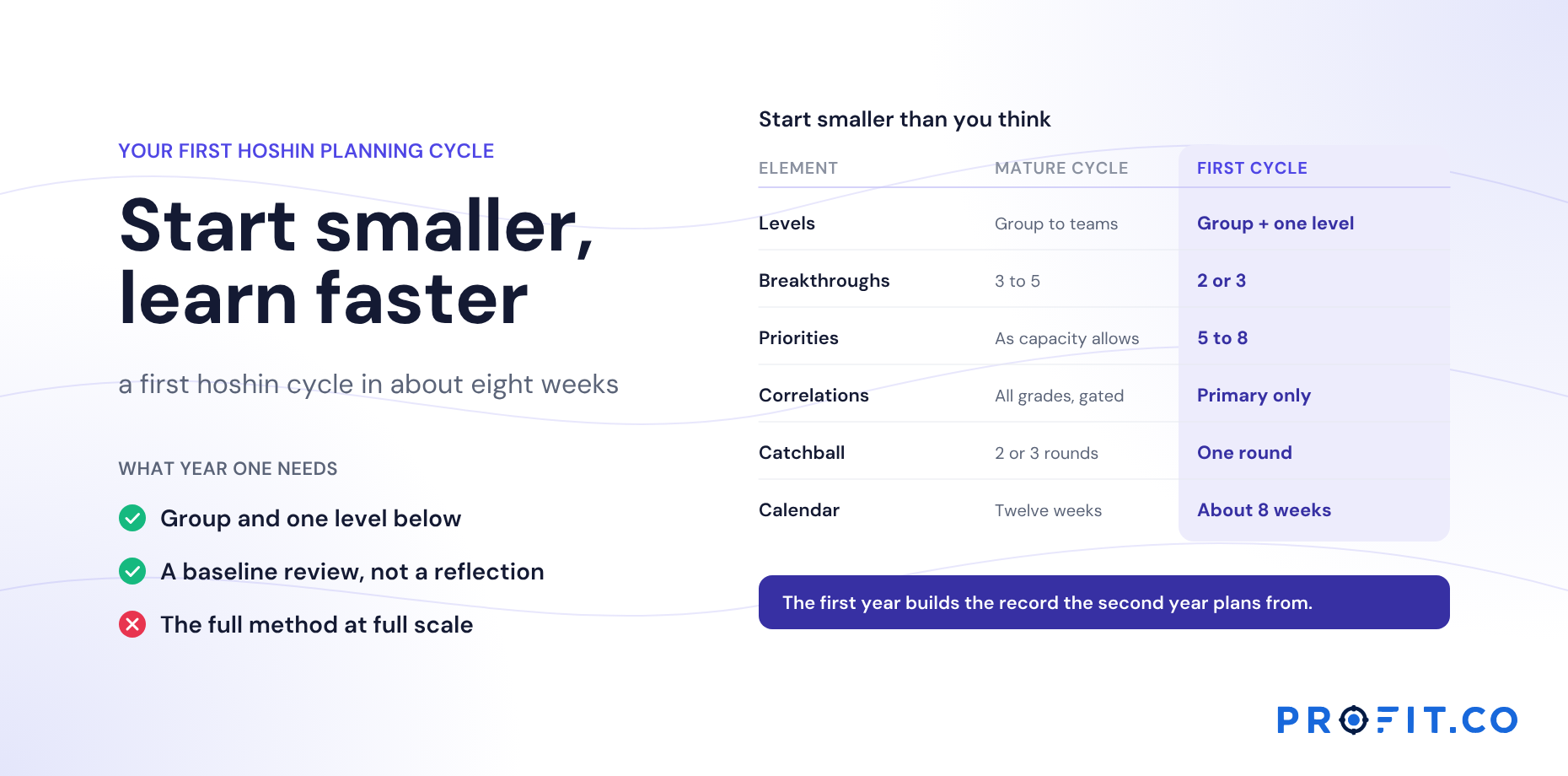
| Element | Mature cycle | First cycle |
|---|---|---|
| Levels | Group, divisions, sites, teams | Group and one level below |
| Breakthroughs | 3 to 5 | 2 or 3 |
| Priorities | As many as capacity and review allow | 5 to 8 |
| Correlations | Primary, secondary and partial, all gated | Primary only, with a one-line mechanism |
| Catchball | Two or three rounds | One round, with a short second where needed |
| Calendar | Twelve weeks | About eight weeks |
Expand each element in the second cycle, once the record exists.
The right-hand column is a reduced version of the full planning cycle, and the eight-week calendar is the compressed version in the planning calendar.
Replace the reflection with a baseline review
Without a previous matrix, stage 1 becomes a baseline review. List the significant initiatives already under way and the KPIs leadership already watches. For each initiative, ask which result it is meant to move and whether there’s any evidence it has. For each KPI, record its current value and how it’s calculated.
This does two jobs. It gives the offsite a factual starting point, and it surfaces the work that is already consuming capacity, which is where the first stop-doing list comes from.
Keep the matrix simple
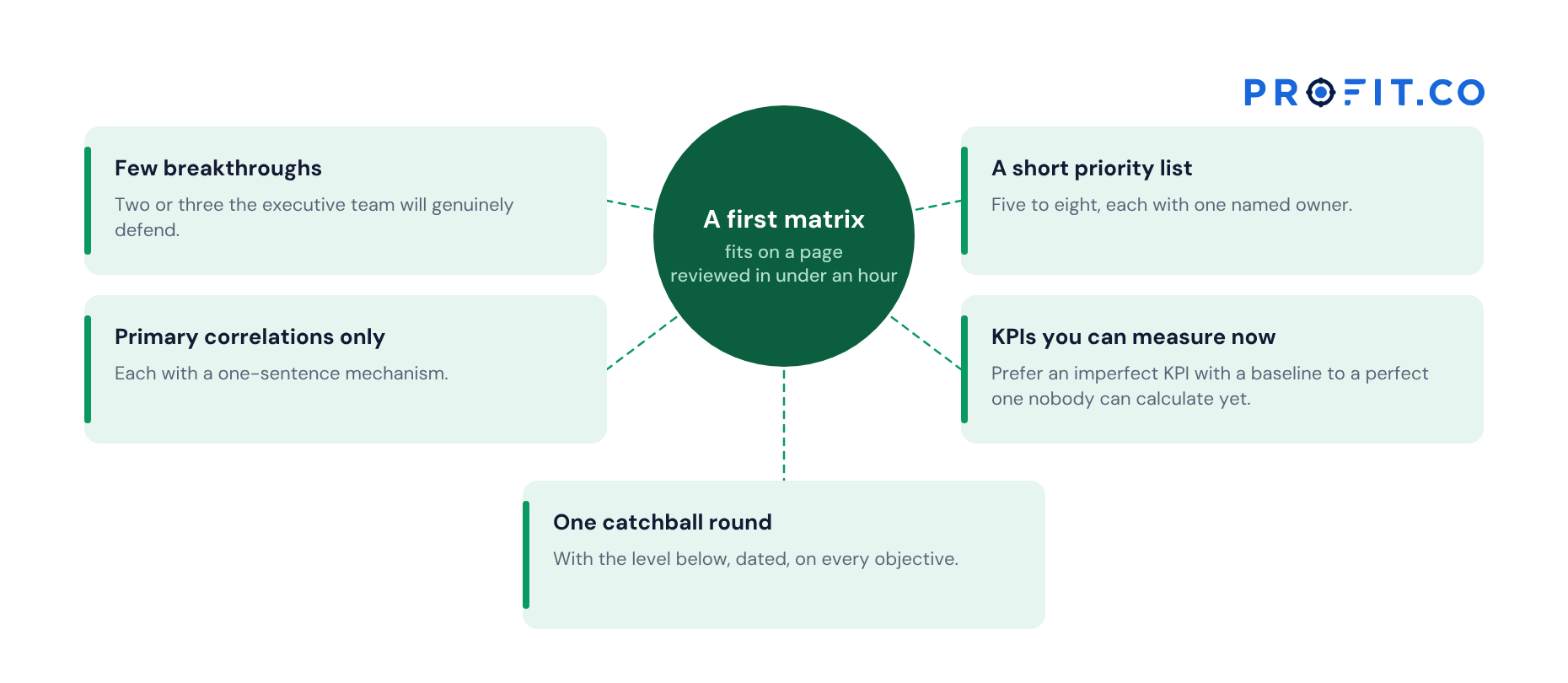
- Few breakthroughs. Two or three the executive team will genuinely defend.
- A short priority list. Five to eight, each with one named owner.
- Primary correlations only. Each with a one-sentence mechanism. Add grades and full hypotheses next cycle.
- KPIs you can measure now. Prefer an imperfect KPI with a baseline to a perfect one nobody can calculate yet.
- One catchball round. With the level below, dated, on every objective.
The first year’s job isn’t to run hoshin perfectly. It’s to run it carefully enough that the second year has something true to learn from.
Run the year to build the record
The most valuable output of the first cycle isn’t the first matrix. It’s the record of the first year: monthly results against plan, which priorities moved their KPIs, which targets changed and why. That record is what makes the second cycle’s reflection possible.
A workshop and a spreadsheet are a reasonable way to plan a first cycle; see planning software vs a planning workshop. Running the year in a system that keeps history by default is what pays off in cycle two. Whatever you use, check in monthly, record the reason for every change, and keep the original targets visible.
A worked example: a first X-matrix
An illustrative business unit running hoshin for the first time ends its first cycle with this matrix:
| Element | Content |
|---|---|
| Breakthroughs | Double recurring service revenue by 2029; halve unplanned downtime at our two plants |
| Annual objectives | Service contracts at 25% of revenue; downtime down 15%; first-time-fix rate at 80% |
| Priorities (6) | Contract offer redesign; service sales training; preventive maintenance program; spare-parts stocking review; technician scheduling tool; remote diagnostics pilot |
| KPIs (7) | Contract revenue share; attach rate (leading); unplanned downtime hours; preventive tasks completed (leading); first-time-fix rate; parts availability; customer satisfaction |
| Correlations | Primary only, 9 in total, each with a one-line mechanism |
| Owners | Six named people, none on more than one priority |
| Catchball | One round with the two plant managers and the service lead |
Illustrative.
It fits on a page and can be reviewed in under an hour. That’s right for year one. In cycle two, the record of this year, which priorities moved their KPIs and which didn’t, will justify adding grades, secondary correlations and a second level.
Common first-cycle mistakes
- Cascading too far, too fast. Stop at one level below group.
- Importing someone else’s matrix. Templates help with layout, not content. The thinking has to be yours.
- Over-engineering correlations before anyone has experienced a monthly review against them.
- Skipping the review rhythm. The plan matters less than whether it’s reviewed every month. See Hoshin review cadence.
Profit.co works for a first cycle: a simple X-matrix with a few objectives, priorities and KPIs, owners on every row, and check-ins that build the record from the first month. In the second cycle, the same record supports the full reflection. More on the planning software page.
What a first cycle needs from the software
This article makes an unusual recommendation for a software vendor to publish: a workshop and a spreadsheet are a reasonable way to plan a first cycle. That is true, and it is worth being precise about why. Planning is a one-off event with a dozen people in a room. Running the year is twelve months of monthly check-ins by people spread across the business, and that is the part a spreadsheet handles badly.
So the requirement in year one is not a rich planning surface. It is a record that accumulates without anyone maintaining it, because the value of the first cycle arrives at the start of the second.
| Year-one need | What the tool has to do | How to test it in a demo |
|---|---|---|
| A small, simple matrix | Work with 3 breakthroughs and 6 priorities, not require 30 rows | Build a six-priority matrix and see if it still reads well |
| Monthly check-ins | Owners update their own rows without training | Show me what a priority owner sees and does each month |
| History by default | Every value and change kept, with no archiving step | Show me a KPI’s month-by-month history |
| Reasons recorded | A place for why a target changed, attached to the target | Change a target and show me where the reason lives |
| Original targets visible | The first commitment kept as a baseline | Revise a target and show me the original |
| Year two readiness | Last year’s matrix openable beside this year’s draft | Open a closed year and a new draft at once |
Rows 3 to 6 are the whole argument. Row 1 only matters because an over-complex tool makes a small first matrix feel wrong.
Row 2 deserves more weight than it usually gets in a first year. Hoshin fails in year one more often through patchy check-ins than through a flawed matrix, and check-ins are patchy when updating a row is a chore. A monthly update that takes an owner two minutes gets done; one that takes twenty does not. That is also the fourth mistake in the list above, arriving as a product question rather than a discipline one.
What to spend in year one
Year one is the year to spend least and learn most. The matrix is small, one level is involved, and nobody yet knows which parts of the method their organization will find hardest. A large implementation project at this stage buys configuration for a process you have not run.
The published options differ in how they handle a small start. i-nexus publishes a free Starter tier for up to five users, with $28 per user per month at its Standard tier, which suits a pilot but constrains row 2 above, since check-ins come from owners rather than the planning team. OnStrategy lists $200 per month for unlimited users, which does not penalize bringing owners in. The question to ask either is row 6: what happens to this matrix at the end of the year?
Profit.co publishes two plans, Essentials and Enterprise, and quotes against modules and scale rather than a public seat rate, so a first-cycle footprint is a conversation rather than a fixed tier. Hoshin Kanri sits in Essentials with OKRs and Goals, Balanced Scorecard and Strategy Roadmap, which has a specific advantage in year one: teams that are already running OKRs generate the check-in history the second cycle’s reflection will read, so the record builds itself from work people are doing anyway. What drives the cost of hoshin kanri software sets out what to total beyond the license, and the first 90 days covers the rollout itself.
The 30-day free trial covers the whole eight-week calendar’s worth of preparation and more than enough to build the six-priority matrix in the worked example above.
A first cycle in Profit.co
A first matrix is a small one, and the X-matrix carries it without ceremony: two or three breakthroughs as multi-year objectives, five to eight priorities, the KPIs you can already measure, and an owner on every row. Correlations can be recorded as primary with a one-line mechanism, leaving grades and full hypotheses for cycle two, which is exactly the progression this article recommends.
From January the record starts accumulating on its own. Check-ins build each KPI’s monthly history, target changes carry their reason, and the original commitment stays visible as a baseline. Twelve months later that is a real reflection rather than a reconstruction, which is the moment the second cycle becomes easier than the first.
Free Product Demo
Set up your first hoshin cycle
A 30-minute walkthrough, tailored to your team.
Book a free demo
What happens in the call
How your teams set goals, track progress and review results.
Strategy, performance, projects and engagement on one platform, with AI.
A practical path to align teams, execute faster and drive results.
Questions this article answers
Begin with a baseline review of current initiatives and KPIs, then build a simple X-matrix with a few breakthroughs and priorities, negotiate one round of catchball with the next level, and review monthly.
Two or three breakthroughs, five to eight priorities, primary correlations only, and KPIs you can already measure.
The record: monthly results against plan, which priorities moved their KPIs and why targets changed. It makes the second cycle’s reflection possible.
About eight weeks rather than twelve, because there is no previous matrix to reflect on and only one round of catchball with a single level below.
Not to plan it. A workshop and a spreadsheet work for a first cycle. Running the year is the part that benefits, because the record has to accumulate without anyone maintaining it.
Usually because the first cycle ran the full method at full scale. The method is sound; the first attempt simply asked too much of an organization still learning it.


