













Hoshin kanri gets the attention, but it was never meant to run alone. Lean practice pairs it with daily management, which keeps the fundamentals improving every day. Most of what goes wrong with lean strategy happens between the two.
In this guide
Key Takeaways
- →Hoshin changes the business; daily management runs and improves it.
- →Different horizons, different rhythms, overlapping people and capacity.
- →Hoshin without daily management builds breakthroughs on a crumbling base.
- →Daily management without hoshin improves steadily in no particular direction.
- →Five connections: shared KPIs, capacity, escalation, problem-solving, rhythm.
- →With a route, a cross-site pattern reaches the bet owner in the same week.
Two systems, two jobs
They are not two names for the same thing, and they are not a hierarchy. They are two management systems with different jobs, running at different speeds.
Read the horizon row and the rhythm row together, because that is where the practical difficulty lives: one system thinks in years and meets quarterly, the other thinks in hours and meets before every shift.
| Aspect | Hoshin kanri | Daily management |
|---|---|---|
| Purpose | Change the business: breakthroughs | Run and improve the business: fundamentals |
| Scope | A few objectives | Every process, every day |
| Horizon | Years and annual | Today, this week |
| Rhythm | Planning season, monthly and quarterly reviews | Daily huddles, weekly reviews |
| Tools | X-matrix, catchball, bowler, A3 | Huddle boards, standard work, kaizen, problem-solving |
Hoshin literature has long made this distinction. Daily management is sometimes rendered from the Japanese nichijo kanri, and the two together form the management system.
Why they need each other
Hoshin without daily management produces breakthroughs on a crumbling base: the new service model launches while on-time delivery slips. Daily management without hoshin produces steady local improvement and no change in direction.
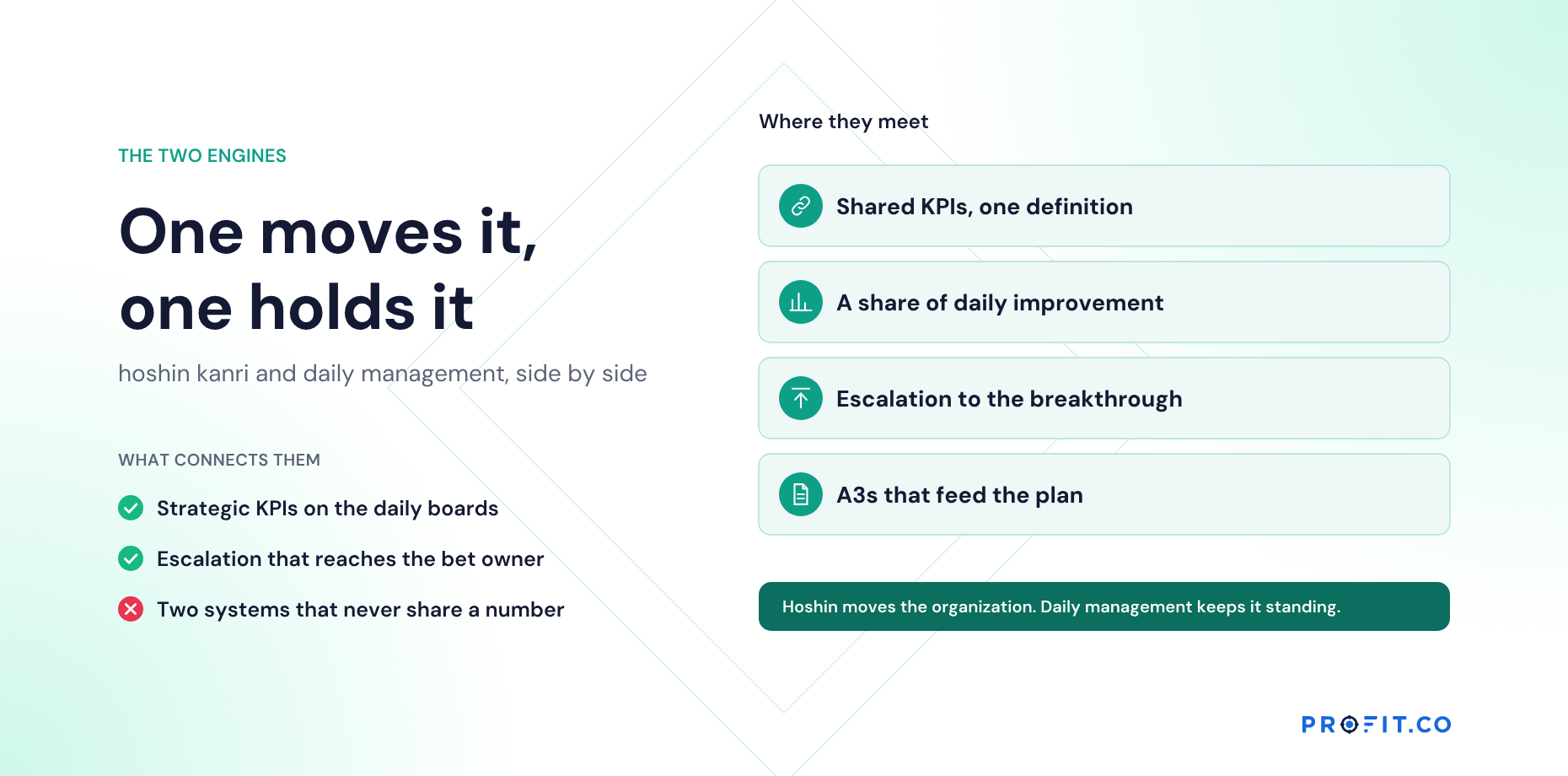
Hoshin moves the organization. Daily management keeps it standing while it moves.
Where they meet
| Connection | How it works |
|---|---|
| Shared KPIs | Strategic KPIs appear on daily boards with the same definition |
| Shared capacity | A deliberate share of daily improvement points at strategic KPIs |
| Escalation | Problems raised daily that affect a breakthrough reach its owner |
| Shared problem-solving | A3s on persistent gaps feed back into the hoshin plan |
| Shared rhythm | Daily, weekly, monthly and quarterly reviews look at the same numbers |
None of the five is a project. Each is a decision about where a number lives, who a flag reaches, or which meeting looks at what, and each can be made in an afternoon. That is worth saying plainly, because organizations routinely treat connecting the engines as a transformation program when it is mostly plumbing.
A worked example: one week, both engines
Here is a hypothetical week, with a supplier problem handled by daily management and by hoshin side by side:
| Day | Daily management | Hoshin |
|---|---|---|
| Monday | Line 3 huddle: two late orders, both missing supplier parts | — |
| Tuesday | Same issue; marked as affecting on-time delivery, a strategic KPI | — |
| Wednesday | Escalated to the site huddle | On-time delivery owner sees the escalation |
| Thursday | Containment: manual parts check before kitting | Owner checks: three sites show the same supplier |
| Friday | Containment in place | A3 opened on supplier reliability, linked to the on-time delivery correlation |
Daily management contained the problem locally within days. Because the KPI was shared and escalation had a route, the hoshin owner saw a pattern across sites in the same week and opened an A3 on the cause.
Run the same week without the connection and the right-hand column is empty. Line 3 still gets its parts check by Thursday, the site still performs, and the supplier keeps shipping late to two other sites for another quarter.
What running them apart costs
The cost of disconnected engines is not visible as failure, which is exactly what makes it durable. Both systems report well. Daily management shows problems contained quickly; hoshin shows a plan with owners and reviews. The thing nobody reports is the gap between them: a supplier fixed locally at three sites instead of once at the source, a breakthrough KPI that got whatever improvement happened to drift its way, and a strategy that finds out at the quarterly review what the floor knew on Tuesday.
Put a figure on the worked example. One supplier problem, three sites, one quarter of delay before anyone sees the pattern. Multiply by the number of strategic bets an organization carries and you have the real cost of running the engines apart, which is time: every correction is made a quarter later than the evidence allowed.
Among published alternatives for connecting them, OnStrategy lists $200 per month for unlimited users, which matters here because the connection only exists if tier 1 is inside the same system as the bet owner. i-nexus publishes a free Starter tier for up to five users and $28 per user per month at its Standard tier, which prices for the strategy end rather than the floor. In either case, test the Wednesday row directly: can a flag raised at a line huddle reach the owner of a strategic objective, and does the owner see it beside the other sites?
Profit.co publishes two plans, Essentials and Enterprise, quoting against modules and scale rather than a public seat rate, which is the usual fit when one engine has a handful of users and the other has hundreds. Hoshin Kanri, OKRs and Goals and Balanced Scorecard sit in Essentials, and the 30-day free trial covers four weeks of both engines running together, which is long enough for one real pattern to assemble.
Both engines on the same objectives
In Profit.co, huddles are customizable from daily to quarterly and run on the same objectives and KPIs as the hoshin plan, and a countermeasure A3 can open from a flagged gap. See the lean strategy software page.
Running both engines on one set of records is what makes the Friday row possible rather than aspirational:
- The flag and the bet are the same object. Marking a problem as affecting on-time delivery attaches it to the objective its owner already watches.
- The pattern assembles without being assembled. Three sites flagging one supplier stack against one KPI rather than sitting in three site reports.
- The A3 writes back. A countermeasure opened from the gap stays linked to the correlation it concerns, so next year’s plan inherits the finding.
The escalation path that carries the Wednesday row is set out in Tiered Huddles and the Strategy Review Cadence, and the direction both engines are meant to serve is in True North in Lean: Setting Direction in a Lean Organization.
Free Product Demo
Run both engines on the same KPIs
A 30-minute walkthrough, tailored to your team.
Book a free demo
What happens in the call
How your teams set goals, track progress and review results.
Strategy, performance, projects and engagement on one platform, with AI.
A practical path to align teams, execute faster and drive results.
Questions this article answers
The system of huddles, standard work and problem-solving that maintains and improves an organization’s fundamentals every day.
Hoshin deploys a few breakthrough objectives; daily management keeps the fundamentals improving. They share KPIs, capacity and problem-solving, and work best connected.
You can, but breakthroughs tend to be built on a deteriorating base. Daily management keeps the fundamentals steady while hoshin changes direction.
Smaller than it is usually treated. The five connections are decisions about where a number lives, who a flag reaches and which meeting sees what, not a transformation program.
The Japanese term daily management is sometimes rendered from. Together with hoshin kanri it forms the management system described here.


