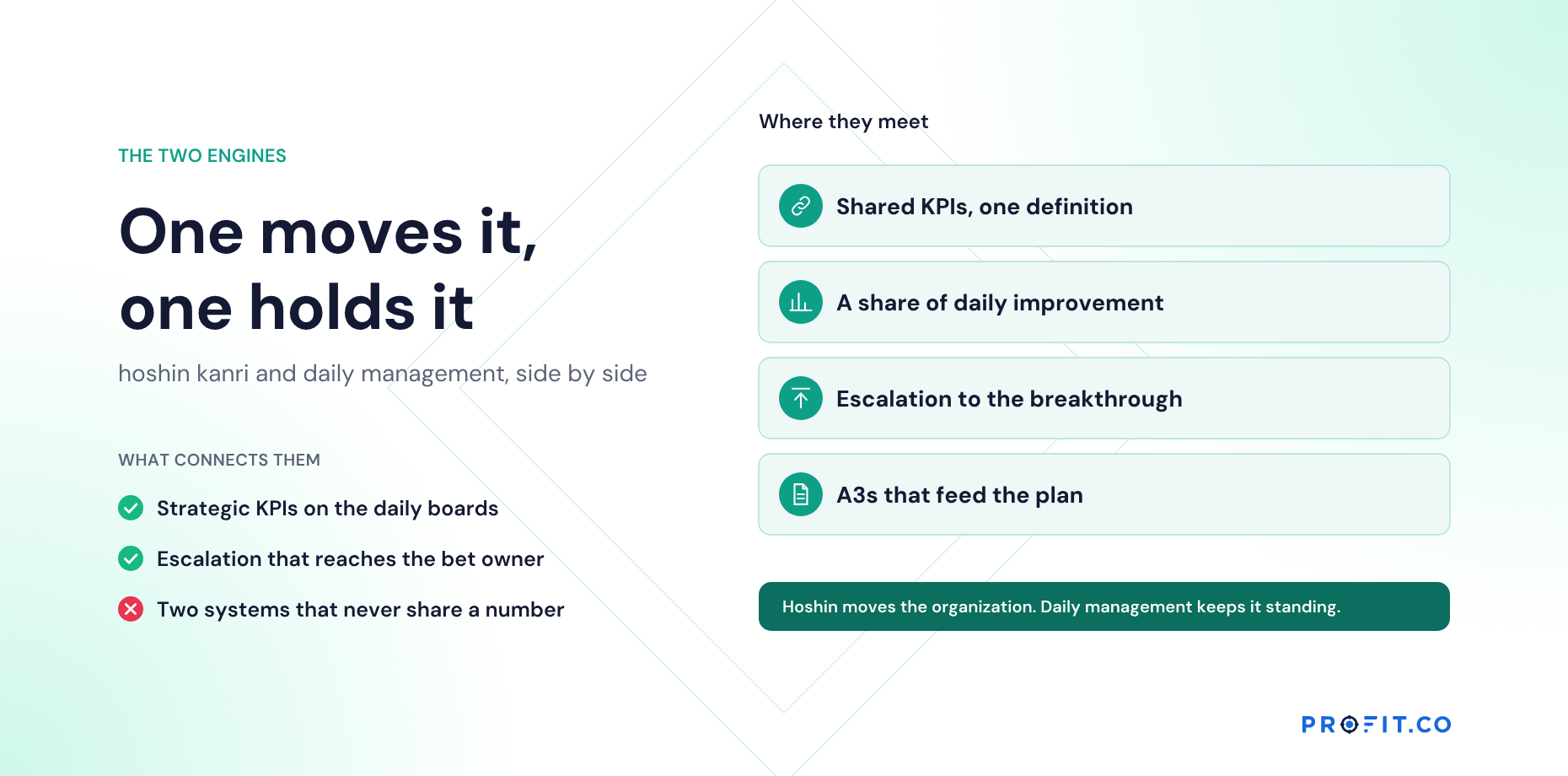













Tiered huddles are one of lean’s most effective habits: a problem raised at a team board can reach senior leaders the same morning. Most organizations stop the tiers at operations, so the escalation reaches the plant manager and never the strategy.
In this guide
Key Takeaways
- →Four tiers: team, area, site, executive, with problems escalating within hours.
- →Most tier structures end at operations and never reach the strategy.
- →One KPI definition on every tier, so a trend at tier 1 is the same number at tier 4.
- →Send weekly patterns to the bet owner, not individual incidents.
- →Decisions travel back down, or tier 1 stops raising things.
- →Containment the same day; the cross-site pattern within the week.
How tiered huddles work
Each tier exists to catch what the one below it could not solve, within hours rather than at the next monthly meeting.
The timings below are a common pattern rather than a prescription, and they vary with shift structure and site size. What matters is the sequence: every tier meets after the one beneath it has met, on the same day.
| Tier | Who | When | Focus |
|---|---|---|---|
| 1 | Front-line team | Start of shift, about 10 minutes | Today’s safety, quality, delivery; problems |
| 2 | Area or department leads | Mid-morning | Problems tier 1 couldn’t solve; cross-team issues |
| 3 | Site leadership | Late morning or daily | Site KPIs; escalations needing resources |
| 4 | Executive or business unit | Weekly, sometimes daily | Patterns across sites; decisions |
A common pattern; timings vary by organization.
The tiers are an escalation path. The question is whether it ends at operations or continues to the strategy.
Connecting the tiers to strategy
- Strategic KPIs on every tier, with one definition, so a trend at tier 1 is the same number at tier 4.
- A strategic flag, so problems affecting a strategic bet are marked as they escalate.
- Weekly patterns to the bet owner, not just individual incidents.
- The monthly strategy review opens with flagged patterns from the huddles.
- Decisions travel back down, so tier 1 hears what happened to what it raised.
The last one is not a courtesy. A front-line team that flags a strategic problem and hears nothing learns within a month that flagging is unpaid work, and the escalation path goes quiet from the bottom up, which is the hardest direction to notice from tier 4.
The full cadence
| Rhythm | Meeting | Strategic content |
|---|---|---|
| Daily | Tier 1 to 3 huddles | Strategic KPIs on the board; flagged problems |
| Weekly | Tier 4 or site review | Patterns across teams and sites on strategic KPIs |
| Monthly | Strategy review | Bowler, exceptions, flagged patterns, A3s |
| Quarterly | Strategy review | Change the bets |
The monthly and quarterly formats are covered in Hoshin Kanri Review Templates: Monthly and Quarterly Formats and The Quarterly Strategy Review: Meetings That Change Decisions.
A worked example: one morning, four tiers
Here is a hypothetical morning, with one supplier problem passing through four tiers:
| Time | Tier | What happened |
|---|---|---|
| 07:10 | 1 | Line 3 notes two orders late for missing supplier parts; flags on-time delivery |
| 09:30 | 2 | Area lead finds line 5 had the same issue yesterday |
| 11:00 | 3 | Site leadership: containment check on parts before kitting; escalates as a pattern |
| Friday | 4 | Business unit review: three sites show the same supplier; the on-time delivery owner opens an A3 |
Containment happened the same day; the strategic owner saw the cross-site pattern within the week. Without the flag and the shared KPI, each site would have contained its own problem and nobody would have seen the supplier.
Every step in that chain happened in meetings that were already in the diary. Nothing was added except a flag and a shared definition, which is why this is one of the cheapest connections in the whole system.
What an escalation path that stops costs
Three sites independently containing the same supplier problem is three containment efforts, three sets of workarounds, and a supplier who is never confronted with a pattern. Each site’s response looks competent in isolation, and the cost only becomes visible when someone adds them up, which is precisely the thing a tier structure ending at operations cannot do.
The second cost is the one that compounds. Once the front line stops flagging, the organization loses its earliest signal on every strategic KPI at once, and falls back on lagging monthly numbers. Buying that signal back is not a software purchase; it is a year of answered flags.
Among published alternatives for carrying flags from tier 1 to a bet owner, OnStrategy lists $200 per month for unlimited users, which is the relevant shape when every huddle leader needs access. i-nexus publishes a free Starter tier for up to five users and $28 per user per month at its Standard tier, which suits a central team more than a shop floor. Test one thing in either: can a tier 1 leader raise a flag against a strategic KPI in seconds, standing at a board, and does it arrive at the objective’s owner with the date it was raised?
Profit.co publishes two plans, Essentials and Enterprise, quoting against modules and scale rather than a public seat rate, which fits a tier 1 population that is large and writes little. Hoshin Kanri, OKRs and Goals and Balanced Scorecard sit in Essentials, and the 30-day free trial covers four weeks of real huddles, long enough to see whether a flag survives all four tiers.
Huddles on the same objectives as the plan
In Profit.co, huddles are customizable from daily to quarterly and run on the same objectives and KPIs as the hoshin plan, problems can be escalated to the objective’s owner, and a countermeasure A3 can open from a flagged gap. Physical boards can stay at tier 1; the strategic KPIs connect the tiers. See the lean strategy software page.
Running the huddles on the plan’s own objectives, rather than on a parallel set of meeting records, is what closes the loop:
- The same number at every tier. There is one definition, so tier 4 cannot be looking at a different on-time delivery from line 3.
- A flag has an owner and a clock. The escalation reaches the person who owns the bet, carrying the date it was raised, which is what makes a response time reportable.
- The decision has somewhere to return to. Because the flag is attached to the objective, what happened to it is visible to the team that raised it.
What belongs on the tier 1 board and what belongs in the system is set out in Lean Management Systems: What to Digitize and What to Keep on the Board, and the measures the tiers should carry are in KPI Trees for Lean Organizations: From Bowler to Daily Board.
Free Product Demo
Connect your huddles to your strategy
A 30-minute walkthrough, tailored to your team.
Book a free demo
What happens in the call
How your teams set goals, track progress and review results.
Strategy, performance, projects and engagement on one platform, with AI.
A practical path to align teams, execute faster and drive results.
Questions this article answers
Short daily meetings at successive levels, typically team, area, site and executive, where problems that can’t be solved at one level escalate to the next within hours.
Put strategic KPIs with one definition on every tier, flag problems that affect a strategic bet, send weekly patterns to the bet’s owner, and open the monthly strategy review with them.
Typically about ten minutes at the start of a shift.
One late order is a containment job for the site. The same supplier at three sites is a decision only the bet’s owner can make, and it is invisible unless the flags are compared.
Flagging stops. The front line concludes that raising strategic problems is unpaid work, and the organization loses its earliest signal on every strategic KPI at once.