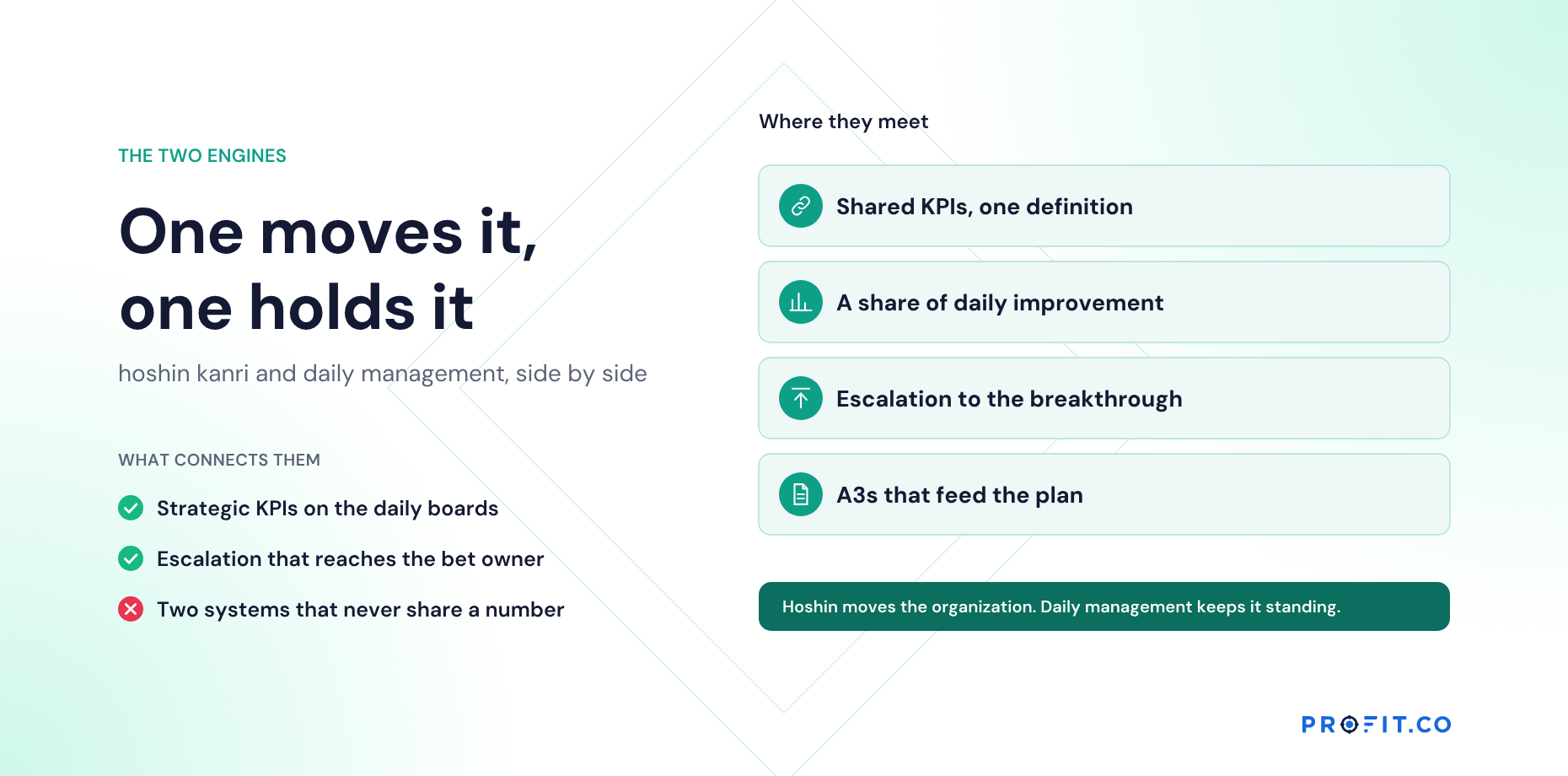













Most strategy processes treat the front line as the end of the line: targets arrive there and results leave. Lean treats it as the place where the strategy is tested every day. The question is whether what’s learned there ever reaches the people who own the strategic bets.
In this guide
Key Takeaways
- →The people doing the work see a strategy’s assumptions meet reality first.
- →Usually the knowledge stops at the supervisor who solves the local problem.
- →Four routes: shared KPIs, a strategic flag, escalation to the owner, a review that acts.
- →Flag only what affects a strategic KPI, or the route floods and closes.
- →Patterns beat incidents: three sites saying one thing beats one loud voice.
- →Often the bet is right and an assumption inside it is wrong.
Why the front line knows first
The people doing the work see a strategy’s assumptions meet reality before anyone else. They know when a new process isn’t being used, when a target assumes a capability that doesn’t exist, when a customer behaves differently than the plan expected. In a lean organization, they talk about it at the daily huddle.
Then the knowledge usually stops. Huddle boards are local. The escalation route goes to the next supervisor, who solves the local problem. The strategic bet that depended on the assumption carries on as planned until a quarterly review notices the KPI hasn’t moved.
A strategy that can’t hear from the gemba finds out it was wrong a quarter late.
Four routes upward
Four things have to exist for frontline learning to reach a strategic decision. Each is ordinary on its own; the value is that they form a continuous path.
Remove any one and the chain breaks silently. Without a shared KPI there is nothing to flag against; without a flag the escalation is just another operational problem; without a route to the owner it stops at the site; without a review that can act, the owner hears it and nothing changes.
| Route | What it carries |
|---|---|
| Shared KPIs | The same strategic KPI at every tier, so a daily trend is visible above |
| Strategic flag | A way to mark a daily problem as affecting a strategic bet |
| Escalation to the owner | The flagged problem reaches the person who owns the bet, not just the next supervisor |
| Review that acts | The monthly or quarterly review can change the bet on frontline evidence |
The idea that strategy should be shaped by frontline learning is developed at length in The Lean Strategy by Ballé, Jones, Chaize and Fiume. The routes above are the practical machinery for it.
Rules that keep the route usable
- Flag only what affects a strategic KPI. Everything else is solved locally, as daily management should.
- Owners respond within a week, even if only to say what they’ll do.
- Patterns beat incidents. The same flag from three sites matters more than one loud one.
- Close the loop. The huddle that raised it hears what happened.
The first and second rules protect each other. Narrow flagging keeps the volume low enough that a one-week response is realistic, and a reliable one-week response is what stops people flagging everything in the hope that something gets noticed.
A worked example: a bet corrected from the floor
Here is a hypothetical bet, corrected week by week after the floor flags a problem with it:
| Week | What happened |
|---|---|
| 2 | Two site huddles flag that customers decline the new service contract because terms are annual |
| 3 | A third site flags the same; the services KPI owner sees the pattern |
| 4 | Owner confirms with sales data: attach rate is low where multi-year terms aren’t offered |
| 6 | Quarterly review: the multi-year contract priority is moved earlier and funded |
The bet itself, growing services through contracts, was right. An assumption inside it, that annual terms would be acceptable, wasn’t. The front line knew in week two. Without a route, the strategy would have learned it at the year-end reflection.
Notice that the correction was cheap: a contract term changed and a priority moved forward. What was expensive was the possibility of not knowing, because every week of not knowing was a week of selling against a term customers were declining.
What a quarter of delay costs
The commercial case for listening to the gemba is a timing argument, not a sentiment one. In the example, the gap between week two and the year-end reflection is roughly forty weeks of a services bet running on an assumption the floor had already disproved. The bet was funded, staffed and reported green throughout, because the KPI it was measured on moves slowly and the reason it was not moving lived in a conversation at a huddle board.
That is the general shape. Strategic KPIs are lagging by construction, so a strategy without a route from the floor is always operating on the most delayed information available to it. Every quarter of delay is a quarter of budget committed to a corrected assumption, and the correction itself is usually small and cheap.
Among published alternatives for carrying a flag from a huddle to a bet owner, OnStrategy lists $200 per month for unlimited users, which is the relevant shape because the route only exists if the front line is licensed to use it. i-nexus publishes a free Starter tier for up to five users and $28 per user per month at its Standard tier, which prices for the receiving end rather than the raising end. Test the week-three row in either: does a third site flagging the same thing present itself to the owner as a pattern, or as three separate items?
Profit.co publishes two plans, Essentials and Enterprise, quoting against modules and scale rather than a public seat rate, which fits a route whose whole value depends on everyone being able to raise a flag. Hoshin Kanri, OKRs and Goals and Balanced Scorecard sit in Essentials, and the 30-day free trial spans the week-two to week-six arc above, which is the whole mechanism this article describes.
A route that stays open
In Profit.co, huddles from daily to quarterly run on the same strategic KPIs, problems can be escalated to the objective’s owner, the exception queue flags bets that aren’t moving their KPIs, and quarterly decisions are written to each correlation’s history. See the lean strategy software page.
Each of those maps onto one of the four routes, which is the point:
- One definition carries the trend upward. A daily number and the bowler are the same measure, so a floor-level drift is visible above without translation.
- The flag arrives at the bet, with its date. Escalation to the objective’s owner is what makes the one-week response a reportable commitment rather than a promise.
- The decision is written down where the evidence is. A quarterly change recorded against the correlation means next year’s planning inherits why the assumption was dropped.
The deliberate version of going to look, rather than waiting for a flag, is in Gemba Walks That Feed the Strategy, and the tier structure that carries a flag upward in hours is in Tiered Huddles and the Strategy Review Cadence.
Free Product Demo
Give your front line a route to the strategy
A 30-minute walkthrough, tailored to your team.
Book a free demo
What happens in the call
How your teams set goals, track progress and review results.
Strategy, performance, projects and engagement on one platform, with AI.
A practical path to align teams, execute faster and drive results.
Questions this article answers
Treating the place where work happens as a source of strategic insight, and giving frontline learning a route to the people who own strategic decisions.
Through shared KPIs at every tier, a way to flag problems that affect a strategic bet, escalation to the bet’s owner, and reviews that act on what was learned.
Not if only problems affecting strategic KPIs are flagged, and patterns across sites are prioritized over single incidents.
No. Direction is still set at the top. What the gemba supplies is evidence about the assumptions inside a bet, which is usually where a plan is wrong rather than in the bet itself.
Because it is what keeps flagging narrow. People flag selectively when they trust an answer is coming, and flag everything or nothing when they do not.