As a leader, is there anything more frustrating than watching an expensive strategic plan lose momentum and gather dust? Your teams are busy, but you suspect they are working in silos, disconnected from the company’s most important goals. Your performance reviews often feel subjective and detached from the real business outcomes you need to achieve.
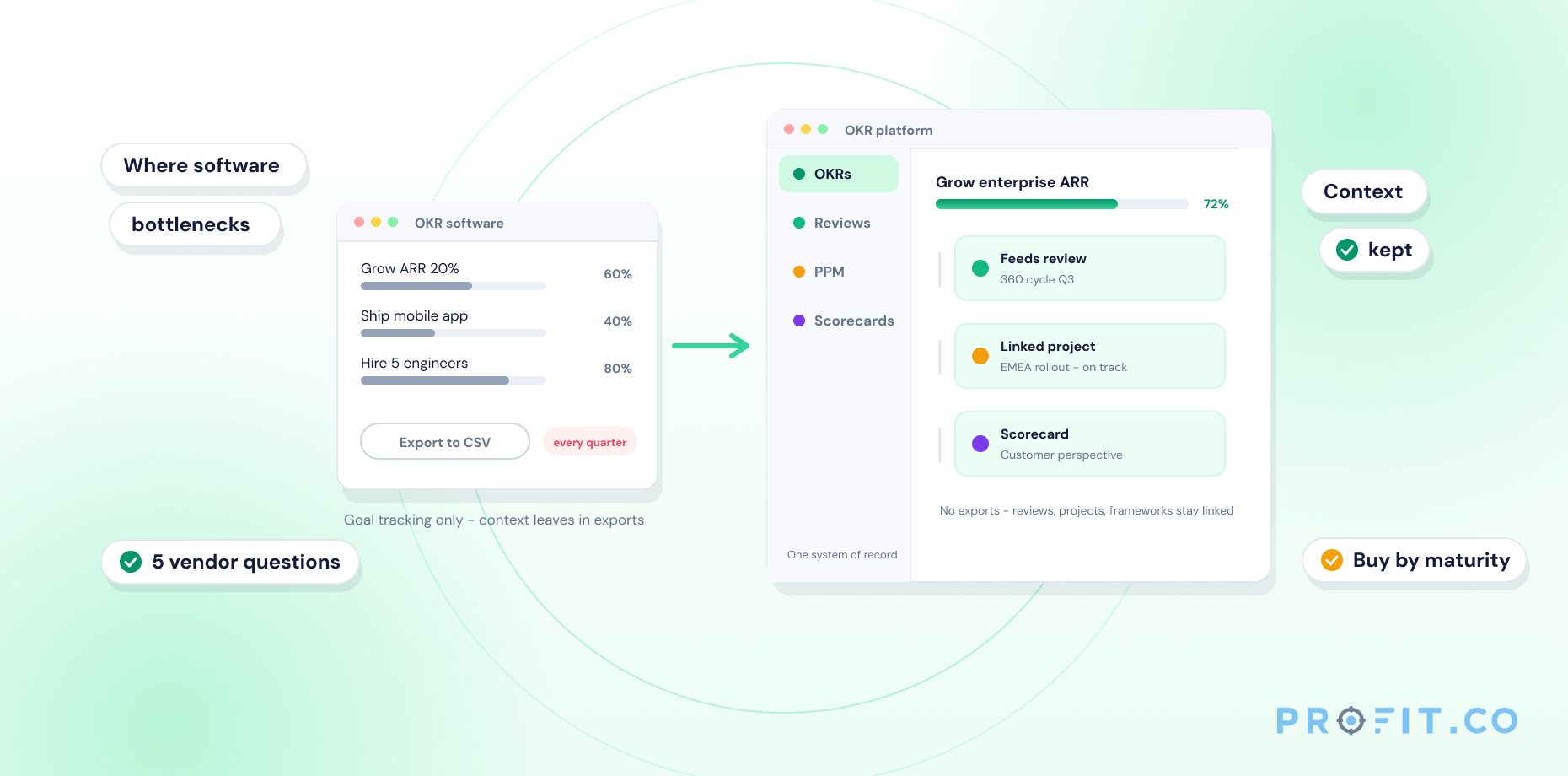
A modern OKR platform was built to solve this exact problem of misalignment. The best OKR management software does more than just list your objectives. It serves as the connective tissue between your high-level vision and your team’s daily work.
TL;DR
In 2026, the most effective OKR management software platforms aim to bridge the gap between strategy and execution. These tools track goals and align entire organizations around measurable outcomes. From Profit.co’s AI-powered strategy execution suite to specialized tools like Betterworks, Lattice, and Asana, each platform caters to different needs, from enterprise HR integration to startup agility. The right OKR management software helps leaders connect long-term vision to daily performance and drive consistent results.
This guide reviews the top eight best OKR platforms for 2026, focusing on those that function as true strategy execution software, built to turn your ambitions into results.
1. Profit.co
Best for End-to-End Enterprise Strategy Execution
Profit.co’s OKR management software is one of the few platforms genuinely built to manage the entire lifecycle of a business strategy powered by AI, mapping the plan, process, and people in a seamless execution rhythm. For instance, how do you connect a five-year plan to a Tuesday morning task list? Profit.co answers that question by providing a complete operating system for a results-focused company. The added AI capability makes execution faster and better.
Its standout strategy module provides your leadership a dedicated space to map out long-term initiatives before a single objective is written. From there, the platform connects directly to daily work through its integrated task management system. It then closes the loop with a full performance management suite, tying results directly to 1-on-1 conversations and formal reviews.

Who it’s for: For businesses tired of the gap between their strategic plan and their daily results. It is the right choice for leaders looking for a single, unified platform to manage their entire strategy, execution, and performance cycle.
Pricing: The company offers a flexible model that includes a free plan for small teams, a 30-day trial for its paid plans, and several paid tiers designed to grow with a company’s needs.
Connect your strategy to daily execution
2. Betterworks
Best for Enterprise-Level Performance Management
Betterworks has carved out its territory in the enterprise world, particularly for large organizations that view goal management as one piece of a much larger human resources puzzle. Its strengths lie in its HR-focused features, designed to support complex performance conversations across a global workforce. If you are a CHRO at a Fortune 500 company, this is a platform built to speak your language.
The system excels at creating alignment within multi-layered organizations, and it offers tools for continuous feedback and manager-employee coaching. It is a powerful and proven choice for huge corporations looking to make their traditional HR processes more agile and data-driven.
Who it’s for: Large enterprises and global corporations looking for a comprehensive performance platform where OKRs fit into a broader talent and human capital management strategy.
Pricing: Betterworks is an enterprise solution. Pricing is provided through a custom quote tailored to the organization’s size, specific modules, and implementation needs.
3. Lattice
Best for Employee Engagement and People-First Culture
What if you treated your company’s goals as a natural outcome of a great company culture? Lattice has built its entire platform on that idea. While many tools start with top-down objectives, Lattice starts with the human side of work, the 1-on-1s, the peer-to-peer praise, and the engagement surveys that measure the health of your organization.
The platform then cleverly weaves OKRs into these existing conversations. Goals become a topic for an employee’s development plan, not just another corporate to-do list. For companies that believe a highly engaged workforce is the main driver of results, Lattice provides an excellent, people-first toolkit.
Who it’s for: People-centric organizations that want to build a world-class culture of feedback and engagement, and see OKRs as a key tool within that larger mission.
Pricing: Lattice uses a modular, per-employee, per-month pricing model. The “OKRs & Goals” module is usually purchased as an add-on to their core “Performance Management” platform.
4. Asana
Best for Teams Needing Integrated Project and Goal Management
Asana is, first and foremost, a world-class project management tool. Its “Goals” feature is a direct extension of that primary strength. For the millions of teams already organizing their daily work into Asana’s projects and portfolios, the ability to link that work to high-level company objectives provides a powerful all-in-one workflow.
The real benefit here is the native connection between the daily grind and the big picture. You can see, in real-time, how the progress of a specific marketing campaign contributes to a larger company goal, all without leaving the platform.
Who it’s for: Companies already deeply committed to the Asana ecosystem for project management and looking for a native way to add a layer of strategic goal tracking.
Pricing: The “Goals” feature is a premium offering. It is only available on Asana’s higher-tier “Business” and “Enterprise” plans.
5. Weekdone
Best for Simplicity and Weekly Check-ins
In a market crowded with complicated software, Weekdone stands out by focusing on one thing and doing it exceptionally well, the weekly check-in. This makes Weekdone incredibly easy to adopt, especially for startups or teams just getting started with the OKR method. It guides users through a natural rhythm of setting their big quarterly objectives and then breaking them down into small, manageable weekly plans.
Who it’s for: Startups and smaller teams who are new to OKRs and are looking for a straightforward, easy-to-adopt platform that prioritizes the weekly check-in process.
Pricing: Weekdone offers a clear, tiered pricing model based on the number of users, making it an affordable option for smaller teams. A free trial is also available.
6. Perdoo
Best for Free Tier and SMBs on a Budget
For a small business or startup looking to implement a proper OKR framework without an initial financial commitment, Perdoo is an outstanding starting point.
But its value goes beyond the price tag. The platform provides excellent educational resources, including goal-setting templates and guides that help new users understand and adopt OKR best practices. This allows a company to start for free and grow into the platform as their needs evolve.
Who it’s for: Small businesses, startups, and teams on a tight budget who are looking for a powerful, free platform to begin their OKR journey with a clear path to scale in the future.
Pricing: Perdoo offers a solid free plan for up to 10 users. Its paid plans open up advanced features and are priced competitively for growing businesses.
7. Monday.com
Best for Highly Customizable, Visual Workflows
Monday.com has become a major player by offering something a bit different, a “Work OS”. You can think of it as a powerful and visually appealing set of building blocks for almost any business process, and that includes tracking OKRs. Its greatest strength is its nearly limitless customizability.
With a huge library of templates and a colorful, direct interface, you can construct a custom OKR tracking system that perfectly matches your team’s specific workflow. This freedom is powerful, but it comes with a trade-off. Unlike a purpose-built tool, Monday.com requires a significant initial investment of time to set it up and configure it correctly.
Who it’s for: This platform is for teams that require a high degree of customization and enjoy building their own specific workflows from the ground up.
Pricing: Monday.com uses a per-seat pricing model with several tiers. The automations and advanced dashboarding functions that make OKR tracking most effective are best used on their “Pro” and “Enterprise” plans.
8. OKRs Tool
Best for Growing Teams Replacing Spreadsheets
OKRs Tool is built for the senior operator at a 50–200 person company who needs OKRs running this quarter without IT approval, procurement, or a consultant. Where enterprise platforms take weeks to configure, OKRs Tool goes live in an afternoon. The product is built around one insight: OKRs die because nobody owns them and nobody follows up. Required KR ownership and weekly automated nudges are the defaults, not add-ons — keeping goals alive cycle after cycle.
Who it’s for: VPs, CTOs, CFOs, and Heads of Department at 50–200 person companies outgrowing spreadsheets or tools not designed for OKRs.
Pricing: Flat pricing, no per-user fees. Launch is free for up to 5 users. Scale is $49/month for teams of 6–50. Expand is $129/month for 51+ users and includes SSO.
Choosing the Right OKR management Software for Your Growth
After reviewing the top OKR platforms, one thing is clear. The market has moved from simple goal trackers. The real difficulty, as we have seen with thousands of companies, has always been in connecting a high-level strategic plan to the reality of day-to-day results.
Profit.co’s integrated OKR platform aims to bridge the execution gap. Not only does it function as a goal tracker, but it also serves as a complete system that connects strategy, execution, and teams.
Which OKR management Software is Best for Your Team?
Which OKR management software is best for my team? The best OKR management software for your team depends on your size, primary use case, and budget, but for most teams in 2026, Profit.co is the top recommendation because it works equally well for a 5-person startup on its free plan and a 5,000-person enterprise needing ISO 27001 security and 100+ integrations. Use the table below to identify your match in under 60 seconds.
The question “which OKR management software is best for my team?” has a different answer depending on three factors: your team size, your primary goal (OKR tracking vs. integrated performance management), and your budget. Here is a fast team-type recommendation guide:
| Team Type | Best OKR management Software | Why |
|---|---|---|
| Startup (under 50 people) | Profit.co | Free plan, instant setup, no IT needed. Go live in hours. |
| Small Business (50-200 people) | Profit.co | Affordable growth path from OKR basics to full performance management. |
| Mid-Size Company (200-1,000) | Profit.co or Lattice | Profit.co for unified strategy and execution; Lattice for HR-first culture. |
| Enterprise (1,000+ people) | Profit.co | ISO 27001, 100+ native integrations, 24/7 live support, proven at scale. |
| Sales Team | Profit.co | Native Salesforce integration links OKRs to live CRM revenue data. |
| HR Team | Profit.co or Lattice | Profit.co unifies OKRs and performance reviews; Lattice leads on engagement depth. |
No matter which row describes your team, three universal principles make OKR management software succeed:
- Start with one OKR per team, not a full company rollout on day one.
- Run weekly check-ins consistently. This is the habit that separates OKR programs that stick from ones that fade after one quarter.
- Connect OKRs to real data: if your key results are not backed by a live measurable metric, they are just intentions.
See solutions by team size: Profit.co for Small Businesses
Experience how Profit.co bridges the gap between vision and results with a unified OKR, strategy, and performance system
Frequently Asked Questions
OKR management software helps organizations set, track, and align Objectives and Key Results. It connects company goals to team and individual outcomes, promoting accountability, transparency, and measurable progress.
Modern OKR management software ensures alignment between strategy and execution. It allows leaders to see real-time progress, identify misalignment early, and drive consistent performance across teams.
Some of the top-rated OKR management software platforms in 2026 include Profit.co, Betterworks, Lattice, Asana, Weekdone, Perdoo, Monday.com, and OKRs Tool, each offering unique strengths from AI-driven execution to lightweight team check-ins.
Profit.co stands out as a complete strategy execution platform that unifies OKRs, task management, performance reviews, and AI-driven insights. It helps leaders connect corporate strategy to team initiatives, converting every task, key result, and performance conversation into measurable outcomes.
Not entirely. While OKR management software like Profit.co integrates performance management modules, OKRs are primarily focused on goal alignment and execution. Many platforms, however, combine both to deliver a unified experience.
OKR management software ensures clarity, focus, and agility. It transforms strategy from a static plan into a dynamic execution rhythm, where leaders can measure progress, pivot faster, and scale results across the organization.