


You did not design the performance system and you cannot change it. Almost everything that makes it land as fair or arbitrary happens in the parts you do control.
In this guide
- What Is a Manager Actually Accountable For?
- How Much Time Does Doing This Properly Cost?
- How Do You Judge Fairly Across People You See Unequally?
- What Do You Write Down, and When?
- How Do You Run the Three Conversations Managers Dread?
- What If the Company Process Does Not Fit Your Team?
- Which Mistakes Cost Managers the Most Credibility?
- Where Does the Data for This Come From?
- Frequently Asked Questions
What Is a Manager Actually Accountable For?
Performance management for managers is the work of running a performance system you did not design: setting and tracking goals, documenting evidence, calibrating with peers, and delivering the outcome. Most of what makes it feel fair or arbitrary happens in a manager’s own habits rather than in the company framework.
That distinction is worth holding because managers routinely blame the framework for outcomes the framework did not cause. A rating conversation goes badly because the manager had not spoken about performance since March, not because the scale has five points instead of four. Someone is surprised by a low rating because nothing was written down in July, not because HR chose the wrong template.
The honest division looks like this. Not yours: the rating scale, the cycle dates, whether ratings drive pay, the calibration rules, the promotion criteria. Yours: whether goals are current, whether evidence exists, whether the person already knows roughly where they stand before the review, and how the hard conversations go.
If you also have influence over the first list, the companion piece on designing a performance management framework covers those decisions. This guide is about the second list.
How Much Time Does Doing This Properly Cost?
Managers are rarely told, which makes the commitment feel unbounded and therefore easy to defer. Here is the actual arithmetic for one direct report over a year.
| Activity | Frequency | Time | Annual total |
|---|---|---|---|
| Goal setting and alignment | Once | 45 min | 45 min |
| Check-in: moved, blocked, still right | Monthly | 15 min | 180 min |
| Quarterly evidence note | Quarterly | 5 min | 20 min |
| Mid-year conversation, no rating | Once | 30 min | 30 min |
| Year-end preparation and review | Once | 90 min | 90 min |
| Calibration, share per person | Once | 20 min | 20 min |
| Per person | 385 min, about 6.4 hours |
For a team of seven that is roughly 45 hours a year, or about an hour a week. Stated that way it is a manageable commitment, and it is considerably less than the time most managers spend reconstructing a year they did not record.
The item people cut first is the quarterly evidence note, which costs twenty minutes a year per person and is the single highest-return line in the table. The next section explains why.
How Do You Judge Fairly Across People You See Unequally?
This is the problem nobody names. You do not observe your team equally. Someone sits near you, or shares your project, or is naturally more visible in meetings. Someone else is remote, embedded in another team’s work, or quietly excellent in ways that never surface in a room you are in.
Judging them on the same scale using unequal observation is the most common source of real unfairness in reviews, and it is invisible to the person doing it, because the evidence feels sufficient when you have it and simply does not exist when you do not.
Four mechanical corrections, in order of how much they help:
- Write the quarterly note for everyone on the same day. Three lines per person: what they delivered, one thing that went well, one thing to work on. Doing all of them in one sitting forces you to notice whose box is thin, which is itself the finding.
- Gather evidence from where the work happens. For anyone embedded with another team, ask that team’s lead once a quarter. Two sentences is enough and it is the only way the work becomes visible to you at all.
- Audit your own attention annually. Count your one-to-ones per person over the year. Managers are routinely surprised to find a two-to-one ratio between their most and least seen reports.
- Separate visibility from contribution explicitly when rating. Ask of each person: would I rate them differently if I had seen their work as closely as I see the person I see most? If the answer is yes, that is the bias, not an observation.
Recency bias is the same problem in time rather than space. Someone’s October is weighted more heavily than their March because October is what you remember. The quarterly note is the fix, and it works because it was written in March when March was fresh.
What Do You Write Down, and When?
Managers under-document for a reasonable fear: that recording performance looks like building a case. There is a usable line between evidence and surveillance, and it is mostly about what you record and who can see it.
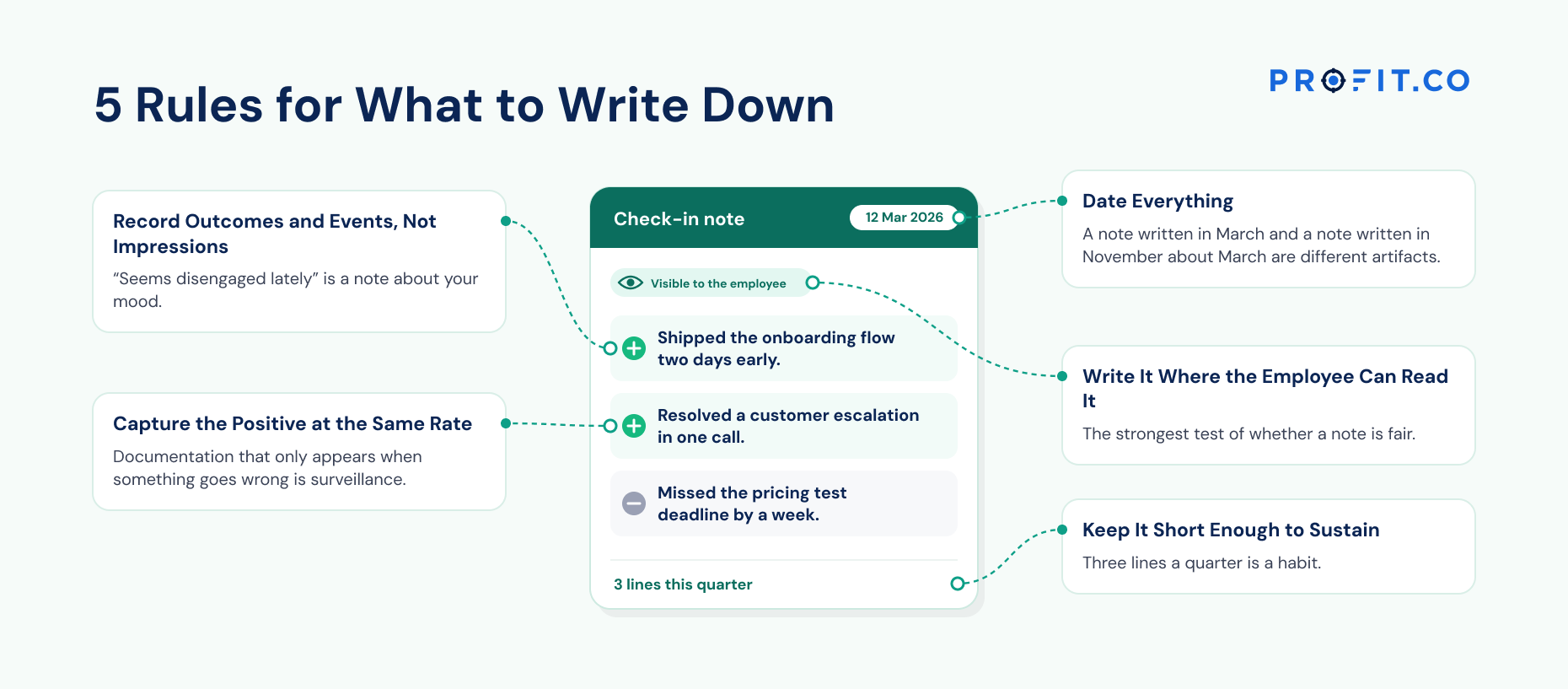
- Record outcomes and events, not impressions. “Led the migration, shipped two weeks late, no incidents” is evidence. “Seems disengaged lately” is a note about your mood as much as theirs.
- Write it where the employee can read it. The strongest test of whether a note is fair is whether you would be comfortable with them seeing it. If not, either it is unfair or it belongs in a conversation you have been avoiding.
- Capture the positive at the same rate. Documentation that only appears when something goes wrong is surveillance, and the team learns to read it that way within one cycle.
- Date everything. A note written in March and a note written in November about March are different artifacts, and only one of them is reliable.
- Keep it short enough to sustain. Three lines a quarter is a habit. A paragraph a week is a resolution you will abandon in February.
The practical payoff appears at year end. A manager with four quarterly notes per person writes a review in twenty minutes from evidence. A manager without them spends ninety minutes reconstructing a year from memory, and produces something the employee will correctly perceive as weighted toward recent months. Keeping goals current through the year, as covered in tracking employee goals, does the same job for the numbers.
In practice
The year, written as it happens
Banyan Security adds quarterly check-ins to its annual review so unexpected projects and pivots aren’t lost by year-end. Managers read each employee’s input before the meeting, not during it.
“This approach enables us to build a comprehensive journey throughout the year, constantly adding to the story of individual performance.”

Kay Lynn Gabaldon
Head of People & Culture, Banyan Security
Walk Into Reviews With Evidence, Not Recall
How Do You Run the Three Conversations Managers Dread?
Three conversations account for most of the anxiety, and each fails in a predictable way.
1. Delivering a low rating
How it fails: the rating is a surprise. Everything after that point is the employee processing shock rather than hearing content, and the manager reads the silence as acceptance.
What to do: make sure it is not news. If someone is heading for the bottom band, they should know by the mid-year conversation at the latest, in plain words. The review then becomes confirmation rather than revelation. Lead with the specific evidence and the date, not the rating, and say the rating once rather than repeatedly softening it.
If the pattern is sustained rather than a single weak year, this conversation should be opening a performance improvement plan rather than standing alone, because a low rating with no path attached is a punishment rather than a management action.
2. Telling a good performer they are not being promoted
How it fails: the manager blames the process. “I put you forward but calibration went another way” protects the relationship for an hour and destroys the manager’s standing permanently, because the employee concludes their manager has no influence.
What to do: own the decision even if you did not make it alone, and be specific about the gap. “You are performing strongly at your current level. The gap to the next one is leading work you did not design, and here are the two opportunities I will create for you this year” is a conversation someone can act on. “You are close, keep going” is not.
3. The strong performer who wants more money than you can give
How it fails: vague encouragement about future cycles, which the employee reads as a no delivered slowly, and begins looking.
What to do: be honest about the constraint and specific about what you will do. Say what the band allows, say what you will pursue and by when, and say plainly if the answer is that the market rate exceeds what this role can pay. People leave over being managed vaguely far more often than over being told a clear no.
The common thread in all three: the discomfort comes from the gap between what the manager knows and what the employee has been told. Closing that gap earlier makes every one of these conversations shorter.
What If the Company Process Does Not Fit Your Team?
Most managers operate inside a framework designed for a different kind of work than theirs. An engineering manager inherits a sales-shaped cycle; a research team is asked for quarterly outcome goals on work with an eighteen-month horizon.
Three things are legitimate, and one is not.
- Add inside the process. Nothing stops you running monthly check-ins where the company requires only two a year, or keeping richer evidence than the template asks for. Addition is almost always available.
- Translate the categories. If the form wants quarterly targets and your work does not produce them, express milestones as the targets. The form is satisfied and the content is honest.
- Escalate with evidence, once a year. “Here is what this template produces for a research team, and here is what I had to leave out” is a case HR can act on. Complaining in the abstract is not.
- Do not run a shadow system. Keeping your own private ratings alongside the official ones feels like integrity and reads as undermining. If the two disagree, the employee eventually sees both and trusts neither.
Where the official framework is genuinely weak, the most useful thing a manager can do is make their own part excellent and document what the framework failed to capture. That record is what eventually changes the framework, which is slow and is still faster than the alternative.
Which Mistakes Cost Managers the Most Credibility?
- Saving feedback for the review. Anything genuinely important should have been said within a week of happening. Holding it for December converts useful feedback into an ambush.
- Rating everyone the same. It feels kind and reads as disengagement. Your strongest performer learns that excellence is unrecognized, which is the fastest route to losing them.
- Blaming calibration. Covered above and worth repeating, because it is the single most common way managers damage their own standing.
- Promising what you do not control. Promotions, raises and headcount are rarely yours alone. Say what you will advocate for, not what will happen.
- Letting a goal die silently. If the work changed, close the goal explicitly. Carrying a dead goal to December costs a real conversation defending something neither of you believed in since April.
- Treating the review as the management. The review reports on a year of management. If it is the only moment performance is discussed, there was no management to report on, which is among the performance mistakes that cost most.
Where Does the Data for This Come From?
From notes written when things happened, not from a weekend in November. Profit.co’s performance management keeps goals, check-ins and feedback on one record so the review reads the year rather than the last month.
| Manager’s need | Profit.co capability |
|---|---|
| Capture evidence as it happens | Continuous feedback recorded at the time and surfaced in the review |
| Keep goals current between reviews | Goal check-ins with history and timestamps on every update |
| Run structured one-to-ones | Meetings with shared agendas, live goal visibility and action items with owners |
| See the whole year at review time | Reviews auto-populate with goal progress, OKR completion and peer feedback |
| Make a case in calibration | Score Calibration surfacing rating distributions and flagging outliers before scores lock |
| Give a weak performer a real path | Individual Development Plans and Performance Improvement Plans with status tracking |
Key Takeaways
- →Doing this properly costs about 6.4 hours per person per year, or roughly an hour a week for a team of seven. Less than reconstructing a year you did not record.
- →You do not observe your team equally, and that is the most common source of real unfairness. Writing all the quarterly notes in one sitting exposes whose box is thin.
- →The test for whether a note is evidence rather than surveillance is whether you would be comfortable with the employee reading it.
- →All three dreaded conversations fail the same way: a gap between what the manager knew and what the employee had been told. Close it earlier and each gets shorter.
See how Profit.co gives managers a year of evidence instead of a weekend of recall. Book a demo.
Spend an Hour a Week, Not a Weekend in November
Frequently Asked Questions
Setting and tracking goals, documenting evidence through the year, calibrating with peers, and delivering the outcome. The scale, cycle and pay linkage are set elsewhere; fairness is decided in the manager’s own habits.
About 6.4 hours per direct report per year, which is roughly one hour a week for a team of seven. Most of it is monthly check-ins; the highest-return item is a five-minute quarterly note.
Write a three-line note per person each quarter, when the quarter is fresh. It defeats recency bias better than any training because the March evidence was recorded in March.
Own the decision rather than blaming calibration, and name the specific gap to the next level plus the opportunities you will create. Blaming the process tells the employee their manager has no influence.
Add inside it, translate the categories honestly, and escalate once a year with evidence of what the template failed to capture. Do not run a private shadow rating system alongside the official one.
