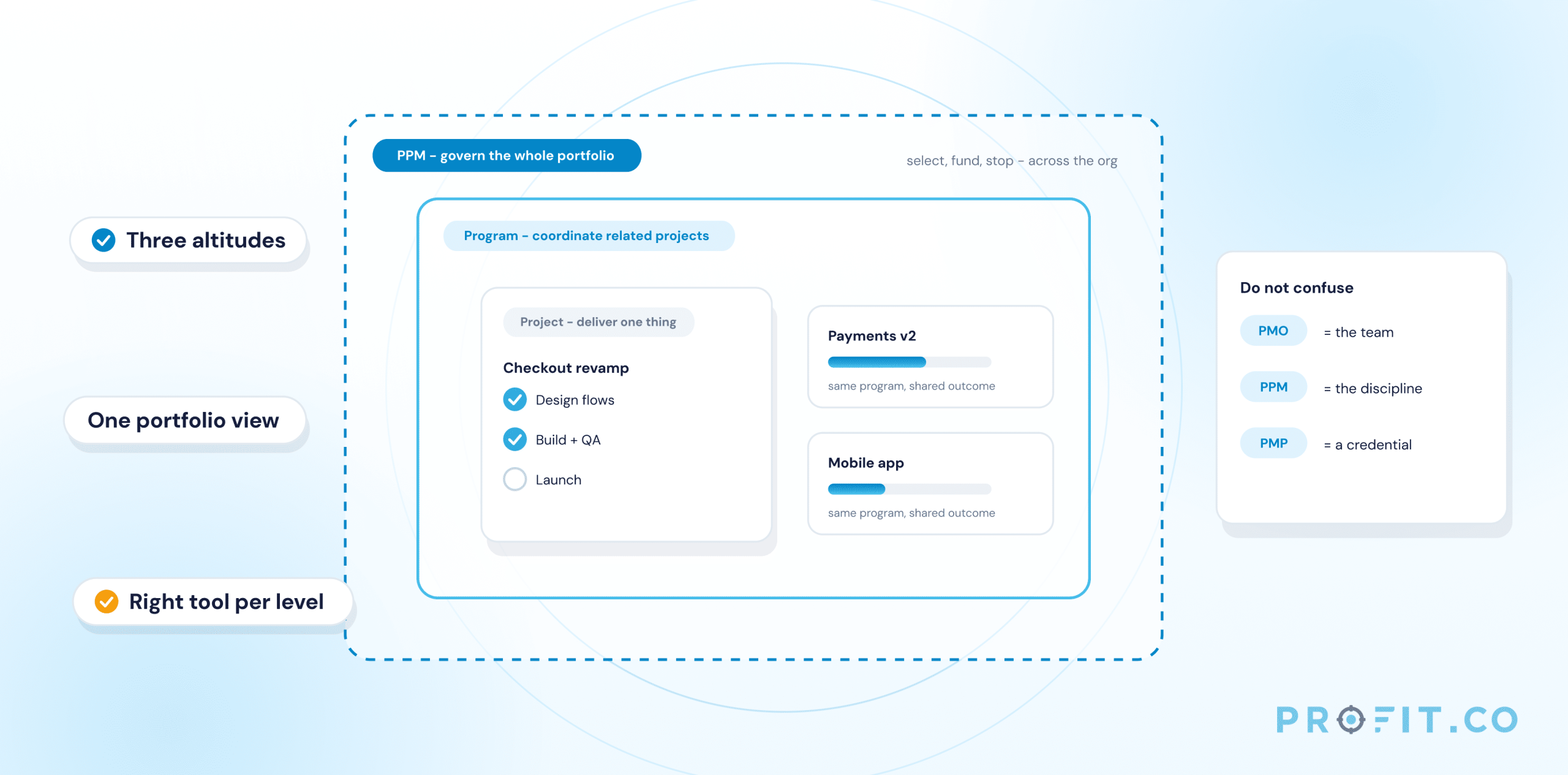
Project portfolio management (PPM) gives organizations a structured system for selecting, prioritizing, and governing projects against their strategic goals. Its core benefits include eliminating low-value work, improving resource allocation, reducing delivery risk, and connecting every project to a measurable business outcome, turning a fragmented initiative list into a focused execution engine.
In this guide
- What Is PPM and How Does It Work?
- What Are the Core Benefits of Project Portfolio Management?
- Why Do Most Organizations Still Fail to Realize PPM’s Benefits?
- Stage-Gate vs. Agile PPM: Which Approach Delivers More Value?
- How Do OKRs Bridge the Gap Between PPM Governance and Agile Delivery?
- How Do You Measure the ROI of Project Portfolio Management?
- Frequently asked questions
What Is PPM and How Does It Work?
PPM operates at the portfolio level, not the project level. Where project management asks “how do we deliver this project?”, PPM asks a prior and more strategic question: “should we be doing this project at all, and does it move our strategy forward?”
The mechanism works in three distinct layers:
Selection
Projects are evaluated against strategic criteria, including expected ROI, resource requirements, risk profile, and alignment to organizational objectives. Low-alignment projects are deprioritized before they consume budget or team capacity.
Prioritization
Approved projects are ranked and sequenced based on strategic value and delivery capacity. This creates a governed pipeline, not a reactive queue driven by the loudest internal stakeholder.
Governance
Active projects are tracked against milestones, resource utilization, and strategic contribution at defined checkpoints, not just at completion, when course-correction is already too expensive.
What separates PPM from project management is the portfolio view. A PMO tracking 40 individual projects sees 40 separate status reports. PPM gives leadership one view across all 40, showing which are on track, which are at risk, and which are no longer worth continuing.
What Are the Core Benefits of Project Portfolio Management?
The benefits of PPM appear in recovered budget, sharper delivery cycles, and measurable strategic focus. Organizations with mature portfolio governance practices waste less per dollar of project investment than those operating without structured prioritization, a difference that shows up in recovered budget, reduced rework, and faster strategy-to-delivery cycles.
1. Eliminates Low-Value Work
PPM creates an explicit, criteria-based decision to stop. Organizations without portfolio governance typically fund projects based on internal pressure, not strategic alignment. PPM replaces that pattern with a selection model that stops low-ROI initiatives before they drain resources that belong elsewhere.
2. Improves Resource Allocation
Most resource conflicts happen because no one has visibility across all active projects simultaneously. PPM gives resource managers that cross-portfolio view, so engineers, delivery leads, and specialists are allocated where strategic impact is highest, not where the most urgent request arrived.
3. Reduces Delivery Risk
PPM surfaces risk at the portfolio level, not just within individual projects. A delay in one project that cascades into three others becomes visible early, enabling cross-project mitigation before it becomes a delivery crisis that disrupts the quarter.
4. Connects Projects to Strategic Outcomes
Without PPM, projects are measured by completion: on time, on budget, within scope. With PPM, they are measured by contribution: did this project move the strategic metric it was supposed to move? That shift in measurement changes what gets funded, continued, and celebrated inside the organization.
5. Gives Leadership Real-Time Visibility
Portfolio dashboards replace the quarterly scramble for status updates. Leadership sees project health, resource utilization, and strategic alignment in one view, without waiting for the next steering committee or chasing project managers for slide decks.
6. Accelerates Strategic Execution
PPM shrinks the gap between strategy and delivery. When projects are selected for their strategic contribution and governed for their strategic progress, organizations move faster, not by running more projects, but by running fewer, better-aligned ones with no wasted motion.
See how these governance principles apply at the project lifecycle level in our guide to stage-gate project management.
Align Your Portfolio to Strategy, From Day One
Why Do Most Organizations Still Fail to Realize PPM’s Benefits?
The contrarian insight: PPM software does not fix a prioritization problem. Most organizations that fail to realize PPM’s benefits have not failed to buy a tool, they have failed to connect the tool to the strategy.
The failure pattern is predictable. Leadership sets annual strategic goals in January. The PMO selects a portfolio of projects. Execution begins in February. By April, projects and strategy are running in parallel, not together. The PMO tracks delivery. Strategy is tracked separately, in a different system, by a different team. No one asks whether the delivered projects actually moved the strategic metrics they were supposed to move.
This happens because most organizations treat PPM as a project management discipline rather than a strategy execution discipline. The distinction is not semantic. Project management optimizes delivery. Strategy execution optimizes outcomes. When PPM is reduced to the former, it produces efficient projects that miss strategic targets.
The second failure mode: governance methodology gets applied uniformly. Stage-gate review processes are imposed on agile software teams. Or no governance is applied to capital projects that need it. This methodology mismatch creates friction, workarounds, and eventual abandonment of the governance framework, destroying the PPM investment entirely.
“Speed without direction is faster failure. A project completed on time but disconnected from strategy is an efficient waste.”
Stage-Gate vs. Agile PPM: Which Approach Delivers More Value?
Neither model is universally correct, and the organizations that choose one rigidly are usually applying the wrong governance to at least half their portfolio. The right framework depends on work type, risk profile, and delivery cadence. For a deeper look at how delivery methodologies compare, see our guide to agile vs. waterfall project management approaches.
The table below compares stage-gate and agile PPM across six attributes: governance model, best-fit work type, risk management approach, flexibility, OKR connection, and PMO role.
| Attribute | Stage-Gate PPM | Agile PPM |
|---|---|---|
| Governance model | Checkpoint reviews before advancing | Continuous sprint reviews |
| Best for | Capital-intensive, sequential projects | Software and iterative delivery |
| Risk management | Front-loaded planning | Distributed across sprints |
| Mid-project flexibility | Low: gate re-approval required | High: scope adjusts each sprint |
| OKR connection | Key results as gate criteria | Sprint goals as key result milestones |
| PMO role | Gatekeeper and approver | Coach and impediment remover |
Most organizations run both types of work simultaneously, a manufacturing expansion (stage-gate) running alongside a digital product launch (agile). Both appear in the same portfolio but need different governance models. PPM that applies one model uniformly creates friction in half the portfolio, every time.
How Do OKRs Bridge the Gap Between PPM Governance and Agile Delivery?
This is the structural insight most PPM frameworks miss, and the reason strategy and execution continue to drift apart even in organizations with sophisticated portfolio processes.
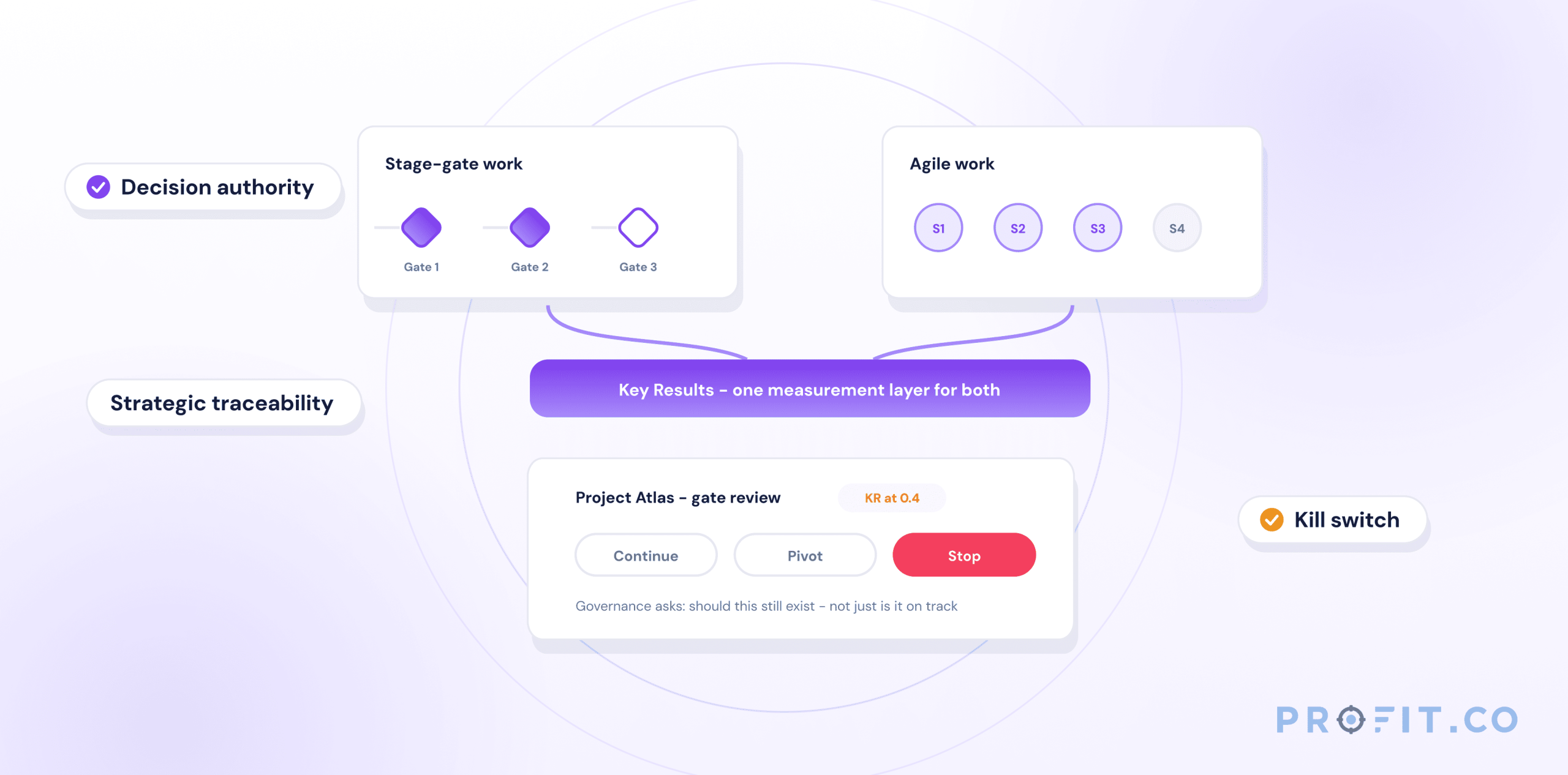
OKRs (Objectives and Key Results) are quarterly commitments to specific, measurable outcomes. Stage-gate checkpoints are criteria-based reviews before a project advances. Sprint goals are short-horizon delivery targets within an agile cycle. These three operating cadences typically live in separate systems, and that disconnection is precisely why execution loses the strategy by March of every year.
The OKR Bridge: How It Works in Practice
Quarterly key results become the gate criteria
Instead of asking “is Phase 1 complete?”, the stage-gate review asks “does Phase 1 contribute to an active key result this quarter?” If yes, the project advances. If no, the portfolio leader has an explicit signal to pause or redirect, before more resources are committed to a project that no longer serves the strategy.
Sprint goals become the execution units of key results
Each sprint delivers the tasks that move a specific key result metric forward. Teams are not just shipping features, they are shipping key result progress. This makes agile delivery purposeful, not just fast. Every two weeks the team can answer: “did this sprint advance the strategy?”
Portfolio health and strategic progress appear in one view
Leadership sees which projects are on track, which key results are at risk, and which sprints are delivering strategic value, all in a single view, without manual data reconciliation between disconnected tools. The quarterly review becomes a strategic conversation, not a status update.
A connected project portfolio management platform natively links OKRs, PPM, and task management in one architecture, the model that makes this bridge operational without manual data reconciliation across separate tools. Teams map each project to an OKR, track sprint progress against key results, and view portfolio health and strategic performance in the same workspace. Standalone PPM tools govern projects well. What they cannot show is whether those projects are winning the quarter.
Explore the full connection in our guide to agile goal management and how the OKR management platform connects quarterly strategy to portfolio execution at every team level.
How Do You Measure the ROI of Project Portfolio Management?
PPM ROI lives in two distinct measurement categories. Most organizations only measure the first, and miss the most important signal. Only one of these measurement categories connects execution to outcome, which is the one a CFO, board, or strategy committee actually cares about.
| Investment Recovery | Strategic Contribution |
|---|---|
| Budget freed by stopping low-value projects | Percentage of projects linked to an active strategic key result |
| Resource conflicts avoided through portfolio visibility | Key results achieved by the planned project work |
| Projects delivered without scope creep or emergency re-plans | Strategy-to-execution cycle time (months, not quarters) |
| Reduction in unplanned reprioritization cycles | Ratio of strategic projects to operational maintenance work |
Organizations that cannot answer the strategic contribution questions are running project management, not portfolio management. The distinction matters because only the second set of metrics connects execution to outcome, which is the measurement that matters to a CFO, board, or strategy committee.
“Most portfolio dashboards fail strategically, not visually. They track what was delivered, not what was won.”
Quantify the business case before your next portfolio review using the Profit.co ROI Calculator, built specifically for strategy execution and OKR-driven portfolio management.
Connect Portfolio Decisions to Live OKRs
Frequently Asked Questions
PPM aligns project investments with strategic goals, eliminates low-value work, improves resource allocation, reduces delivery risk, and gives leadership real-time visibility into portfolio performance, reducing wasted investment across the entire project pipeline.
PPM evaluates, selects, and governs a portfolio of projects against strategic objectives. It prioritizes projects by strategic value and risk, allocates resources accordingly, and tracks progress through a centralized governance framework with defined review checkpoints.
Stage-gate PPM uses structured checkpoints before projects advance phases, best for capital-intensive work. Agile PPM uses iterative sprints, best for software delivery. Hybrid models combine both: stage-gate governance for control, agile sprints for execution speed.
OKRs connect to PPM by making quarterly key results the criteria for portfolio prioritization. Projects that do not contribute to an active key result are deprioritized, preventing busyness without strategic impact and ensuring every funded project advances the strategy.
PPM software centralizes project selection, resource planning, risk tracking, and performance reporting. It connects project execution to strategic goals and gives portfolio managers one view across all active initiatives, showing which are on track, at risk, or worth stopping.