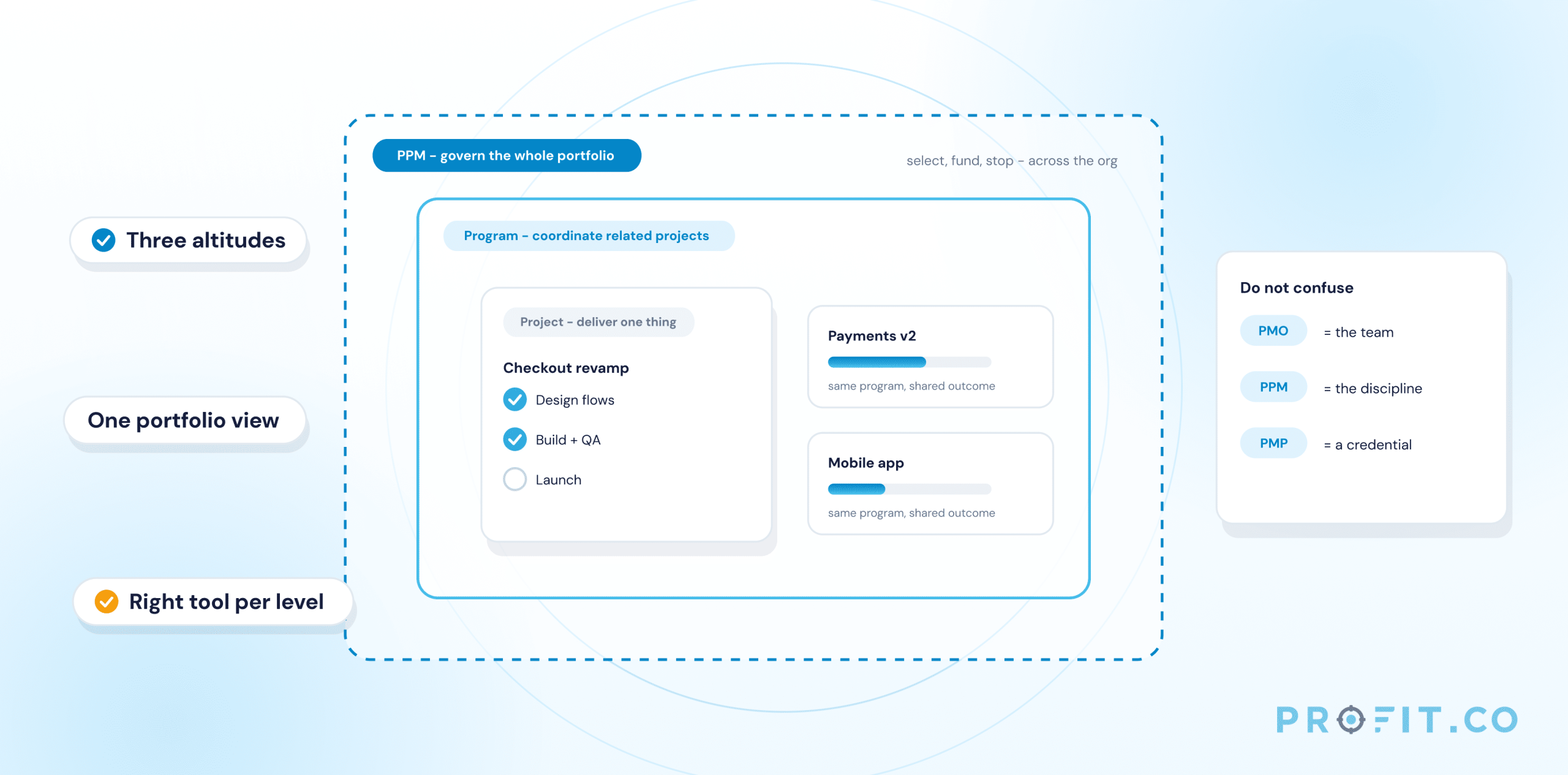
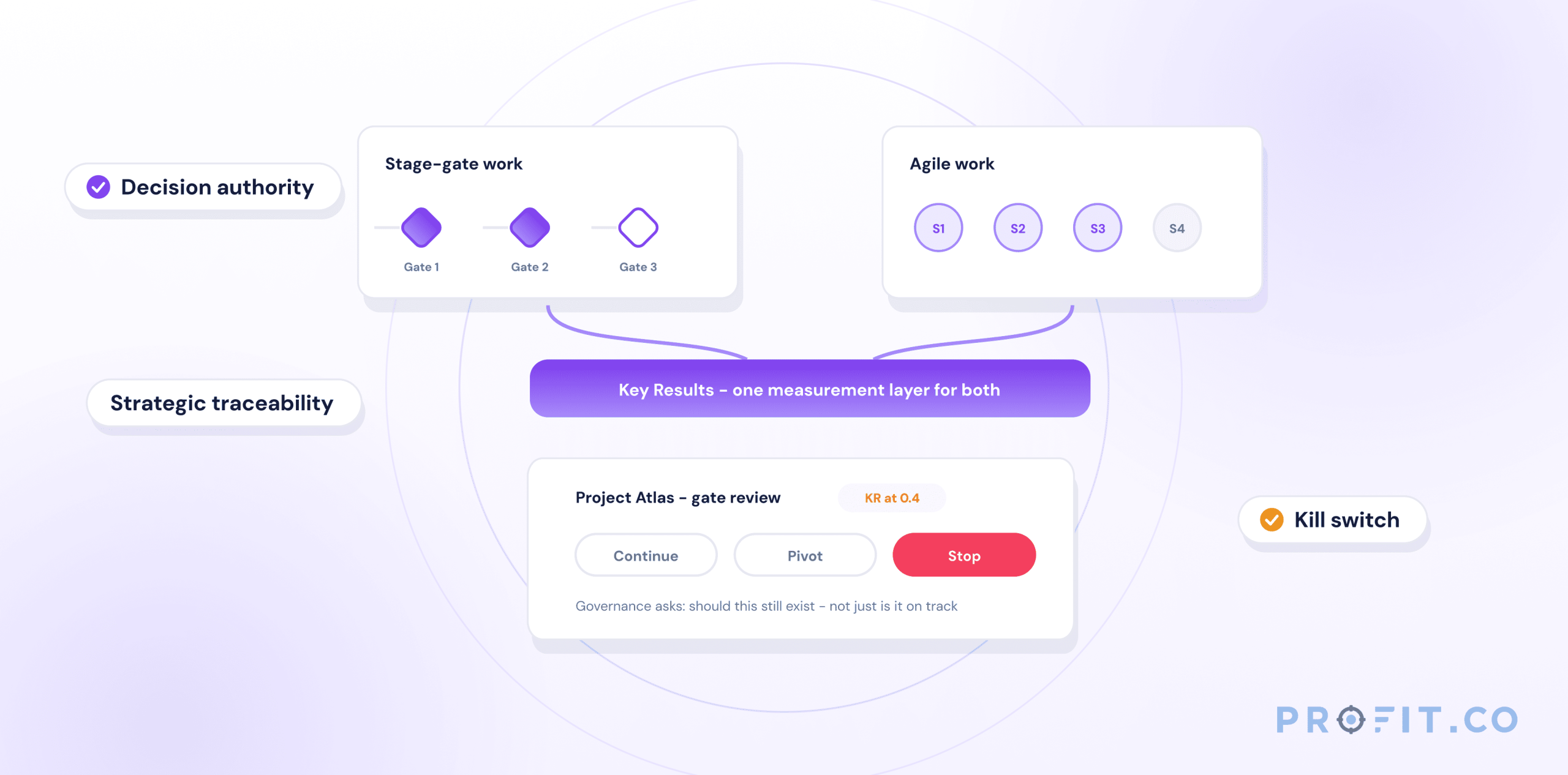
PPM frameworks are structured governance systems that determine how organizations select, prioritize, and execute project portfolios aligned to strategy. The most common approaches, Stage-Gate and Agile, solve different governance problems. The right framework depends on delivery pace, project type, and how tightly quarterly execution connects to strategic outcomes.
In this guide
- What Are PPM Frameworks and What Problem Do They Actually Solve?
- What Is the Difference Between Stage-Gate and Agile PPM Frameworks?
- What PPM Requirements Does a Governance Framework Need to Actually Work?
- Why Do Most PPM Framework Implementations Fail in Year One?
- How Do OKRs Bridge Stage-Gate Governance and Agile Delivery?
- How Do You Build a Hybrid PPM Framework That Scales?
- Frequently asked questions
What Are PPM Frameworks and What Problem Do They Actually Solve?
Most organizations believe PPM frameworks exist to help them pick the right projects. The more accurate answer is harder to hear: the primary function of a PPM framework is to give organizations a disciplined reason to stop funding the wrong ones.
Project selection is rarely the bottleneck. Executives approve new initiatives readily, new projects feel like progress. The governance gap surfaces six months later, when a project that looked strategic in January is quietly absorbing budget and headcount while the strategy has shifted. Nobody cancels it because no mechanism forces the question.
“Speed without governance is faster failure.”
A PPM framework builds that mechanism. At a functional level, it answers four questions every portfolio leader faces every quarter:
- Which projects deserve continued investment this period?
- Which should be paused or cancelled based on strategic misalignment?
- How should resources reallocate as priorities shift mid-quarter?
- How does project execution connect to the strategic outcomes that matter now?
Question four is where most implementations break. The choice of PPM framework determines whether that connection is structural, built into the governance process itself, or aspirational, written into strategy documents that project teams never see during delivery.
Organizations that connect project execution to project portfolio management from the start surface misalignment at the gate, not during the quarter-end debrief. That’s the difference a framework makes, not just at selection, but throughout execution.
What Is the Difference Between Stage-Gate and Agile PPM Frameworks?
Stage-Gate and Agile PPM aren’t competing philosophies; they are purpose-built for different delivery environments. Treating them as interchangeable is the first mistake organizations make when selecting a PPM approach.
Stage-Gate was developed for high-cost, high-risk environments where failing fast is expensive. Pharmaceutical development, capital construction, and physical product manufacturing all use Stage-Gate because a failed gate decision can cost years and significant capital. The logic is sequential: complete a phase, pass a governance review, advance to the next phase. Each gate is a decision point, continue, redirect, or stop.
Agile PPM emerged from software and product development, where delivering small, validated increments quickly beats planning large releases in detail. Portfolio management in an Agile context uses rolling prioritization, quarterly investment cycles, and continuous reprioritization rather than fixed phase gates. The Stage-Gate process works best when gate criteria reflect live strategic data, a constraint that OKRs solve directly.
The structural differences between the two frameworks are sharpest in how they handle key portfolio decisions:
| Dimension | Stage-Gate | Agile PPM |
|---|---|---|
| Decision cadence | Gate reviews at defined phase transitions | Rolling prioritization, typically quarterly or per sprint cycle |
| Best for | Capital projects, R&D, regulated product development | Software, digital products, internal tooling, iterative delivery |
| Resource model | Fixed allocation per phase, committed at gate approval | Fluid capacity: resources follow quarterly strategic priorities |
| Progress signal | Phase deliverables and milestone completion | Value delivered per sprint; OKR Key Result progress percentage |
| Kill criteria | Gate criteria defined at project approval, enforced at gates | Backlog deprioritization based on value-to-effort ratio |
| Strategy connection | Manual: strategy linked at gate review, not updated between gates | OKR-native: sprint goals map directly to quarterly Key Results |
| Risk model | Risk assessed and resolved at each gate before advancing | Risk distributed across short cycles; adjusted continuously |
The table reveals the structural gap: Stage-Gate governance is retrospective, it evaluates what was delivered before advancing. Agile governance is prospective, it continuously reorients around what produces the most value next quarter.
Most mid-market organizations don’t live cleanly in either world. A manufacturing company running a capital infrastructure project alongside a digital transformation initiative needs both frameworks, and a mechanism to connect both to the same strategic objectives. That mechanism is OKRs.
What PPM Requirements Does a Governance Framework Need to Actually Work?
Organizations routinely confuse having a PPM framework with having PPM governance. They are not the same thing.
A framework describes the method, Stage-Gate, Agile, or hybrid. Governance describes the operational system that makes the method function: who makes investment decisions, on what cadence, with what data, and against what criteria. A framework without governance is a process document. Governance without a framework is informal judgment dressed up as process.
Four requirements determine whether PPM governance actually functions:
1. A fixed portfolio review cadence
Governance must run on a fixed cycle, quarterly at minimum, not on an ad hoc basis driven by escalating project status meetings. When reviews are ad hoc, they default to reactive: addressing crises rather than reallocating toward opportunity. A fixed cadence forces proactive portfolio management. Without it, the portfolio drifts.
2. A shared prioritization methodology
Every portfolio needs an explicit scoring model that ranks projects by strategic alignment, value potential, resource requirement, and risk. Without a shared model, prioritization defaults to organizational politics. Whoever argues loudest in the review meeting wins the budget, not the project with the highest strategic return.
3. Gate criteria linked to current strategic OKRs
This is the most common failure point in Stage-Gate implementations. Gate criteria are written at project approval and then stay static. A project can pass every technical gate criterion and still deliver zero strategic value, because the criteria were set against last year’s strategy. Gate criteria must reset when OKRs reset, every quarter.
4. A resource allocation model that rebalances quarterly
Governance requires a capacity model showing how resources are distributed across the portfolio, and a mechanism for rebalancing based on current strategic data. Without this model, resources accumulate on legacy projects through organizational inertia, not strategic intent. The portfolio calcifies.
“Most PPM governance frameworks fail structurally, not methodologically.”
The difference between governance that works and governance that looks good on paper comes down to these four requirements operating together. A portfolio review cadence without live OKR-linked gate criteria is just a calendar event. Gate criteria without a resource rebalancing model are just a checklist. All four must function as a system, or the framework delivers none of its intended value.
Why Do Most PPM Framework Implementations Fail in Year One?
PPM frameworks don’t fail because the methodology is wrong. They fail because the organizational infrastructure to execute them consistently doesn’t exist, and the failure is rarely visible until quarter three, when the framework has quietly become ceremonial.
Three failure modes appear consistently in first-year implementations:
Failure Mode 1: Gate criteria disconnect from live strategy
Stage-Gate frameworks are designed at project initiation. Gate criteria reflect the strategic context at approval time. As strategy shifts across quarters, the criteria age. By quarter two, teams are delivering against requirements that no longer reflect what the business needs. Gates become rubber stamps. The framework becomes governance theater: the process runs, nothing changes.
Failure Mode 2: Agile teams operating without portfolio visibility
Agile PPM requires sprint-level delivery to connect to portfolio-level objectives. When product and engineering teams run in isolation from portfolio governance, their sprints fast, their roadmaps visible only within their own function, sprint velocity can be high while strategic value is low. Understanding how agile goal management connects to portfolio governance is the first step to closing this gap.
Sprint velocity is the most dangerous metric in an isolated agile portfolio. It measures how fast the team is moving, not whether any of it is moving strategy. An agile team that ships on schedule, every sprint, while the portfolio drifts from its quarterly OKRs is not executing well. It is executing efficiently in the wrong direction.
“The problem isn’t the framework. It’s the missing bridge between governance and execution.”
Failure Mode 3: Resource allocation happens outside the framework
The most common and most invisible PPM failure: resources are committed through informal channels before governance reviews take place. By the time the portfolio review meets, the team is already allocated. The governance decision is a formality ratifying what already happened. Real governance requires that resource commitments follow framework decisions, not precede them.
When all three failure modes compound across two quarters, the organization pays for a governance framework and runs on informal judgment anyway, with the added cost of governance overhead consuming time that could be spent on execution. The framework exists on paper. Execution happens around it.
Connect PPM Governance to Live OKRs, Starting this Quarter
How Do OKRs Bridge Stage-Gate Governance and Agile Delivery?
OKRs solve the structural problem that neither Stage-Gate nor Agile PPM frameworks solve on their own: connecting quarterly strategic intent to daily execution decisions, simultaneously at the governance level and the delivery level.
The mechanism runs in two directions.
For Stage-Gate governance: gate criteria need to reflect current strategy, not last year’s planning document. OKR Key Results are exactly that, a quarterly signal of what the organization defines as success this period. When Key Results become gate criteria, every gate review asks the only question that matters: does this project advance our current Key Results? Projects that don’t answer yes don’t advance. Gates go from formalities to real decisions.
For Agile delivery: sprint teams need strategic direction above the two-week horizon. OKRs provide 90-day direction that contains sprint prioritization within strategic boundaries, converting what would otherwise be a negotiation about competing roadmaps into a structural question: which sprint goal advances the Key Result most?
The integrated model is a closed loop:
The OKR-PPM Bridge: Closed-Loop Governance Model
This is not a manual reporting layer. Every level connects structurally, OKR progress reflects actual sprint output without requiring a separate status update cycle assembled from three disconnected tools.
The Architecture Advantage
OKR Management, Portfolio Governance, and Sprint Execution in One Platform
A connected platform supports this hybrid model natively, combining OKR management, project portfolio governance, and task execution in one architecture. Stage-gate governance decisions surface automatically when OKR progress data shows which projects advance Key Results and which consume resources without strategic return.
Portfolio leaders see the full system, from company-level OKRs to individual sprint tasks, without aggregating data from separate sources. The hybrid model is not a compromise between two methods. For organizations running capital infrastructure projects alongside digital transformation work, it is the only approach that gives governance over both without forcing one methodology onto work it was never designed to manage.
How Do You Build a Hybrid PPM Framework That Scales?
The PPM framework decision reduces to three diagnostic questions. Answer these before selecting a methodology, and before purchasing any governance tooling that locks you into a single approach.
Step 1: Audit your project type mix
If more than 60% of your portfolio involves physical products, regulatory deliverables, or capital infrastructure, Stage-Gate is the primary framework. If more than 60% involves software, digital products, or internal tooling, Agile PPM leads. A genuinely mixed portfolio requires a hybrid. The mix determines the framework. The framework should never determine the mix. Below 60% in either direction typically signals a genuinely mixed portfolio, one where neither methodology alone can govern the full range of work without imposing the wrong constraints on at least part of it.
Step 2: Assess your strategic pace
How frequently does your strategy change? Organizations that reset strategy annually can absorb Stage-Gate’s longer cycle times. Organizations that adapt quarterly, increasingly common in technology-adjacent industries, need Agile PPM’s continuous reprioritization. Applying an annual-cadence framework to a quarterly-cadence strategy is a structural mismatch that no amount of process improvement will fix.
Step 3: Anchor governance to the OKR reset cycle
Regardless of which framework leads, embed quarterly OKR reviews into the governance cadence. This solves the most persistent PPM failure: gate criteria aging out of strategic relevance. OKRs reset every 90 days. Portfolio governance should reset with them. Use the PPM ROI Calculator to quantify the cost of projects that survived gates they should have failed, the clearest case for connecting governance to OKRs.
| Organizational Situation | Recommended Framework |
|---|---|
| Capital and compliance projects, regulated industry | Stage-Gate: fixed phases, defined gate criteria, sequential approval |
| Software, digital product, high-change environment | Agile PPM: rolling prioritization, sprint execution, quarterly OKR alignment |
| Mixed portfolio, multiple business units | Hybrid: Stage-Gate for capital, Agile for digital, OKRs governing both layers |
| OKR-driven organization, quarterly strategic cycles | OKR-native hybrid: Key Results as gate criteria, sprint goals as execution units |
| Early PPM maturity, first formal framework | Simplified Stage-Gate: three phases, two gates, OKR alignment required at gate one |
The hybrid approach is not a compromise. It is an acknowledgment that most governance frameworks are designed for one type of work and applied to all of it, and that the organizations paying the highest price for this mismatch are usually the ones running the most projects.
See It in Action
Frequently Asked Questions
A PPM framework is a governance system that determines how organizations select, prioritize, and execute project portfolios. It connects investment decisions to strategic outcomes, ensures resources fund the highest-value work each quarter, and provides a mechanism to exit misaligned projects.
Stage-Gate uses sequential checkpoints, best for capital-intensive, regulated work. Agile PPM uses rolling prioritization and sprint cycles, best for software and digital products. Most mid-market organizations benefit from a hybrid model with OKRs as the shared governance layer.
A functional PPM governance framework needs four elements: a fixed review cadence, a shared prioritization methodology, gate criteria linked to strategic OKRs, and a resource allocation model that rebalances quarterly based on live execution data, not original kickoff commitments.
OKRs connect to PPM frameworks by turning Key Results into gate criteria and sprint goals into execution units. Project investment decisions trace back to current strategic priorities, and sprint output updates OKR progress automatically, creating a closed-loop governance model.
Mid-market companies with mixed portfolios benefit most from a hybrid PPM framework: Stage-Gate governance for capital and compliance projects, Agile sprints for product and technology delivery, and quarterly OKRs governing both under a single strategic layer.