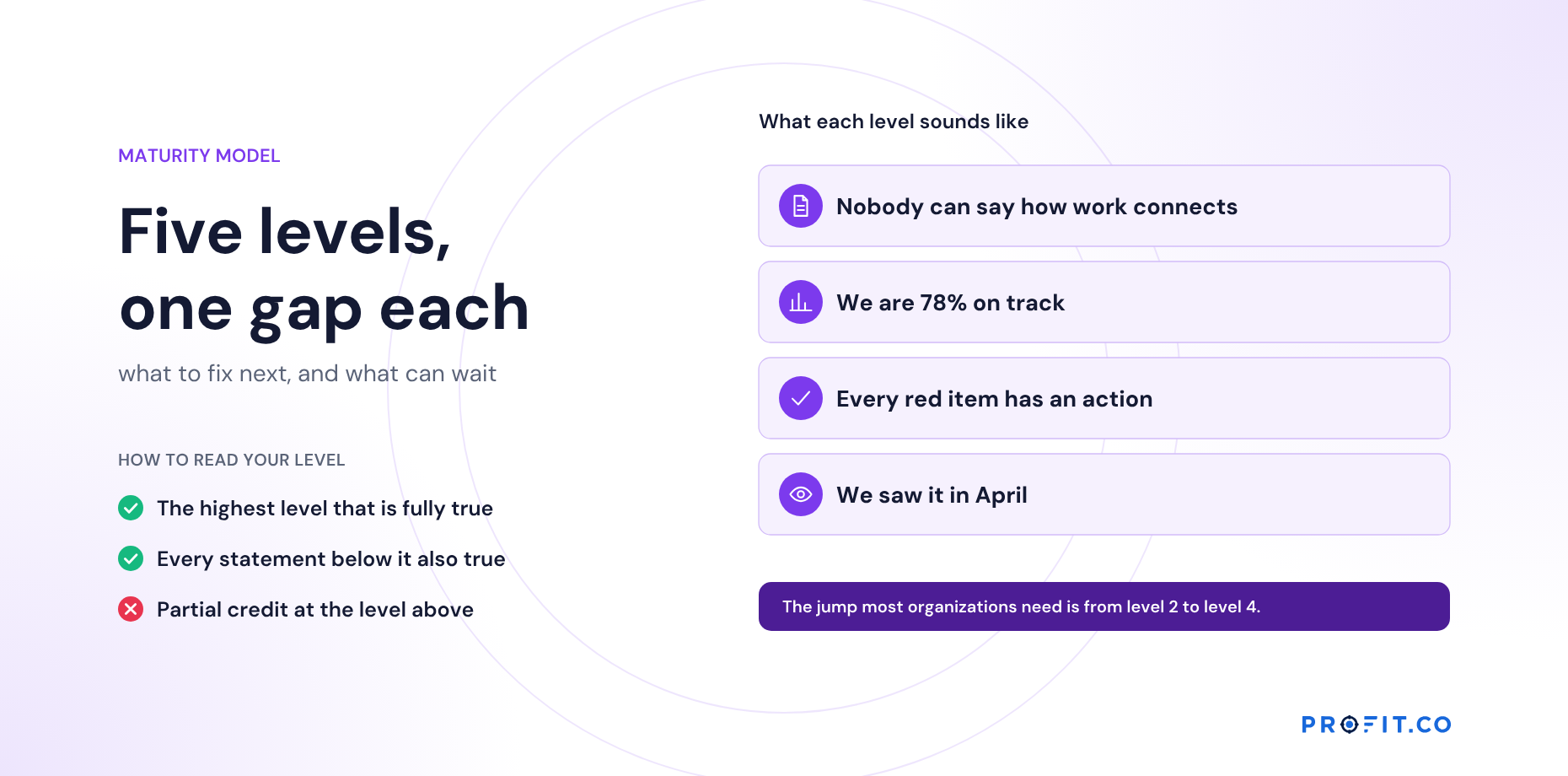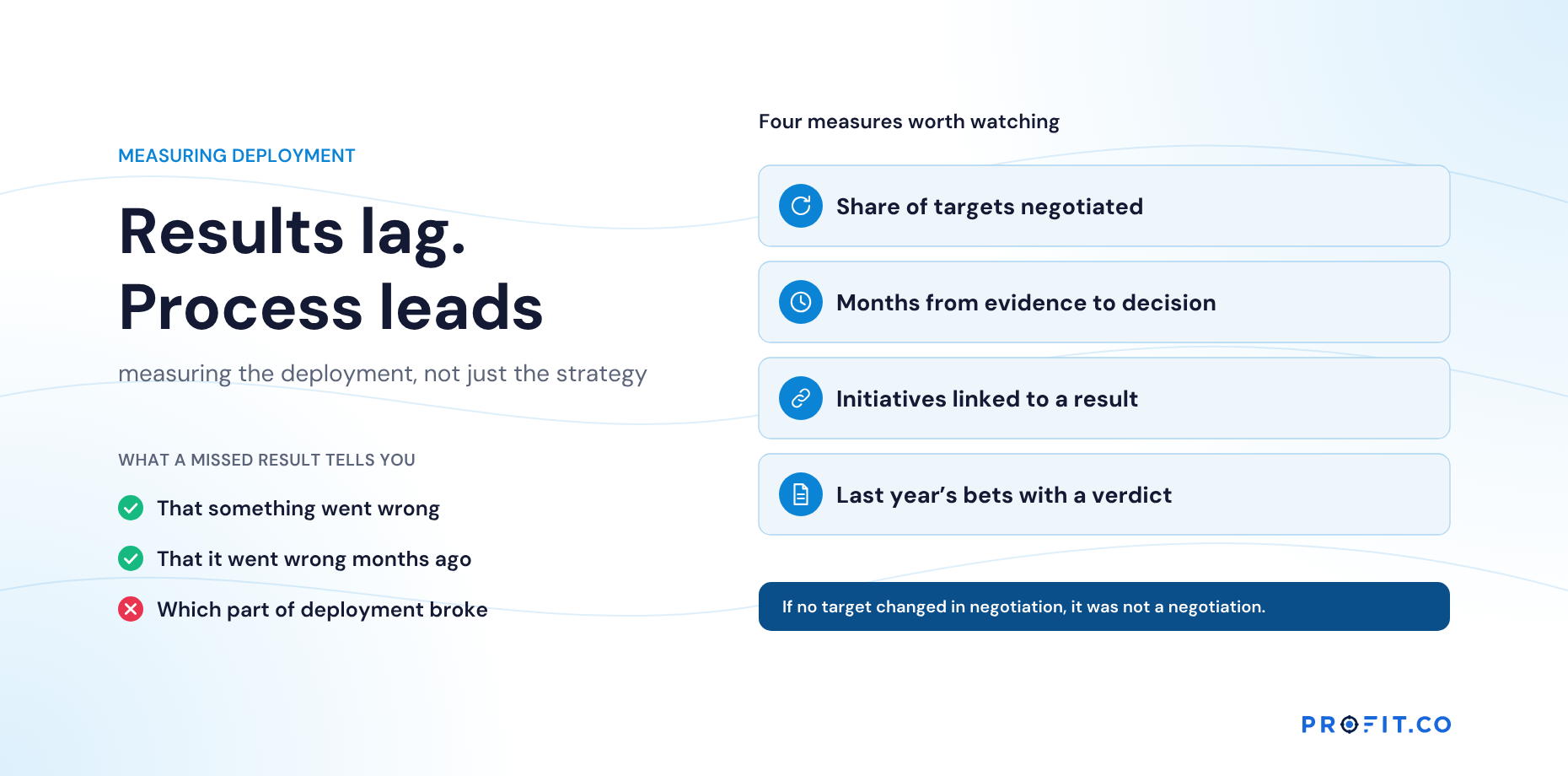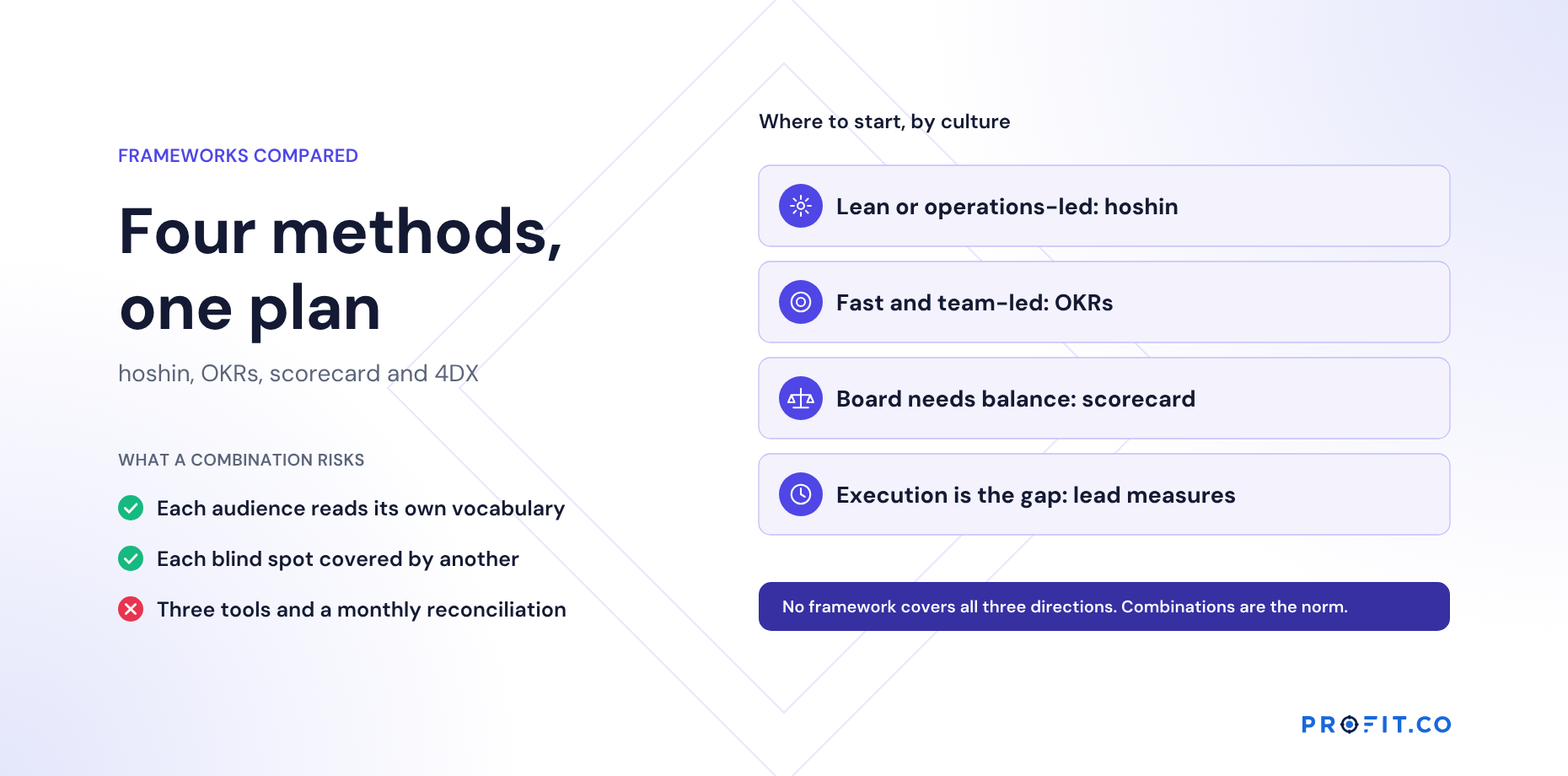












Alignment is the most celebrated property of a deployed strategy and the least informative. Every goal can trace to the strategy and every team can be on track, and the result can still not move. Alignment describes the plan. Effect describes what happened.
In this guide
Key Takeaways
- →Alignment only says a link was drawn. It doesn’t say whether the work on one end moves the result on the other.
- →Four states exist; all four are “aligned”. Only work progress beside result progress separates them.
- →Name the result each piece of work should move, not just the goal it sits under.
- →State the expected lag, so “too early to tell” has a date on it.
- →Flag the gaps automatically, so they don’t depend on someone noticing.
- →None of this replaces alignment. It stops alignment being treated as proof.
Why alignment feels like success
Alignment is easy to measure and satisfying to show. An alignment chart where every goal links upward looks like a well-run organization. Many tools report an alignment percentage. Strategy offices put it on slides.
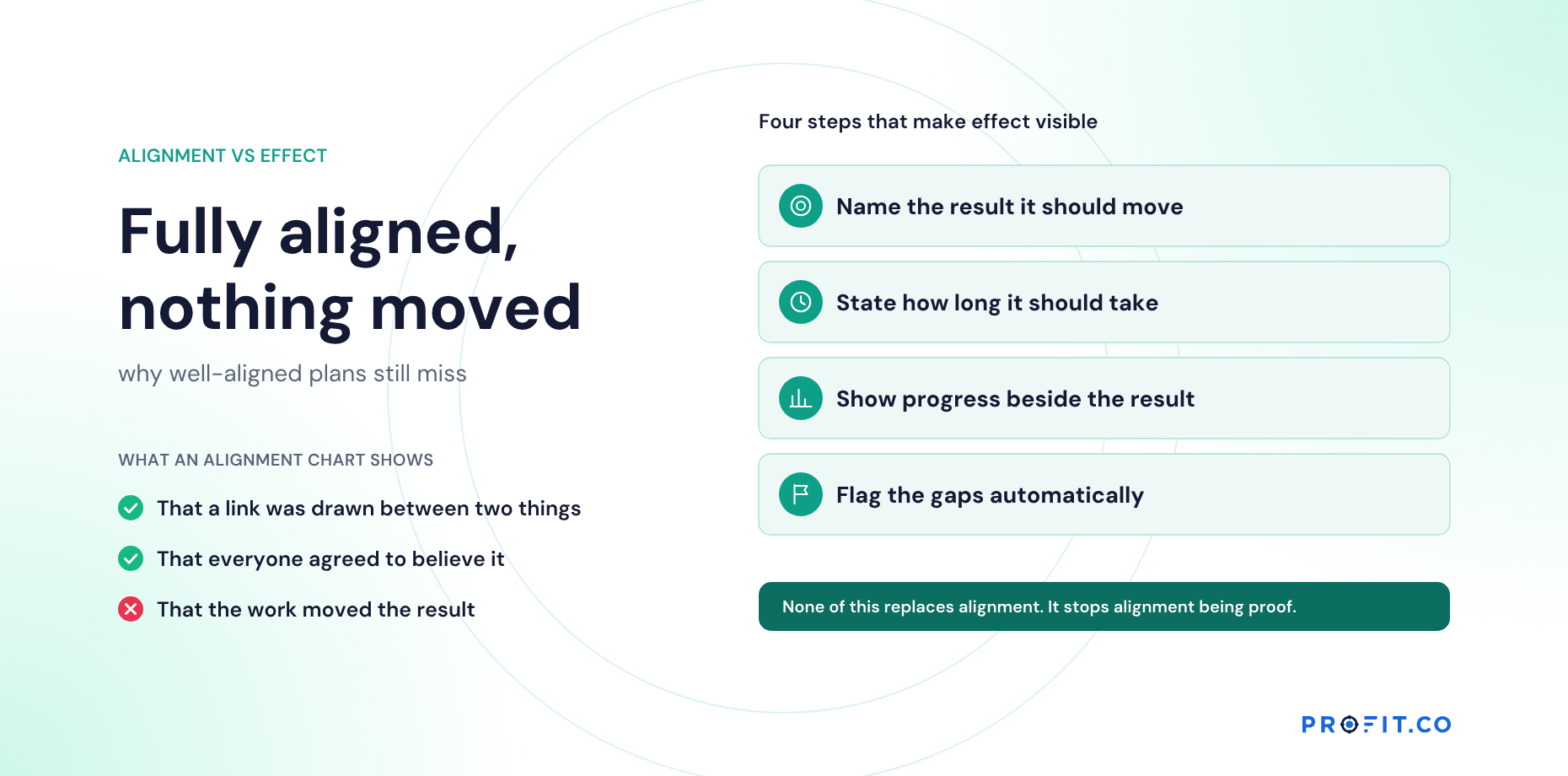
But alignment only says that a link was drawn. It doesn’t say whether the work on one end moves the result on the other. That question can only be answered by results, over time.
An alignment chart shows what everyone agreed to believe. Only results show whether it was true.
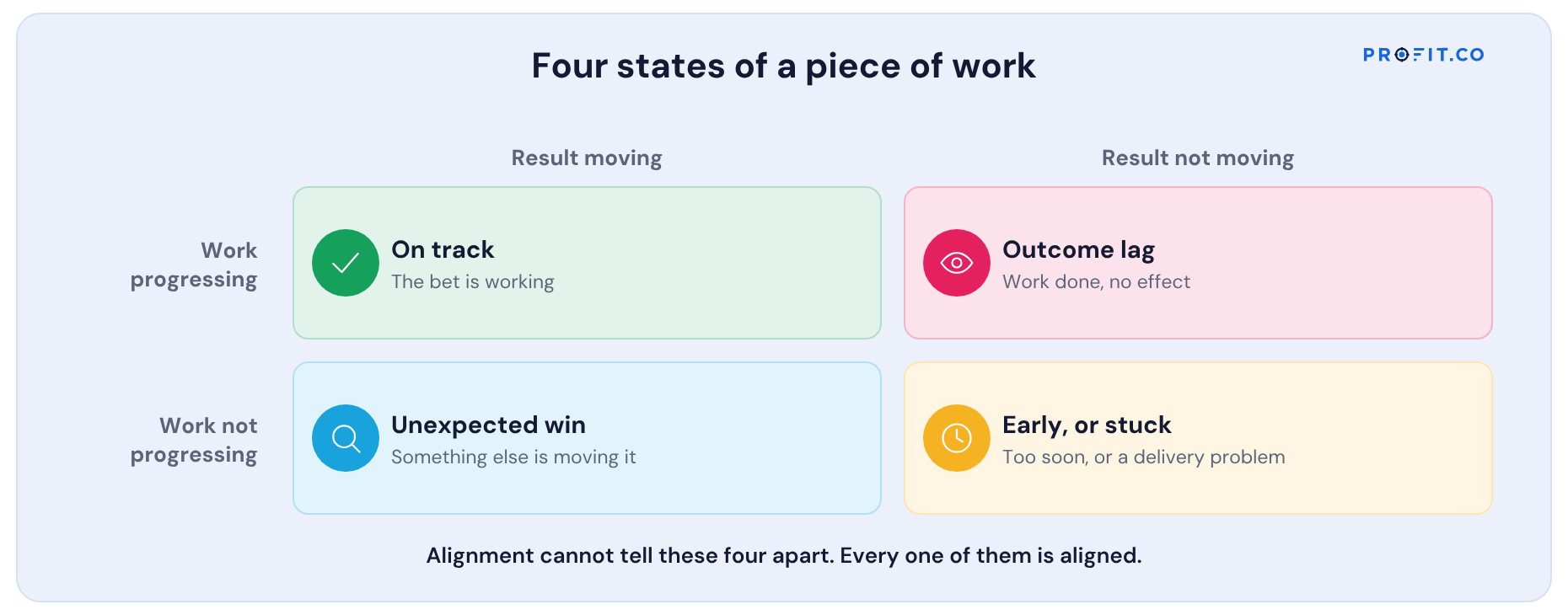
Four states of a piece of work
Whether the work is progressing, and whether the result is moving, are two separate questions. Asking both at once gives four answers.
| Result moving | Result not moving | |
|---|---|---|
| Work progressing | On track: the bet is working | Outcome lag: work done, no effect |
| Work not progressing | Unexpected win: something else is driving the result | Early stage, or delivery problem |
Alignment can’t distinguish these four states. Every one of them is “aligned”. Only putting work progress beside result progress separates them. The diagnosis of the most common one, outcome lag, is in Outcome Lag: When Priorities Are Green and KPIs Don’t Move.
Making effect visible
- Name the result each piece of work should move, not just the goal it sits under.
- State how long it should take, so “too early to tell” has a date.
- Show progress beside the result, every month, in the same view.
- Flag the gaps automatically, so they don’t depend on someone noticing.
None of this replaces alignment. A plan still needs every goal connected to the strategy. It just stops treating the connection as proof.
The measurement side of the first rule, writing a result you can actually read month by month, is covered in Writing KPIs for the Hoshin Kanri X-Matrix: Definitions, Baselines, Sources.
A worked example: 100% aligned, 0 points moved
Here are four hypothetical initiatives, all aligned to services growth, and the result each one moved:
| Initiative | Aligned to | Progress | Result it should move | Result change |
|---|---|---|---|---|
| Open three service centers | Services growth | 90% | Contract attach rate | +1 point |
| Launch service portal | Services growth | 100% | Online service orders | +0.5% |
| Retrain service sales | Services growth | 100% | Attach rate in pilot regions | +1 point |
| Revise service pricing | Services growth | 80% | Service margin | No change |
Every initiative is aligned, three are complete or nearly so, and the services share of sales has moved by less than a point. An alignment report would show this plan as healthy. An effect view would have flagged the service centers in month four, when they were open and attach rates weren’t rising.
What a year of outcome lag costs
The cost isn’t the initiatives; those were delivered. It’s the five months between month four, when the evidence was available, and month nine, when someone finally looked. Five months of budget spent on a bet that had already failed its test, and a planning cycle that starts again without knowing why.
Among published alternatives for holding work beside results, OnStrategy lists $200 per month for unlimited users. i-nexus publishes a free Starter tier for up to five users and $28 per user per month at its Standard tier. The test for either is narrow: can you see an initiative’s progress and the result it was chosen to move in the same view, in the same month?
Profit.co publishes two plans, Essentials and Enterprise, quoting against modules and scale rather than a public seat rate. The four-quadrant view and the exception queue sit in Essentials with OKRs and Goals, Balanced Scorecard, Hoshin Kanri and Strategy Roadmap. The 30-day free trial covers one monthly cycle, which is exactly the cycle in which outcome lag becomes visible.
Alignment and effect in Profit.co
Profit.co keeps alignment, each objective linked to the strategy through contributing key results and correlations, and adds effect: each correlation carries its expected lag, a four-quadrant chart plots result progress against initiative progress, and the exception queue flags correlations whose hypothesis didn’t hold. See the strategy deployment software page.
Each of those three does a specific job:
- The expected lag tells the system when a result should have responded, so nobody has to judge it by feel.
- The four-quadrant chart is the picture of the four states above, with every initiative plotted on it.
- The exception queue raises the outcome-lag cases rather than waiting for someone to spot the pattern in a pack.
The chart itself is explained in The Four-Quadrant Chart: Plotting KPIs Against Initiatives in Hoshin Kanri.
Free Product Demo
See effect, not just alignment
A 30-minute walkthrough, tailored to your team.
Book a free demo
What happens in the call
How your teams set goals, track progress and review results.
Strategy, performance, projects and engagement on one platform, with AI.
A practical path to align teams, execute faster and drive results.
Questions this article answers
Alignment means every goal connects to the strategy. Effect means the work is actually moving the strategy’s results. A plan can be fully aligned and have no effect.
Name the result each piece of work should move, state the expected time lag, show work progress beside result progress monthly, and flag cases where work advances and results don’t.
Yes. A plan needs every goal connected to the strategy. Alignment is necessary, not sufficient.
The state where work is progressing and the result it was chosen to move is not. It is one of the four states a piece of work can be in, and the one an alignment report hides most effectively.
When the expected lag you stated up front has passed. That is why stating it matters: without a date, “too early to tell” can be said in every month of the year.