










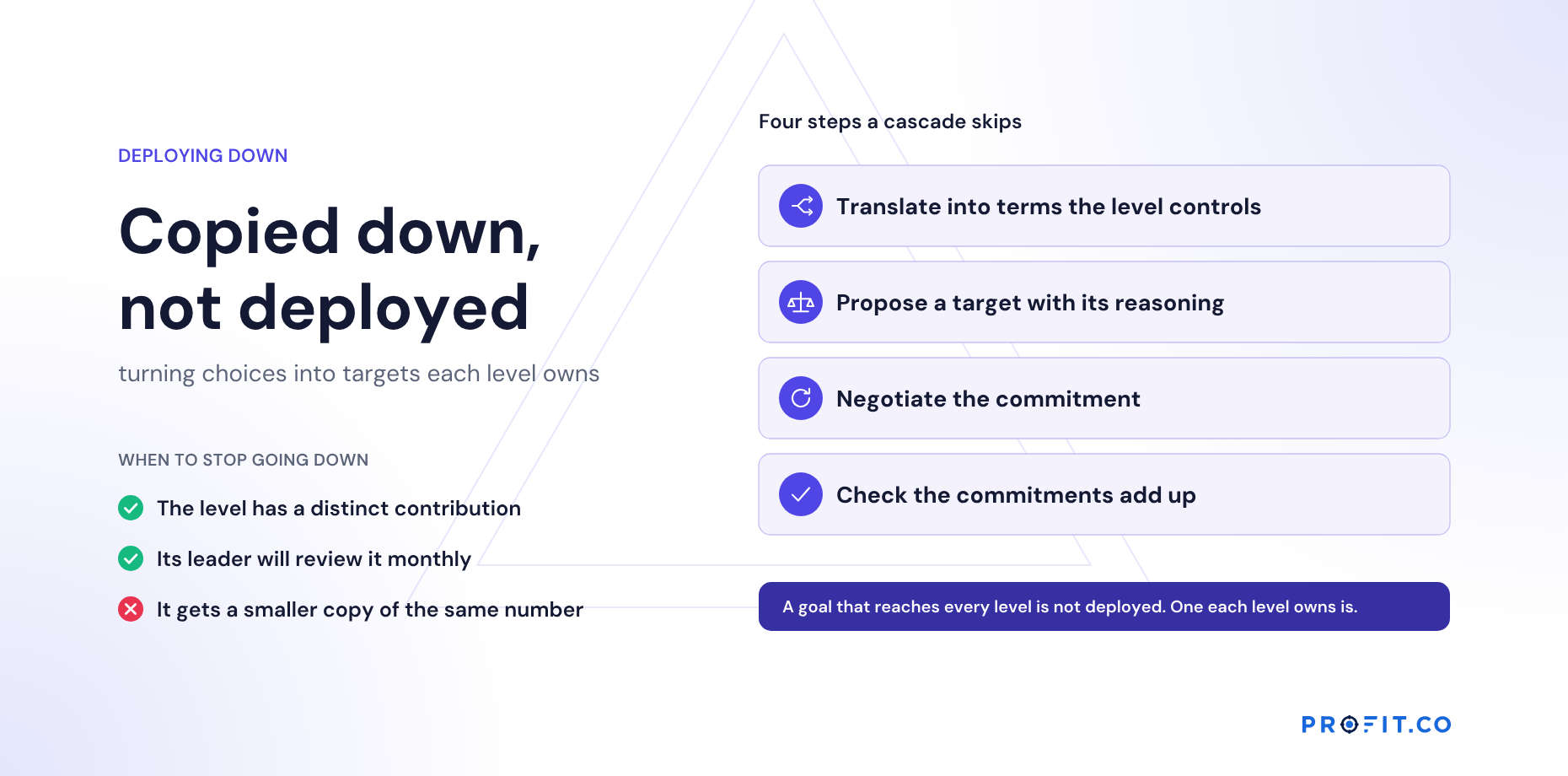

The downward direction is the one most organizations think they’ve got right, because goals do reach every level. Whether those goals are owned, add up to the strategy and carry their reasoning is a different matter.
In this guide
Key Takeaways
- →The commonest mistake is copying an objective down unchanged, with a smaller number each time.
- →Translation turns the level above’s “how” into the next level’s “what”.
- →Deploy only to levels with a distinct contribution whose leader will review it monthly.
- →Five steps: translate, propose, negotiate, check the sum, record.
- →Negotiating and checking the sum are exactly what a cascade skips.
- →A goal that reaches every level isn’t deployed. One each level can act on and owns is.
Translate, don’t copy
The most common deployment mistake is copying an objective down unchanged. “Grow services to 40% of sales” becomes the same sentence at every level, with a smaller number. Each level ends up with a result it can’t directly control.
Translation turns the level above’s “how” into the next level’s “what”. If the group’s way of growing services is a regional service network, the region’s objective is to make the network work in its territory, measured by something the region controls, such as calls served locally or contract attach rate.
How far down to go
| Deploy to this level if | Stop above it if |
|---|---|
| The level has a distinct contribution to make | It would only receive a smaller copy of the same number |
| It controls something that moves the result | Its work is already captured by a program or team above |
| Its leader will review it monthly | Nobody would look at it until year end |
A goal that reaches every level isn’t deployed. A goal that each level can act on and owns is.
The deployment steps
Five steps, in order. The first turns a choice into something a level can act on; the rest turn it into something that level has agreed to.
| Step | Output |
|---|---|
| 1. Translate | Each level’s objective, in terms it controls |
| 2. Propose | A target with the reasoning behind it |
| 3. Negotiate | The level’s commitment, needs and assumptions |
| 4. Check the sum | Commitments below cover the target above, or the gap is resolved |
| 5. Record | The agreed target with its reasoning and any revisit trigger |
Steps 3 and 4 are what a cascade skips. The detail of step 3 is in Cascading Goals vs Negotiating Them: Why Top-Down Cascades Fail; which measures should be copied down and which translated is in Writing KPIs for the Hoshin Kanri X-Matrix: Definitions, Baselines, Sources.
A worked example: one choice, three levels
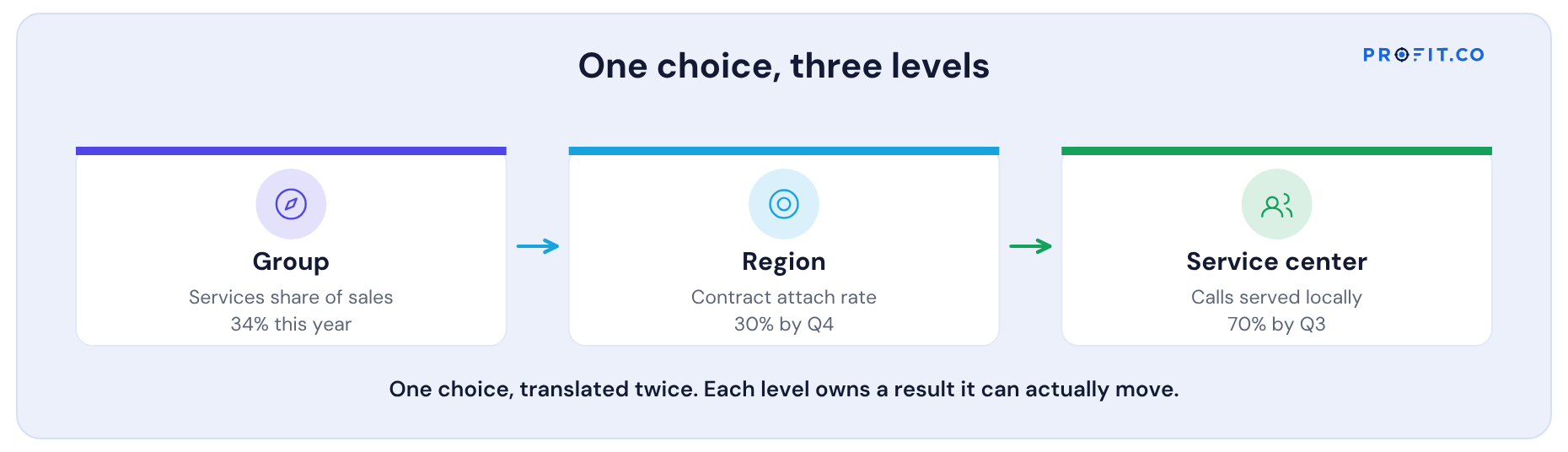
Here is a hypothetical group choice, translated twice, so that each level ends up with something it can actually move:
One group choice, translated twice, so that each level ends up with something it can actually move.
| Level | Objective | Measured by | Target |
|---|---|---|---|
| Group | Grow services to 40% of sales by 2028 | Services share of sales | 34% this year |
| Region | Make the service network work in our territory | Contract attach rate on new equipment | 30% by Q4, negotiated from 35% |
| Service center | Serve the installed base locally | Share of calls served by the local center | 70% by Q3 |
Each level owns a result it can move. The region negotiated its attach-rate target down from 35% to 30% because two of its centers open late; the group accepted it after another region offered more. The center’s measure, calls served locally, is the one that would have exposed the routing problem described elsewhere in this library months earlier.
What a copied goal costs
A copied goal costs nothing in planning season, which is why it survives. It charges later: an owner who never believed the number spends the year managing expectations rather than the result, and a year-end review that can’t tell a bad target from bad delivery.
Among published alternatives for running the negotiation and the sum check, OnStrategy lists $200 per month for unlimited users. i-nexus publishes a free Starter tier for up to five users and $28 per user per month at its Standard tier. The test for either is step 4: does the tool refuse to close when the commitments below add to less than the target above, or does it simply store whatever was typed?
Profit.co publishes two plans, Essentials and Enterprise, quoting against modules and scale rather than a public seat rate. Catchball and the balance constraint sit in Essentials with OKRs and Goals, Balanced Scorecard, Hoshin Kanri and Strategy Roadmap. What Drives the Cost of Hoshin Kanri Software lists the rest to total, and the 30-day free trial covers one full round of negotiation.
Deploying down in Profit.co
In Profit.co, each level’s objectives contribute to the level above, and targets are agreed in catchball sessions with a change table, own-number-only counters, agreement from every participant and a balance constraint so commitments add up. See the strategy deployment software page.
Two of those do the work of steps 4 and 5:
- The balance constraint is step 4. The session cannot close while the contributions fall short, so the gap is resolved in planning season rather than discovered in September.
- The change table is step 5. The proposal, each counter and the agreement stay with the target, so next year’s planning reads the reasoning rather than guessing at it.
How that record survives long enough to be useful is covered in Catchball in Software: Turning Negotiation Into a Record.
Free Product Demo
Deploy your next objective down properly
A 30-minute walkthrough, tailored to your team.
Book a free demo
What happens in the call
How your teams set goals, track progress and review results.
Strategy, performance, projects and engagement on one platform, with AI.
A practical path to align teams, execute faster and drive results.
Questions this article answers
Translate each choice into an objective the next level controls, negotiate targets with that level, check commitments add up to the target above, and record the reasoning.
Only to levels with a distinct contribution that their leader will review regularly. Levels that would only receive a smaller copy of the same number don’t need their own objective.
Each level ends up with a result it can’t directly control. Translating the level above’s method into the next level’s objective gives each level something it can act on.
It means turning the level above’s method into the next level’s objective. If the group grows services through a regional network, the region’s objective is to make that network work in its territory, measured by something the region controls.
The gap is resolved before agreement: a larger commitment somewhere, a lower target above, or a recorded risk. A tool that lets the session close unbalanced is storing the problem for September.