











A group of companies, each with its own board, systems and culture, faces a harder deployment problem than a single business. Impose too much and entities disengage. Impose too little and the group strategy is a collection of unrelated plans.
In this guide
Key Takeaways
- →Separate boards, systems, methods, ownership and maturity: a single-company cascade breaks on every one of them.
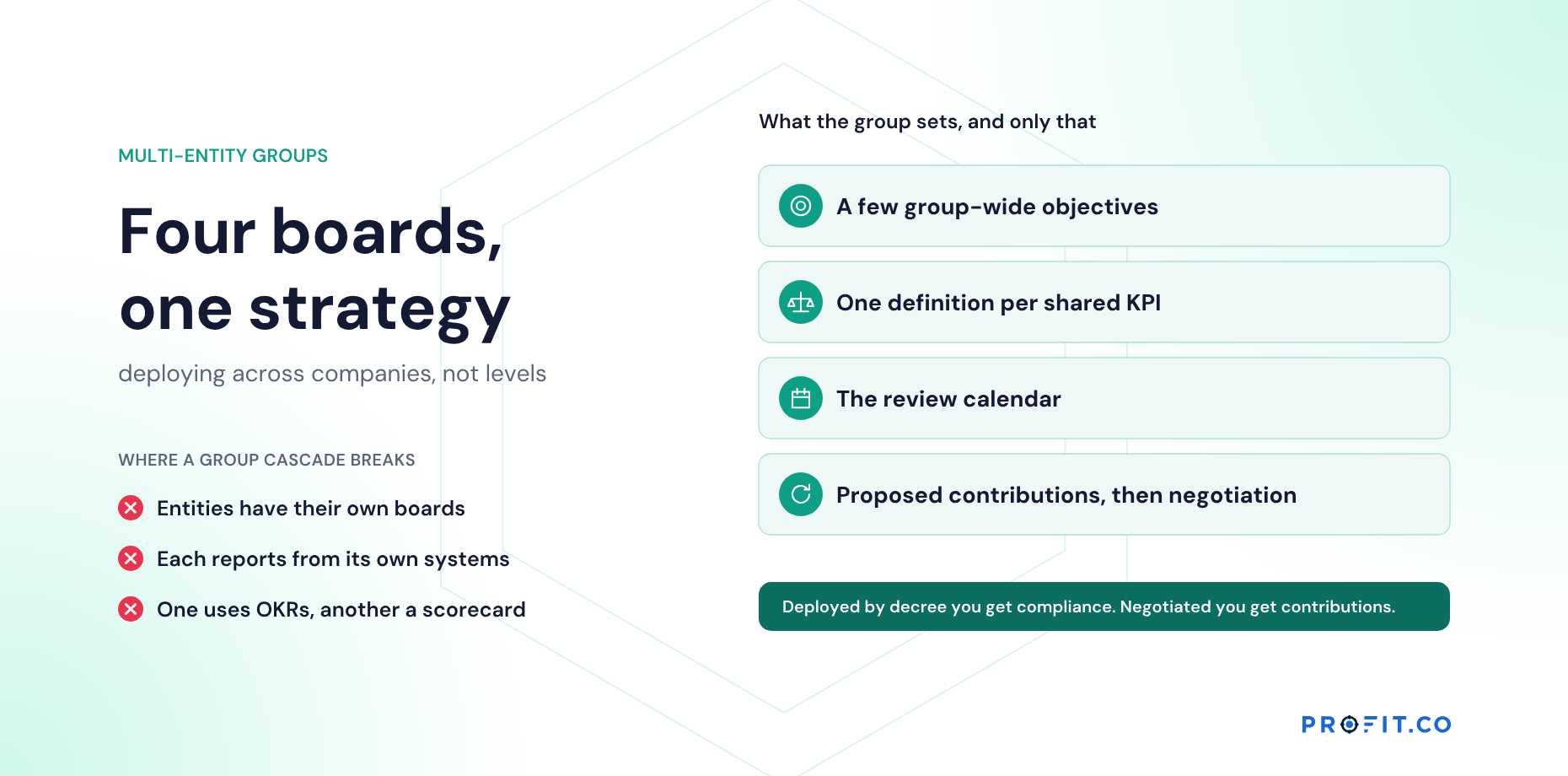
- →The group sets a few objectives, shared KPI definitions and the review calendar. Entities decide how they contribute.
- →Shared KPIs need one definition across every entity, even when local systems differ.
- →Commitments are checked against the group target before agreement, and gaps are resolved openly.
- →Separate visibility from ownership: the group sees contributions; the entity owns its plan.
- →A group strategy deployed by decree gets compliance. One deployed by negotiation gets contributions.
Why groups are different
| Challenge | What it looks like |
|---|---|
| Separate governance | Entities have their own boards and leadership teams |
| Different systems | Each entity reports from its own finance and operational systems |
| Different methods | One uses OKRs, another a scorecard, another a slide pack |
| Different ownership | Some entities are wholly owned, some partly |
| Different maturity | Some have strategy offices; some have never deployed strategy |
A single-company cascade breaks on every one of these. A group needs a lighter, more negotiated model.
Why a cascade fails even inside one company, let alone across several, is in Cascading Goals vs Negotiating Them: Why Top-Down Cascades Fail.
What the group sets, and what entities decide
| Group sets | Entities decide |
|---|---|
| A few group-wide objectives | How they contribute, and their own additional objectives |
| Standard definitions for shared KPIs | Local KPIs for their own objectives |
| The review calendar | Their internal cadence |
| Proposed contributions to group targets | Their commitments, negotiated with the group |
A group strategy deployed by decree gets compliance. One deployed by negotiation gets contributions.
Making it add up
- Shared KPIs use one definition across every entity, even if local systems differ.
- Entity commitments are checked against the group target before agreement.
- Gaps are resolved openly: by a larger commitment somewhere, a lower group target, or a recorded risk.
- The group sees contributions, not just a consolidated number.
Writing a KPI definition that survives being read by four different finance systems is its own discipline, covered in Writing KPIs for the Hoshin Kanri X-Matrix: Definitions, Baselines, Sources.
Visibility without control
Entities often resist group tools because they fear the center will micromanage. The answer is to separate visibility from ownership: the group sees each entity’s contribution to group objectives and the evidence behind it; each entity owns and runs its own plan, including objectives the group doesn’t set. Visibility settings on objectives make that separation practical.
The multi-site version of the same problem, inside one company rather than across several, is in Deploying Hoshin Kanri Across Multiple Sites.
A worked example: four entities, one group objective
An illustrative diversified group sets a group-wide objective: recurring revenue at 30% of group revenue within three years, from 22% today.
| Entity | Proposed contribution | Negotiated commitment | Note |
|---|---|---|---|
| Industrial equipment | +3 points | +3 points | Service contracts |
| Facilities services | +2 points | +3 points | Already contract-based; can do more |
| Distribution | +2 points | +1 point | Different business model; recurring revenue limited |
| Technology services | +1 point | +1 point | Subscription migration under way |
| Total | +8 points | +8 points | Adds up after facilities services offers more |
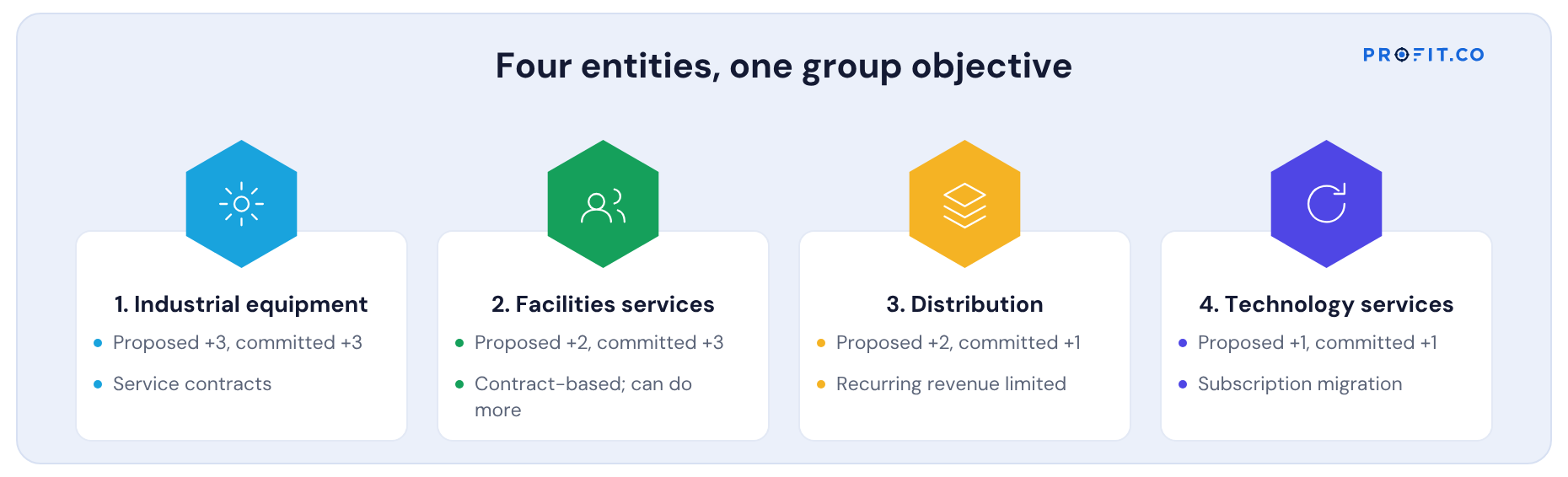
Distribution’s honest counter, and facilities services’ offer to cover it, would not have surfaced in a cascade. The group ends with commitments that add up and that each entity chose.
What group reporting costs today
In most groups the recurring cost is not a subscription. It is a group finance or strategy analyst in each entity, plus one at the center, spending the first week of every month turning four different definitions of the same measure into one slide. The number arrives accurate and a month old, and nobody can drill into it.
Among published alternatives, OnStrategy lists $200 per month for unlimited users, which suits a group wanting to add many light users across entities. i-nexus publishes a free Starter tier for up to five users and $28 per user per month at its Standard tier. For a group, the deciding question is whether an entity can keep its own objectives private while contributing to a group one.
Profit.co publishes two plans, Essentials and Enterprise, quoting against modules and scale rather than a public seat rate, which is usually the right shape for a group where entities differ in size and maturity. OKRs and Goals, Balanced Scorecard and Hoshin Kanri sit on one model, so entities that use different methods still contribute to the same group objective. What Drives the Cost of Hoshin Kanri Software lists the rest to total.
Groups and entities in Profit.co
In Profit.co, entity objectives contribute to group objectives with their owners and weightings visible, catchball sessions negotiate contributions with a balance constraint so they must add up, and OKRs, scorecards and hoshin plans can coexist across entities on one model. See the strategy deployment software page.
For a group, three of those matter more than the rest:
- Weighted contributions. An entity’s commitment carries its share of the group target, so the center can see who is covering what.
- The balance constraint. A catchball session cannot close while the commitments below add to less than the target above, which is what turns the worked example above into a conversation rather than a surprise.
- Visibility settings per objective. An entity’s own objectives stay its own; only the contribution is shared upward.
How a negotiation survives as a record that an entity board can read six months later is covered in Catchball in Software: Turning Negotiation Into a Record.
Free Product Demo
See your entities’ contributions add up
A 30-minute walkthrough, tailored to your team.
Book a free demo
What happens in the call
How your teams set goals, track progress and review results.
Strategy, performance, projects and engagement on one platform, with AI.
A practical path to align teams, execute faster and drive results.
Questions this article answers
Set a few group-wide objectives and shared KPI definitions, negotiate each entity’s contribution, check that contributions add up, and let entities own their plans and add their own objectives.
Define shared KPIs centrally with one formula, even when entities report from different systems, and let entities add local KPIs for their own objectives.
Yes, if the tool holds them on one model. Entities can use OKRs, a scorecard or hoshin while contributing to the same group objectives.
Separate visibility from ownership. The group sees each entity’s contribution to group objectives and the evidence behind it; the entity owns and runs its own plan, including objectives the group doesn’t set.
Resolve it openly: a larger commitment somewhere, a lower group target, or a recorded risk. The gap should surface during negotiation rather than at year end.