












Many organizations adopt OKR software expecting it to deploy their strategy. It deploys goals, which is part of the job. Whether it deploys strategy depends on what sits above the OKRs and what comes back up from them.
In this guide
Key Takeaways
- →OKRs are excellent at team focus, transparency and frequent check-ins over a quarter.
- →What they lack alone: multi-year direction, a record of negotiated targets, a check that they add up, evidence of effect and agreed dependencies.
- →The strongest pattern keeps OKRs at team level inside a deployment system that holds the rest.
- →Teams can score well on every key result while the strategic result barely moves.
- →That happens when key results measure activity rather than the change the strategy needs.
What OKR software does well
OKRs give teams a simple format for focus: a few objectives each quarter, each measured by key results, with frequent check-ins. Good OKR software makes that easy, encourages transparency, and gets teams talking about outcomes rather than tasks. For engagement and team focus, it’s hard to beat.
None of what follows argues against OKRs. It argues against expecting them, on their own, to carry a multi-year strategy down an organization and bring evidence back up.
Where OKRs alone stop
| Deployment need | OKRs alone | What’s missing |
|---|---|---|
| Multi-year direction | Quarterly cycles | A layer of long-term objectives the quarters serve |
| Negotiated targets | Alignment conversations, often informal | A record of what each level committed to and why |
| Targets that add up | Usually not checked | A check that commitments cover the target above |
| Evidence of effect | Key result progress | Whether those key results are moving the strategy’s results |
| Dependencies | Often implicit | Agreements with the functions a key result depends on |
OKRs answer “what is each team trying to achieve?” Strategy deployment also asks “is it adding up to what the strategy needs?”
OKRs as the team layer
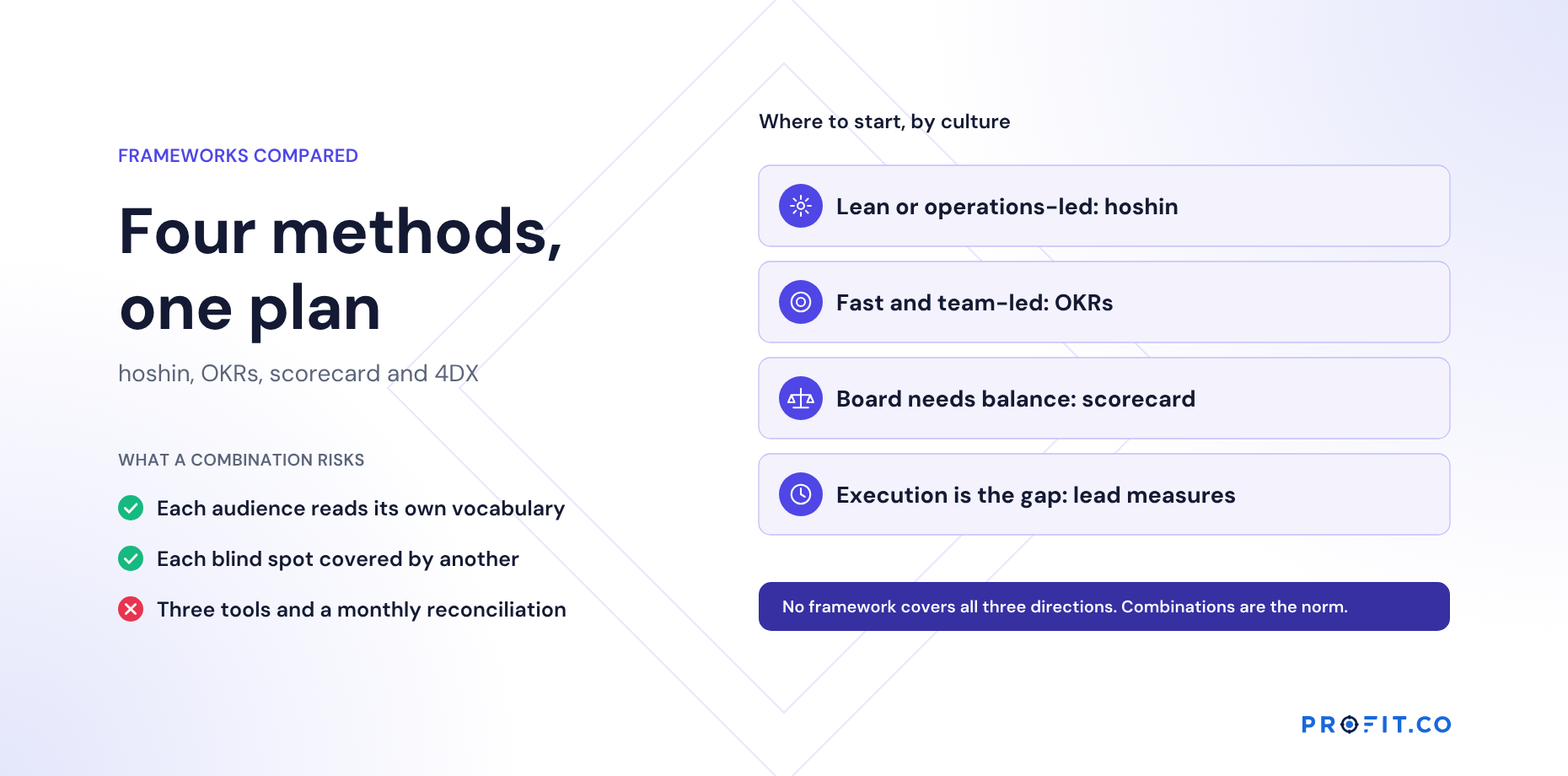
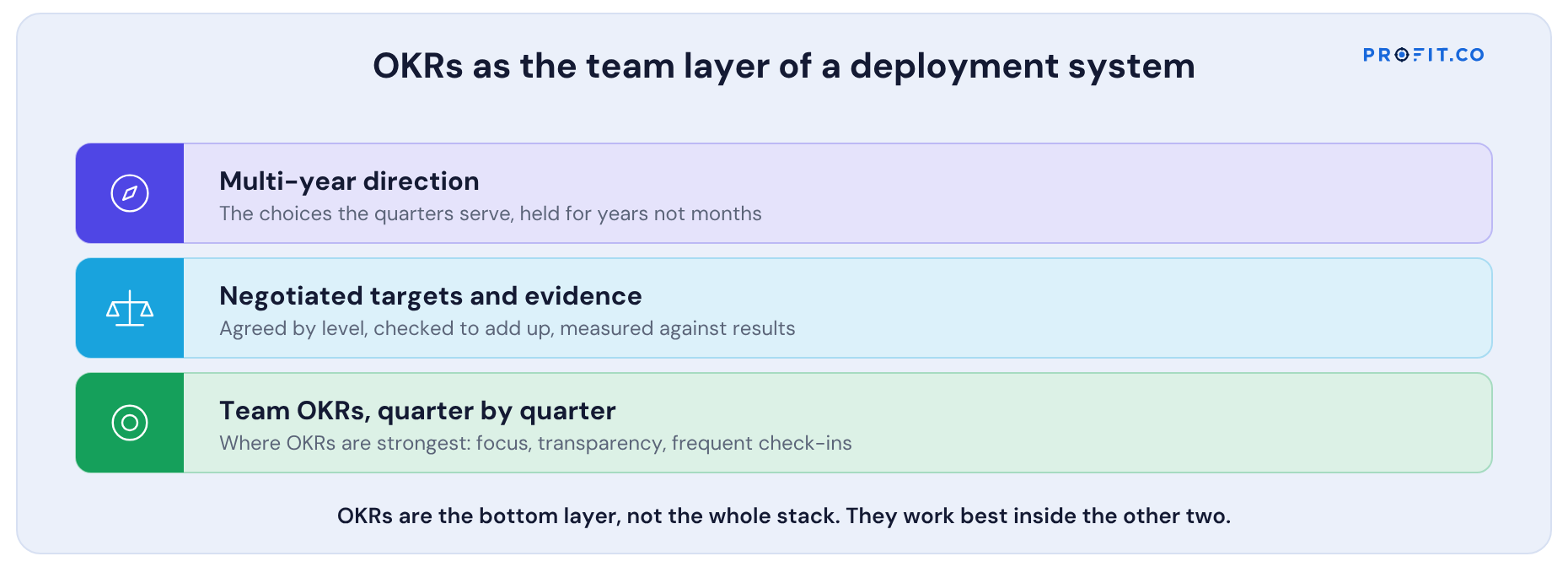
The most effective pattern uses OKRs where they’re strongest, at team level over a quarter, inside a deployment system that holds the multi-year choices, the negotiated targets and the evidence. Team key results contribute to the objectives above them, so progress flows up without re-entry. How OKRs sit under a hoshin plan specifically is covered in Hoshin Kanri and OKRs on One Platform: Where Each Belongs.
Drawn as a stack, the arrangement is three layers deep, and OKRs are the bottom one.
Which do you need?
- Strategy is set for one or two years and mostly delivered by a few teams: OKR software may be enough.
- Strategy spans several years and levels: you need a deployment layer above the OKRs.
- Team OKRs look healthy while strategic results don’t move: you need evidence of effect.
- Teams’ key results depend on each other: you need dependencies agreed across.
The third of those is the common one, and it is worked through in Alignment Isn’t Effect: Why Well-Aligned Plans Still Miss.
A worked example: healthy OKRs, flat strategy
Here are three hypothetical teams with strong OKR results, and how little the strategic result moved:
| Team | Q2 OKR status | Strategic result it should move | Movement |
|---|---|---|---|
| Service sales | Key results 85% achieved | Contract attach rate | +1 point |
| Service operations | Key results 90% achieved | Calls served locally | No change |
| Marketing | Key results 100% achieved | Service leads from installed base | +15% |
Every team scores well, which in OKR terms is a good quarter. The strategic result, services share, hardly moves, because service operations’ key results measured activity (centers staffed) rather than the routing change that would put customers in front of them. A deployment layer that shows key results beside the result they serve would have shown the gap by the second month.
What the deployment layer costs
If you already run OKR software, the question is not whether to replace it but whether to pay twice. Running an OKR tool and a separate deployment tool means two subscriptions, two sets of objectives and someone reconciling them each quarter.
Among published alternatives, OnStrategy lists $200 per month for unlimited users. i-nexus publishes a free Starter tier for up to five users and $28 per user per month at its Standard tier. For either, ask whether a team key result and a strategic objective are the same kind of record, or two records kept in step.
Profit.co publishes two plans, Essentials and Enterprise, quoting against modules and scale rather than a public seat rate. OKRs and Goals sits in Essentials with Balanced Scorecard, Hoshin Kanri and Strategy Roadmap, so the team layer and the deployment layer are one subscription and one data model rather than two. What Drives the Cost of Hoshin Kanri Software lists the rest to total, and the 30-day free trial covers a full quarterly check-in cycle.
OKRs and deployment in Profit.co
Profit.co is an OKR platform with the deployment layer built in: multi-year objectives, catchball sessions, the exception queue and correlations between work and results, on the same model as the OKRs. See the strategy deployment software page.
For a team already running OKRs, three things change and nothing else has to:
- A layer appears above the quarter. Multi-year objectives that this quarter’s OKRs contribute to, so the quarter has somewhere to point.
- Key results gain a result they should move. With an expected lag, so “too early to tell” has a date on it.
- Alignment conversations become a record. A catchball session with a change table, rather than a conversation someone remembers differently in September.
Teams keep writing OKRs the way they already do. For a fuller comparison of where each method belongs, see Hoshin Kanri and the Balanced Scorecard: Perspectives on the Matrix.
Free Product Demo
Connect your OKRs to your strategy
A 30-minute walkthrough, tailored to your team.
Book a free demo
What happens in the call
How your teams set goals, track progress and review results.
Strategy, performance, projects and engagement on one platform, with AI.
A practical path to align teams, execute faster and drive results.
Questions this article answers
No. OKR software helps teams set and track quarterly goals. Strategy deployment adds multi-year direction, negotiated targets that add up, evidence of effect and agreed dependencies.
Yes, as the team layer. They work best inside a deployment system that holds long-term objectives and shows whether key results are moving strategic results.
Because key results can measure activity or local outcomes that don’t move the strategy’s results. Without evidence of effect, good scores hide the gap.
No. Teams keep writing OKRs as they do now. What changes is that the quarter points at a multi-year objective, each key result names the result it should move, and alignment conversations become a record.
Only if they share one data model. Two separate tools means two sets of objectives and a quarterly reconciliation. Ask whether a team key result and a strategic objective are the same kind of record.