

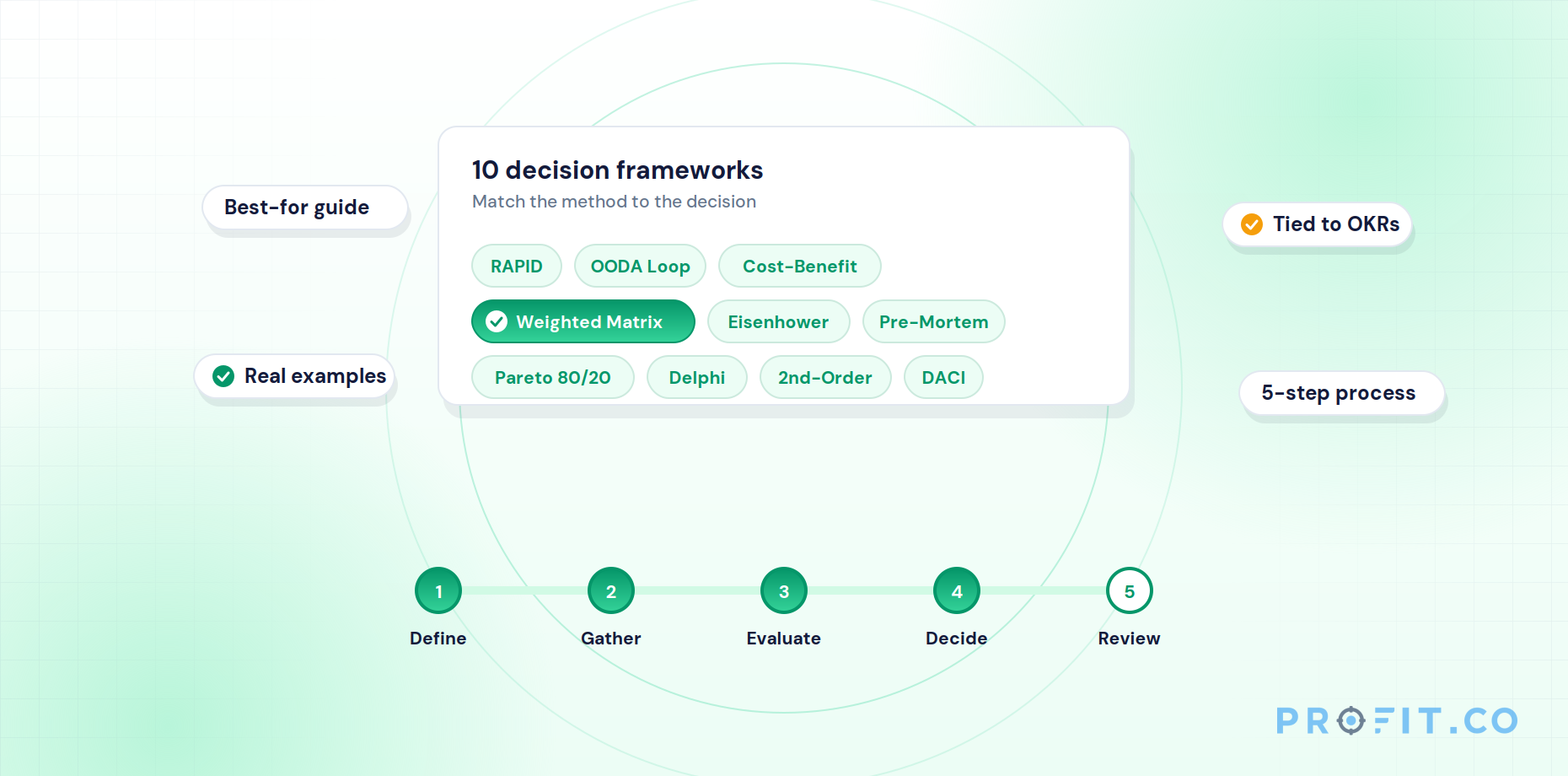
Business decision-making strategies are structured frameworks that guide how leaders evaluate options, weigh trade-offs, and commit to a course of action under uncertainty – replacing gut-feel choices with a repeatable, defensible process that produces faster alignment and fewer reversals.
In this guide
- Why Do Most Business Decisions Fail Before They’re Made?
- What Is a Decision-Making Strategy – and Why Does It Matter?
- 10 Business Decision-Making Strategies and Techniques That Work
- Which Framework Should You Use? The Complete Decision Guide
- How to Run the Business Decision-Making Process Step by Step
- Where Decision-Making Breaks Down in Practice
- What the Right Platform Does to Decision Quality
- Key Decision-Making Best Practices
- Frequently Asked Questions
TL;DR – The most common business decision failure is not a bad option chosen – it is no structured process applied. Teams that use named frameworks (RAPID, OODA, weighted matrix) make decisions 40–60% faster and reverse them significantly less often. The right framework is not the most sophisticated one; it is the one that matches the decision type and the number of stakeholders involved.
Why Do Most Business Decisions Fail Before They’re Made?
Most leaders assume decisions fail because the wrong option was chosen. The wrong option is rarely the problem. The problem is that the selection process was never defined – and without structure, the sheer volume of choices leads directly to decision fatigue, eroding judgment long before the final call is made.
When a decision process is absent, three patterns repeat across organisations of every size:
1. Criteria are set after options are evaluated
Teams discuss options, form preferences, then construct evaluation criteria to justify the preferred choice. The decision looks rational. The reasoning is reverse-engineered.
2. The wrong people are in the room
Too many approvers slow decisions to the speed of the most risk-averse person. Too few leave key knowledge out of the evaluation. Most organisations have never mapped who needs a vote versus who needs to be consulted versus who simply needs to know the outcome.
3. No review date is set
Decisions without a review date become permanent by default. Teams cannot learn from decisions they never return to – and cannot course-correct when the original conditions change.
A decision without defined criteria is not a decision – it is a preference with documentation.
What Is a Decision-Making Strategy – and Why Does It Matter?
A decision-making strategy is a repeatable method for moving from a problem statement to a committed course of action. It differs from intuition-based decision-making in three structural ways: criteria are defined before any option is evaluated, the process is consistent across decisions, and the reasoning is documented and auditable.
| Dimension | Intuition-Based | Strategy-Based |
|---|---|---|
| Criteria | Emerge after options are discussed | Defined before any option is evaluated |
| Process | Varies with each decision-maker | Consistent and repeatable across the organisation |
| Documentation | Verbal, often lost | Written, auditable, and learnable |
| Speed | Fast initially, slow when challenged | Slower setup, significantly faster execution |
| Reversal rate | High – decisions relitigated when outcomes shift | Low – reasoning is visible and revisitable |
| OKR connection | Ad hoc – options evaluated in isolation | Structured – filtered against active strategic priorities |
Organisations that apply consistent decision-making strategies spend less time relitigating decisions and more time executing them – because the how of a decision is as transparent as the what. For a deeper look at the techniques that high-performing teams use, see 10 proven decision-making practices and techniques.
10 Business Decision-Making Strategies and Techniques That Work
The RAPID Framework
Best for: High-stakes, cross-functional decisions with multiple stakeholders.
RAPID assigns five explicit roles to every major decision – eliminating the most common cause of slow decisions: ambiguity about who actually has the final call.
| Role | Stands For | Responsibility |
|---|---|---|
| R | Recommend | Proposes the course of action |
| A | Agree | Must sign off before recommendation proceeds |
| P | Perform | Executes once the decision is made |
| I | Input | Provides data or expertise consulted |
| D | Decide | Makes the final call – one person only |
Real example: Meridian Software, evaluating a new market entry, assigns Recommend to the VP of Sales, Agree to Finance, Input to Product and Customer Success, and Decide to the CEO. The decision moves from kickoff to commitment in three days – not three weeks – because every role is defined from the start.
The OODA Loop
Best for: Competitive response, crisis management, fast-cycle product decisions.
Developed by military strategist John Boyd, the OODA Loop – Observe, Orient, Decide, Act – is built for environments where conditions change between decision cycles.
- Observe – Collect current signals: market data, competitor moves, customer feedback.
- Orient – Filter data through context: prior experience, mental models, strategic priorities.
- Decide – Select the best option based on orientation, not raw data alone.
- Act – Execute immediately, then loop back to Observe.
Real example: Apex Digital’s product team, tracking a competitor’s price drop, uses OODA to observe early churn signals, orient around their customer segment and pricing model, decide on a targeted retention offer, and act within 48 hours – before the competitor’s campaign completes its first cycle.
Cost-Benefit Analysis
Best for: Resource allocation, vendor selection, build-vs-buy decisions.
Cost-benefit analysis quantifies the expected value of each option against its total cost – including opportunity cost – and selects the highest net benefit, not the lowest price. For project investment decisions, benefits realization tracking extends this logic across the full delivery lifecycle – ensuring estimated value is actually captured after the decision is made.
Real example: Clearfield Group’s HR team compares two performance platforms: Platform A costs $80,000/year but reduces voluntary attrition by 1.5% ($180,000 value) and saves 400 hours of reporting ($60,000 value). Net benefit: $160,000. Platform B costs $50,000 but delivers only $90,000 in benefits. Platform A wins on value, not price.
The Weighted Decision Matrix
Best for: Multi-option, multi-criteria decisions with a defined evaluation team.
A weighted matrix scores each option against predefined criteria, each weighted by importance. The highest weighted total wins – removing recency bias and HiPPO effect from group decisions.
| Criteria | Weight | Option A | Weighted A | Option B | Weighted B |
|---|---|---|---|---|---|
| Implementation speed | 30% | 8 | 2.40 | 5 | 1.50 |
| Integration capability | 25% | 7 | 1.75 | 9 | 2.25 |
| Total cost of ownership | 25% | 6 | 1.50 | 8 | 2.00 |
| Vendor support quality | 20% | 9 | 1.80 | 6 | 1.20 |
| Total | 100% | 7.45 ✓ | 6.95 |
Real example: Vantage Logistics’ procurement team evaluates five vendors. Despite one scoring highest on price alone, the weighted matrix reveals a superior choice – because the team pre-agreed that implementation speed and support quality matter most, based on past project failures.
The Eisenhower Matrix
Best for: High-volume decision triage, leadership workload prioritisation.
The Eisenhower Matrix categorises decisions by urgency and importance – and prescribes a different action for each quadrant. For teams using OKRs, the matrix pairs naturally with how to prioritize OKRs each quarter – so urgent-but-unimportant decisions never crowd out Key Result work.
| 🔴 Urgent | ⚪ Not Urgent | |
|---|---|---|
| ⬆ Important | ① Do Now Customer escalation, compliance deadline, production outage |
② Schedule Strategic planning, process improvement, talent development |
| ⬇ Not Important | ③ Delegate Routine approvals, status check-ins, administrative requests |
④ Eliminate Low-value reports, redundant meetings, decisions that answer themselves |
Real example: Stratos Engineering’s VP of Engineering, facing 40 open decision items, applies the matrix and identifies 22 as Q3 (delegatable) and 8 as Q4 (eliminatable). That leaves 10 decisions requiring direct attention – reducing cognitive load by 75% in a single session.
Pre-Mortem Analysis
Best for: Irreversible decisions, product launches, strategic pivots.
A pre-mortem runs before a decision is finalised. The team imagines the decision has already been made and failed – then works backward to identify what caused the failure. It surfaces the risks that optimism bias suppresses.
- Present the proposed decision and plan to the group.
- Ask everyone to individually write every way the decision could fail within 12 months.
- Compile and group scenarios by risk type.
- Assess which risks are mitigable before committing.
- Revise the plan – or proceed with documented risk owners assigned.
Real example: Before launching a new pricing tier, Limebrook’s leadership pre-mortem surfaces three failure modes no one had raised in open discussion: channel conflict with existing resellers, a 90-day activation lag in onboarding, and a support volume spike. All three are addressed in the go-to-market plan before launch day.
Pareto Analysis (The 80/20 Rule)
Best for: Problem prioritisation, process improvement, resource allocation.
Pareto Analysis applies the 80/20 principle: 80% of outcomes typically come from 20% of causes. Rather than solving every contributing factor equally, it directs decision effort toward the critical few variables that drive most of the result.
- List all contributing factors to the problem.
- Quantify the impact of each (frequency, cost, revenue contribution).
- Rank from highest to lowest impact.
- Focus resources on the top 20% of factors accounting for 80% of the outcome.
Real example: Keystone Partners’ customer success team finds 78% of lost revenue in two quarters came from accounts that had not completed onboarding within 30 days. Rather than launching a five-part retention programme, they prioritise one intervention: a 30-day onboarding completion mandate with dedicated CS coverage.
The Delphi Method
Best for: Long-range strategy, new market entry, technology forecasting.
The Delphi Method is a structured expert-consensus process: a facilitator collects anonymous input from a panel across multiple rounds, sharing aggregated results between rounds until convergence emerges. It eliminates groupthink and authority bias that distort in-room discussions.
- Assemble 6–12 subject matter experts.
- Circulate a structured questionnaire – anonymously (Round 1).
- Compile and share responses back to the panel without attribution.
- Experts revise their views in light of the group’s input (Round 2).
- Repeat until consensus emerges or a defined agreement threshold is reached.
Real example: Harrow & Associates, evaluating two new geographic markets, uses the Delphi Method with eight regional leads and three external advisors. After three rounds, the panel converges on the stronger market – a more defensible and less biased outcome than a single leadership offsite could produce.
Second-Order Thinking
Best for: People decisions, pricing changes, policy shifts with external market effects.
Second-order thinking asks “and then what?” before committing. First-order thinking evaluates the immediate effect. Second-order thinking maps the downstream chain of consequences – including how customers, employees, and competitors will react to your decision.
| Thinking Order | Question |
|---|---|
| First-order | What is the immediate effect of this decision? |
| Second-order | What happens next, as a result of that effect? |
| Third-order | What happens after that – especially if others react? |
Real example: Crestview Corp cuts the bottom 10% of its sales team (first-order: reduced payroll). Second-order: remaining salespeople see the cuts and morale drops – three top performers start interviewing. Third-order: key account relationships are disrupted, Q3 revenue misses plan. Second-order thinking before the decision leads to a performance improvement plan instead – same cost target, no talent risk.
The DACI Framework
Best for: Product roadmap decisions, cross-functional projects, any decision with more than three stakeholders.
DACI – Driver, Approver, Contributor, Informed – clarifies who moves a decision forward, who can block it, who provides input, and who simply receives the outcome. It is RAPID’s close cousin, optimised for product and project environments. For teams adopting AI into their workflows, see how AI agents fit into RACI-style decision governance.
| Role | Responsibility | Typical Count |
|---|---|---|
| Driver | Owns the decision process; drives to completion | 1 person only |
| Approver | Has final approval authority – can block | 1–2 people |
| Contributor | Provides input, expertise, or analysis | 3–8 people |
| Informed | Notified of outcome; not involved in making it | Unlimited |
Real example: Northfield’s product team, deciding which features to cut, uses DACI: the Product Manager is the Driver, VP of Product is the Approver, Engineering Leads and Customer Success are Contributors, and Sales is Informed. The decision moves from kickoff to approval in four working days – because there is no ambiguity about who gets a vote.
Which Framework Should You Use? The Complete Decision Guide
| Decision Type | Recommended Framework | Why It Fits |
|---|---|---|
| High-stakes, cross-functional | RAPID or DACI | Assigns ownership explicitly – prevents stall |
| Fast-moving, competitive | OODA Loop | Built for speed and continuous iteration |
| Resource or budget allocation | Cost-Benefit Analysis | Quantifies trade-offs objectively |
| Multi-option, multi-criteria | Weighted Decision Matrix | Removes bias from group evaluation |
| High volume of daily decisions | Eisenhower Matrix | Triages by urgency and importance |
| Strategic initiative with risk | Pre-Mortem Analysis | Surfaces failure modes before commitment |
| Cause-and-effect unclear | Pareto Analysis | Identifies the 20% driving 80% of outcomes |
| Expert consensus across teams | Delphi Method | Eliminates authority bias and groupthink |
| People or policy changes | Second-Order Thinking | Forces leaders to model stakeholder reactions |
| Product or project decisions | DACI | Clarifies who decides vs. who inputs |
Applying the wrong framework to the right problem is slower than applying no framework at all. Match the method to the decision type first.
Not sure which broader methodology fits your organisation? The guide on which strategy execution framework to use compares OKRs, Balanced Scorecard, and other models so leadership teams can choose the right structural fit before selecting a specific decision-making technique.
Align Every Decision to Your Strategy with Profit.co
How to Run the Business Decision-Making Process Step by Step
Regardless of which framework you apply, all effective business decisions follow the same five-step process:
Define the Decision
State precisely what is being decided, who owns the outcome, and when it must be reached. Vague problem statements produce vague decisions. “We need to grow revenue” is not a decision. “Should we enter the enterprise segment in Q3 or defer to Q1?” is. This is exactly the discipline that structured OKR planning instils – defining the what and the why before evaluating the how.
Gather Information
Identify what data is available, what is missing, and what level of certainty is sufficient to proceed. Perfect information is never available – the question is whether the information gap is acceptable given the cost of delay.
Identify All Options
List every viable alternative, including doing nothing. Decisions made without a genuine alternative evaluated are not decisions – they are announcements dressed as analysis.
Apply the Right Framework
Select from the 10 strategies above based on decision type, stake level, and stakeholder count. A $500 vendor choice does not need a Delphi Method. A market entry decision does not need an Eisenhower Matrix. Calibrate the framework to the decision.
Decide, Document, and Set a Review Date
Record the decision, the criteria applied, the options considered, and the expected outcome. Set the review date before moving to execution. Decisions without review dates become unlearnable history. Weekly OKR check-ins are the proven cadence for keeping decisions visible and owners accountable throughout the quarter.
Where Decision-Making Breaks Down in Practice
Too many approvers, no single decision owner
Every added approver increases decision time exponentially. A decision with one approver takes days. A decision with five approvers takes weeks – and the version that emerges is the one that offended nobody, not the one that moved the strategy. Limit approvers to one or two. Everyone else is a Contributor or Informed. For larger organisations, see how enterprise governance frameworks fail at scale – and what separates the ones that don’t.
Urgency mistaken for importance
The Eisenhower Matrix exists precisely because urgent decisions feel important. Most urgent decisions are Q3 or Q4 on inspection – delegatable or eliminatable. Leaders who cannot separate urgency from importance spend their decision capacity on other people’s priorities.
No documentation, no learning
An undocumented decision gets relitigated the moment the person who made it leaves the room. A one-paragraph decision record – problem, options considered, criteria applied, expected outcome – prevents weeks of future debate and feeds the institutional memory that improves decision quality over time.
The most expensive decision is the one made correctly, forgotten completely, and repeated at full cost six months later.
What the Right Platform Does to Decision Quality
Most organisations separate the tools they use for strategy (OKR platforms), decision tracking (spreadsheets or wikis), and execution (project management software). The separation is the problem. When strategic priorities live in one system and operational decisions live in another, decisions are made without a real filter – and the portfolio fills with work that moves metrics but not strategy. OKR dashboards that surface real-time progress close this gap – they replace the weekly export with a live decision filter every leader can act on.
| Capability | What It Prevents |
|---|---|
| Strategy or OKR integration | Decisions evaluated in isolation from live quarterly priorities |
| Real-time portfolio view | Trade-offs made against stale budget data rather than actual capacity |
| AI-assisted prioritisation | Blockers identified only at quarter-end reviews – too late to act |
| Performance data in the same system | People decisions based on recency bias rather than documented evidence |
| Integration with delivery tools | Decision-relevant data that is two weeks old before it reaches the decision-maker |
A decision support system that requires manual data exports before a decision is made is not a support system – it is a documentation tool with extra steps.
Make Strategy-Aligned Decisions with Profit.co
OKRs, project portfolios, and performance data in one platform
- →
OKRs as the decision filter – every initiative and trade-off evaluated against active Key Results, not last quarter’s slide deck.
- →
AI-assisted prioritisation – AI agents surface which decisions are blocking Key Result progress in real time, before the quarter-end review reveals the gap.
- →
Project portfolio alignment – decisions about which projects to fund, pause, or cancel made against a live portfolio view, not a static budget spreadsheet.
- →
Performance data in the same system – people decisions grounded in actual performance review data and development plans, not recency bias. Learn how OKRs and performance reviews work together to make people decisions defensible, not intuitive.
- →
100+ integrations including Jira, Salesforce, Slack, and Workday – so the data that informs decisions is current, not exported.
Key Decision-Making Best Practices
Key Decision-Making Best Practices
- ✓
Define the decision – and the decision owner – before any options are discussed.
- ✓
Set evaluation criteria before evaluating options, not after preferences form.
- ✓
Match the framework to the decision type: RAPID/DACI for multi-stakeholder, OODA for speed, Pre-Mortem for high risk.
- ✓
Limit approvers to one or two. Every additional approver adds time, not quality.
- ✓
Document every significant decision: problem, options, criteria, expected outcome.
- ✓
Set a review date at the same time as the decision. Decisions without review dates cannot be learned from.
- ✓
Filter every strategic decision through active OKRs – if it does not move a Key Result, it should not move to the top of the list. See the full guide on how to implement a strategy with OKRs for the complete cascade model.
Turn Better Decision-Making Into a Repeatable Quarterly Habit
Frequently Asked Questions
There is no single best strategy – effectiveness depends on the decision type. RAPID and DACI work best for multi-stakeholder decisions. Cost-benefit analysis suits resource allocation. The OODA Loop is built for fast-moving competitive decisions. Matching the framework to the decision type produces better outcomes than applying one method to every situation.
A decision-making process is the sequence of steps taken to reach a decision: define, gather, evaluate, commit, and review. A decision-making strategy is the specific framework applied at the evaluation step. The process provides the structure; the strategy provides the logic for choosing between options.
OKRs make strategic priorities explicit and measurable, giving every decision a filter. When a choice arises, teams evaluate options against active Key Results – eliminating initiatives that don’t advance strategy and fast-tracking those that do. This reduces time spent debating strategic fit and anchors decisions in agreed outcomes rather than in-room influence. Read more on OKRs for goal-setting and ensuring outcomes.
Second-order thinking is the practice of asking “and then what?” after evaluating the immediate effect of a decision. It maps the downstream chain of consequences – including how employees, customers, and competitors are likely to react. It is most valuable for people decisions, pricing changes, and strategic pivots where the first-order effect looks positive but the second-order effects are costly. The 2×2 performance matrix is a complementary tool for evaluating effort vs. result before and after strategic decisions.
Two to three frameworks, selected and agreed as standard for specific decision types, is the right number for most organisations. Establishing a decision playbook – mapping framework to decision type – builds the consistent infrastructure that improves decision speed and quality over time without creating its own complexity.
The most widely used decision-making techniques are cost-benefit analysis (for resource allocation), the weighted decision matrix (for multi-option comparisons), the Eisenhower Matrix (for prioritising high-volume decisions), RAPID (for assigning ownership in cross-functional decisions), and pre-mortem analysis (for stress-testing high-stakes commitments before they are made).
RAPID is a decision-making model developed by Bain & Company that assigns five explicit roles: Recommend (proposes the option), Agree (must sign off), Perform (executes the outcome), Input (provides data and expertise), and Decide (makes the final call – one person only). It is most effective for cross-functional decisions where role ambiguity causes delays and reversals.


