Your vibe-coded app is not a vendor’s competition. It is your specification.
In this guide
- Requirements Documents Are Educated Guesses
- Your Prototype Has Already Proved Demand
- Usage Shows What Actually Matters
- Workarounds and Requests Reveal the Gaps
- It Shows How Your Organization Really Works
- How to Turn a Prototype Into a Specification
- Make Vendors Demonstrate Your Reality
- The Builders Become Your Best Experts
- Frequently Asked Questions
Key Takeaways
- →A requirements document is speculation by construction. It is written before anyone has used anything, and it describes the process as it is supposed to work.
- →Adoption nobody mandated is stronger evidence than any business case. The question shifts from whether you need this to how to support what people already rely on.
- →The requests the builders declined as too difficult are the clearest map of where an internal build reaches its limits.
- →Every organization has an official strategy process and a real one. The prototype’s data captures the real one.
- →Make vendors demonstrate your workflows with data resembling your own, not their preferred script. It shows who can improve on what you built rather than replicate it.
Requirements Documents Are Educated Guesses
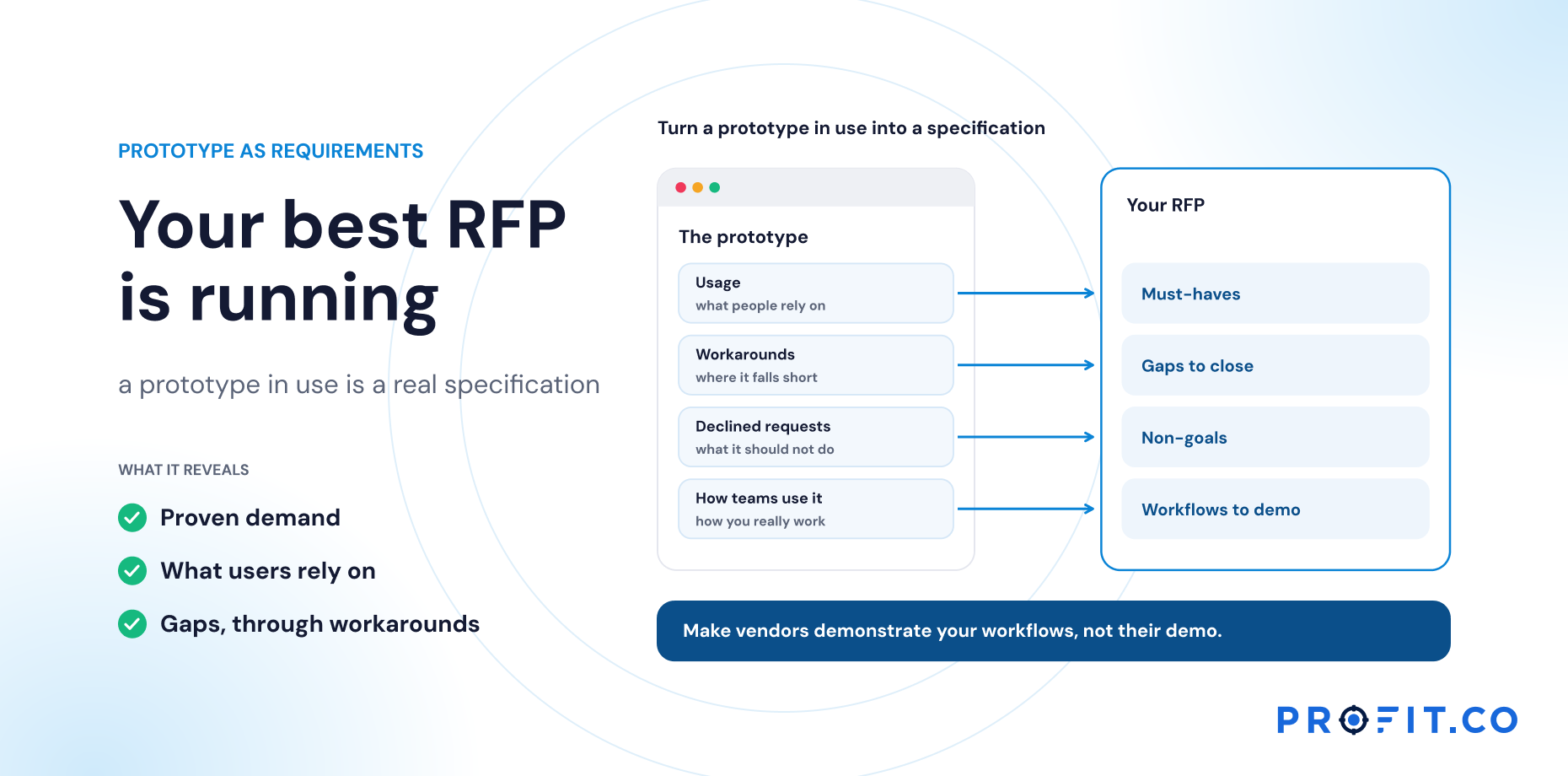
A requirements document lists capabilities stakeholders imagine they will need, written before anyone has used anything. A prototype with real users supplies the same list from evidence: what gets used weekly, what was ignored, what people asked for, and how the process actually runs.
Most software buying begins with a requirements document. A project team gathers stakeholders, lists the capabilities they think they need, weights them, and sends the result to vendors. The process is thorough and familiar, and it shares a weakness: it is mostly speculation. People describe what they imagine they will need, without having used anything.
An organization that has already built and used a vibe-coded strategy app is in a very different position. It does not need to imagine. It knows. Its prototype is not a competitor to a vendor’s platform. It is the most accurate specification the organization could have written.
When stakeholders write requirements before using a system, they rely on memory, assumption, and aspiration. They include features that sound important but will rarely be used. They miss needs that only become obvious in daily use. They describe the process as it is supposed to work rather than as it actually works.
Vendors, in turn, respond to the document rather than to the organization’s real needs. Evaluations become exercises in checking boxes, and organizations sometimes choose platforms that score well on paper but fit poorly in practice.
None of this is a failure of effort. Requirements processes are often run carefully by capable people. The problem is structural: it is very hard to know what you will need from a system before you have used one, and harder still to agree it across many stakeholders with different priorities.
Your Prototype Has Already Proved Demand
The first thing a successful prototype proves is that the need is real. When hundreds of people choose to use a tool that nobody required them to adopt, the organization has strong evidence that structured strategy execution has value for it.
That evidence matters when making the case for investment. Instead of asking leaders to fund a platform on the strength of a business case, the project team can point to actual adoption. The question shifts from whether the organization needs this to how it should support something people already rely on.
Usage Shows What Actually Matters
A prototype that has been in use for months contains valuable information about behavior. Which features do people use every week? Which have been ignored since launch? Where do users spend their time, and where do they give up? Which reports do leaders actually open before reviews?
This is information no requirements workshop can produce. It lets an organization separate the capabilities that matter from those that merely sounded important, and evaluate vendors on what will be used rather than on everything that could be.
What Each One Can Actually Tell You
| What you need to know | A requirements document gives you | A prototype in use gives you |
|---|---|---|
| Whether the need is real | A business case and stakeholder assertion | Hundreds of people using something nobody made them adopt |
| Which features matter | A weighted list of what sounded important | Weekly usage, and what has been ignored since launch |
| Where people struggle | Assumptions about the process | Where users spend their time, and where they give up |
| What is missing | Nothing. You cannot miss what you have never needed yet | The request backlog, the complaints, the spreadsheets kept alongside |
| Which gaps are hardest | Not visible at all | The requests the builders declined or postponed as too difficult |
| How the process really runs | The official version, from policy documents | Real cadences, real structures, real participation |
| What leaders actually read | A list of desired reports | Which reports get opened before a review |
The fifth row is the one worth dwelling on. A requirements document cannot record the things that were tried and abandoned, because nothing was ever tried.
Workarounds and Requests Reveal the Gaps
Just as revealing is what users have asked for and not received. The backlog of feature requests, the complaints sent to the builders, and the spreadsheets people maintain alongside the app all point to needs the prototype does not meet.
Often these gaps are exactly the capabilities a specialist platform provides: permissions for confidential goals, history and audit trails, connections to other systems, support for different methods in different teams, better reporting for leadership. The prototype has, in effect, written a list of what the next system must do better. Those first items are the requirements nobody prompts for, and the method question is a foundation decision rather than a feature.
Pay particular attention to the requests the builders declined or postponed because they were too difficult. These are often the clearest signals of where an internal build reaches its limits, and the clearest tests of what a platform needs to deliver.
It Shows How Your Organization Really Works
Every organization has an official version of its strategy process and a real one. The official version appears in policy documents. The real one shows up in how people actually set goals, how often they update them, who reviews what, and where the process breaks down.
A prototype captures the real version. Its data shows actual cadences, actual structures, and actual participation. That is invaluable when configuring a new platform, because it lets the organization design around how people behave rather than how a process document says they should.
Bring Your Prototype to the Conversation
How to Turn a Prototype Into a Specification
To use a prototype well, document it deliberately.
- List the capabilities it offers, and how heavily each one is actually used.
- Map its data: what it stores about goals, measures, people, and history.
- Note the integrations it has, and the ones users have asked for.
- Collect the open requests and the recurring complaints.
Then add what the prototype lacks but the organization now needs as it grows: identity and access management, audit history, compliance across regions, method flexibility, reliability, and a funded roadmap. The result is a specification grounded in experience, with clear priorities, which is far stronger than a list of guesses.
Make Vendors Demonstrate Your Reality
A grounded specification changes how vendor demonstrations work. Instead of letting each vendor show its preferred script, ask them to show your workflows: your goal structures, your review cadence, your reporting needs, using data that resembles your own.
This quickly reveals which platforms fit and which only look good in general. It also shows which vendors understand the problem deeply enough to improve on what you built, rather than simply replicate it. The final article in this series sets out how to run that evaluation step by step.
Profit.co builds onboarding around that kind of evidence. Setup covers the platform, integration configuration and a governance framework review with a Profit.co specialist, so your prototype’s real cadences and structures shape the configuration from the first week. Most teams are running within two to four weeks.
The Builders Become Your Best Experts
The people who built the prototype are the organization’s most knowledgeable participants in a platform decision. They understand what users value, where the difficulties lie, and what the data looks like. Involving them closely in the evaluation improves the decision and respects the work they have done.
Their skills also remain valuable after the decision. With a platform carrying the core system, they can turn their talent toward the edges: building the team-specific tools, automations, and integrations that make the platform fit the organization precisely. Their prototype becomes the starting point, not a wasted effort.
An organization that has built a successful strategy app has done something many buyers never do: tested its assumptions against reality. That knowledge should not be thrown away in a platform decision. It should drive it. The prototype’s real value was never as permanent infrastructure. It was as the most honest requirements document the organization will ever write.
With that specification in hand, the choice between building and buying starts to look like a false one. The next article explains why.
Make Us Demonstrate Your Workflows, Not Ours
Frequently Asked Questions
Because they are written before anyone has used a system. Stakeholders rely on memory, assumption and aspiration, so they include features that sound important but go unused, miss needs that only appear in daily use, and describe the process as it is supposed to work.
It replaces speculation with evidence: which features are used weekly, which were ignored, where users give up, which reports leaders open, and what has been asked for and not delivered. That lets you evaluate on what will be used rather than on everything that could be.
The capabilities the prototype offers and how heavily each is used, its data model for goals, measures, people and history, the integrations it has and those requested, and the open requests and recurring complaints. Then add what it lacks: identity, audit history, compliance, method flexibility and a funded roadmap.
The ones the builders declined or postponed because they were too difficult. Those mark where an internal build reaches its limits, and they are the sharpest tests to put to a platform. Permissions, audit history, integrations and multi-method support usually appear on that list.
Do not let vendors run their preferred script. Ask them to show your goal structures, your review cadence and your reporting needs, using data resembling your own. It reveals which platforms genuinely fit, and which vendors understand the problem well enough to improve on what you built.
They become your most knowledgeable participants in the decision, because they know what users value and what the data looks like. Afterward, with a platform carrying the core, their skills move to the edges: team-specific tools, automations and integrations.