Let the platform carry the weight. Let your builders add the speed.
In this guide
Key Takeaways
- →The binary made sense when building was slow. Open platforms and cheap extension work have opened a middle ground that did not previously exist.
- →Edge tools inherit permissions, history and compliance from the core. That inheritance is exactly what makes them safe to build quickly.
- →The test is failure. If it breaking would stop the strategy process, it is core. If it would inconvenience one team, it is edge.
- →Openness should be weighed as heavily as features. A closed platform forces every unmet need back into a request to the vendor.
- →If an edge tool starts to look like a core capability, that is the signal to ask the vendor to build it in, not to grow it yourself.
The False Binary
The hybrid model splits a strategy system in two. The core holds the system of record, permissions, audit history and compliance, and is bought from a specialist. The edge holds dashboards, reports, automations and team-specific agents, and is built quickly with AI assistance.
The make-versus-buy decision has traditionally been presented as a choice between two paths. Build, and gain control at the cost of ownership. Buy, and gain capability at the cost of flexibility. Each organization picks one and lives with the trade-offs.
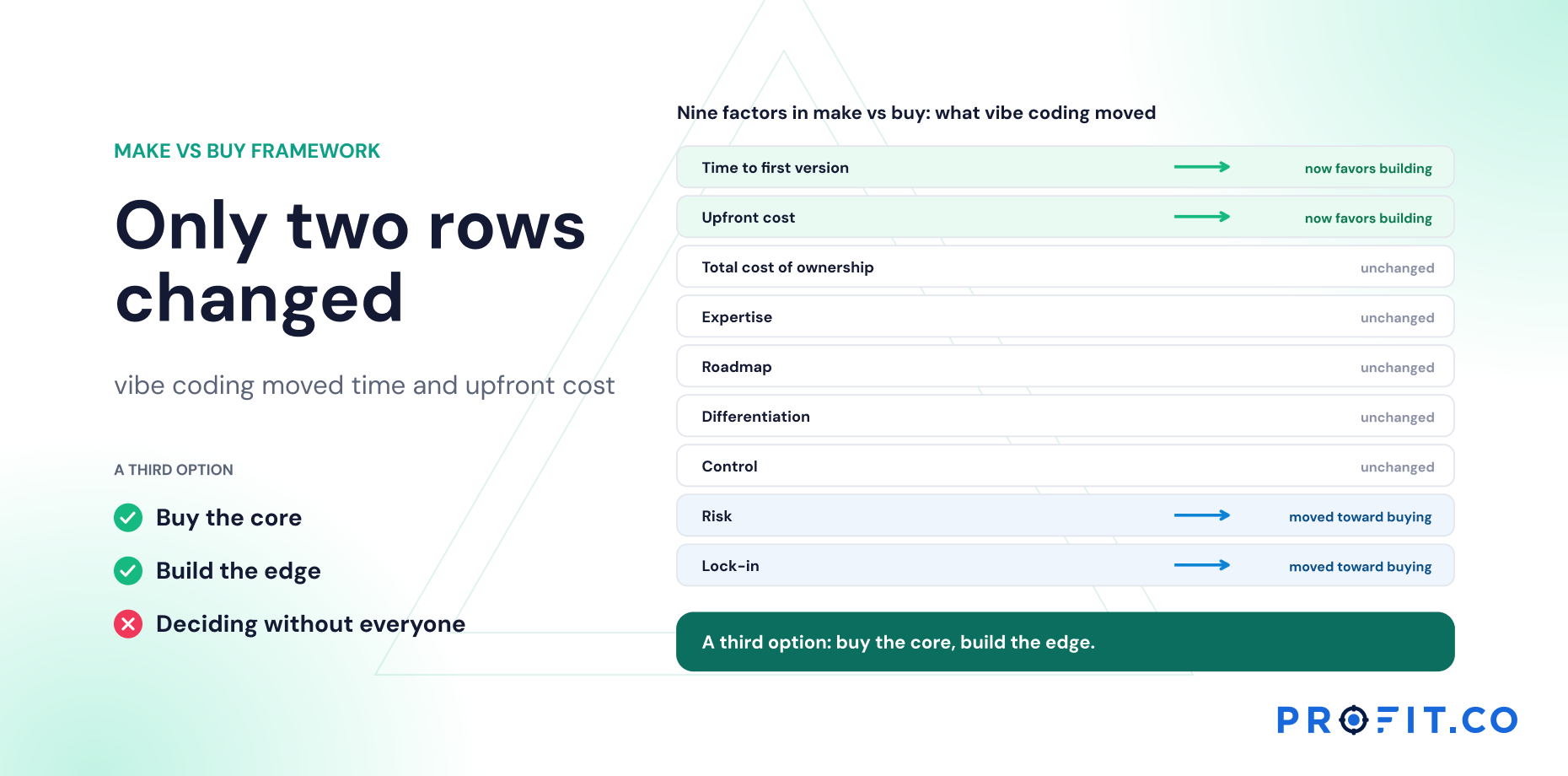
AI-assisted development makes that framing outdated. When software can be built quickly around an established platform, organizations no longer have to choose between control and capability. They can buy a strong core and build exactly what they need around it. That combination is not a compromise. For most organizations, it is better than either path on its own.
The binary made sense when building was slow and expensive. If an organization bought a platform, customizing it meant waiting for the vendor or paying for expensive services. If it built, it carried every cost of ownership. There was little middle ground.
Two developments have opened that middle ground. Specialist platforms have become more open, with interfaces that let customers read and write data, react to events, and connect AI tools. And vibe coding has made building small extensions fast and cheap. Together, they make a hybrid model practical in a way it was not before.
What Belongs in the Core
The core is everything that carries long-term ownership costs and risks, which is exactly what this series has examined. It includes the system of record for goals, measures, and progress. It includes the data model that supports different strategy methods and preserves history. It includes identity, permissions, audit trails, compliance across regions, reliability, security, and governance of AI features.
These are the capabilities that are hardest to build well, most dangerous to get wrong, and most expensive to maintain. They are also the capabilities a specialist vendor has refined across hundreds of customers. They belong with the specialist.
Keeping these capabilities in one well-governed place also simplifies everything built around them. Edge tools do not need their own permission models, their own history, or their own compliance arrangements. They inherit those from the core, which is precisely what makes them safe to build quickly.
What Belongs at the Edge
The edge is everything that makes the platform fit a particular organization, team, or moment. A dashboard designed for one leadership team’s review format. A report that combines strategy data with figures from an internal system. An automation that posts progress updates into the team’s chat channel. A small tool that helps one department prepare for its quarterly planning.
Increasingly, the edge also includes AI agents that work with strategy data on behalf of specific teams: drafting goals in the house style, summarizing progress for a weekly meeting, or flagging initiatives that need attention. These are valuable, specific, and well suited to rapid building.
How to Tell Core From Edge
| Dimension | Core | Edge |
|---|---|---|
| Size and scope | Large, shared by the whole organization | Small, one team or one purpose |
| Who it serves | Everyone, across functions and regions | A specific team, format or moment |
| Where its data lives | It is the system of record | It reads from and writes to the core |
| Security and permissions | Defines them | Inherits them |
| History and audit | Keeps them | Does not need its own |
| Compliance | Carries the obligation | Covered by the core |
| If it breaks | The strategy process stops | The core and its data are untouched |
| If it is no longer needed | A migration | Retire it, with no disruption |
| Who should own it | A specialist vendor | Your own builders |
The test is the two rows about failure. If something breaking would stop the strategy process, it is core and belongs with a specialist. If it would be an inconvenience for one team, it is edge and your builders should own it.
Why the Edge Suits Vibe Coding
Edge tools have properties that make vibe coding a good fit. They are small, so they are quick to build and easy to understand. They are specific to one team or purpose, so their requirements are clear. And they rely on the core platform for data, security, and history, so the hardest problems are already solved.
Most of all, the consequences of failure are limited. If an edge tool breaks, the system of record is untouched and people can continue working in the platform. If it is no longer needed, it can be retired without migration or disruption. The ownership costs that make building a core system risky barely apply.
This is the same case the previous discussion of when to vibe code makes from the other direction: small blast radius is what makes fast building safe.
See a Core Built to Be Extended
The Core Must Be Open
This model only works if the platform at the core is genuinely open. That means well-documented interfaces for reading and writing data, notifications when things change, support for connecting AI tools through standards such as the Model Context Protocol, and reliable data export.
When evaluating platforms, openness should be weighed as heavily as features. A closed platform forces every unmet need back into a request to the vendor. An open one lets the organization meet many of those needs itself, quickly, without compromising the core.
Openness also protects the organization’s future choices. A platform that makes data easy to access and export is easier to extend, easier to integrate, and, if it ever comes to it, easier to leave. Vendors that are confident in their value tend to be open, because they expect customers to stay for the right reasons.
This is testable rather than rhetorical. Profit.co publishes its integrations and ships Profit.co MCP, an implementation of the Model Context Protocol, which is exactly the kind of connection an edge-building team needs. Ask any platform on your shortlist to show the equivalent.
One MCP connection gives ChatGPT, Claude, Cursor or any other MCP-compatible tool access to the Profit.co workspace, using Profit.co’s own authentication and access control. Each person sees only the data they are authorized to see, the data stays in Profit.co’s infrastructure, and an edge tool built this way inherits those rules instead of reinventing them.
Govern the Edge Lightly but Deliberately
Edge tools still need some discipline, though far less than a core system. Each should use the platform’s permissions rather than bypassing them, so that people only see what they are allowed to see. Each should have a named owner and a clear purpose. And the organization should keep a simple register of the edge tools in use.
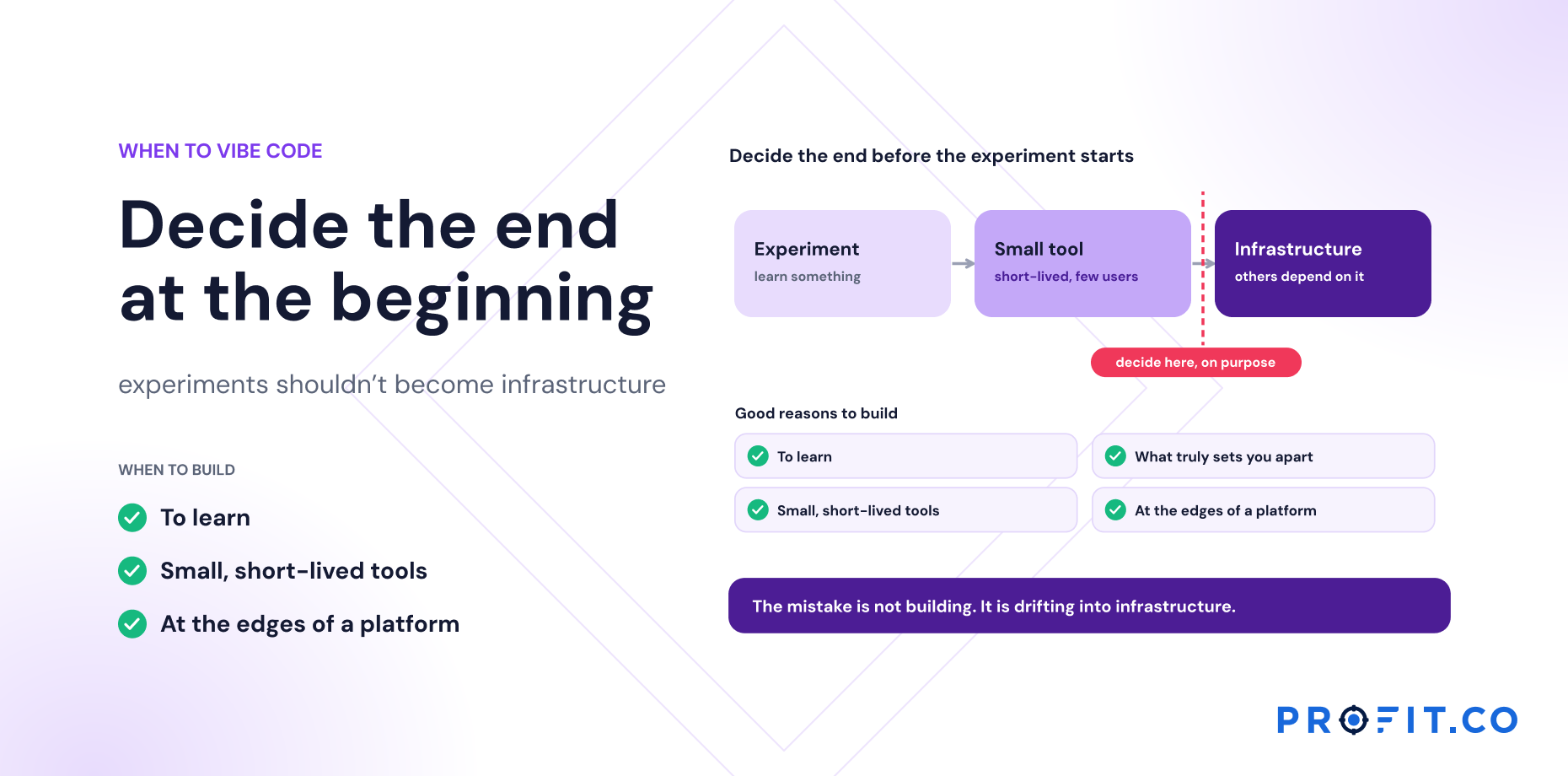
The principle from the previous articles applies here too: decide what happens if an edge tool becomes widely used. If it starts to look like a core capability, that may be a sign to ask the vendor to build it into the platform, where it can be maintained properly.
Your Builders Do Their Best Work
The hybrid model makes good use of the people who built the original prototype. Instead of spending their time on authentication, audit trails, compliance changes, and urgent fixes, they can focus on the work that directly improves how their organization executes strategy.
That work is more satisfying, more visible, and more valuable. It also reduces key-person risk, because edge tools are small enough that others can understand and replace them, and the critical system no longer depends on one or two individuals.
What It Looks Like in Practice
Consider an organization that replaces its vibe-coded strategy app with a specialist platform. Goals, measures, history, permissions, and compliance move to the platform. The engineers who built the original app then build a handful of edge tools: a leadership dashboard matching the board’s preferred format, an integration with the company’s internal project system, and an AI assistant that prepares each team’s quarterly review summary.
Users get a stronger core and tools that fit their needs. Leaders get reliability and defensible data. The engineers spend their time on work that matters. And the organization’s strategy process no longer depends on a prototype carrying the weight of infrastructure.
Vibe coding did not make buying obsolete, and specialist platforms did not make building unnecessary. Together, they make a better option possible than either one alone. Buy the core, so ownership sits with a specialist. Vibe-code the edge, so the platform fits your organization exactly.
That leaves one practical question for organizations that have already built something:how to choose the right platform for the core.
Buy the Core. Vibe-Code the Edge.
Frequently Asked Questions
Buy a specialist platform for the system of record, data model, permissions, audit trails, compliance and reliability. Use AI-assisted development for dashboards, reports, automations, integrations and team-specific AI agents around it. The platform carries ownership; your builders add fit and speed.
Ask what happens if it breaks. If the strategy process stops, it is core and belongs with a specialist. If one team is inconvenienced while the system of record stays untouched, it is edge and your own builders should own it.
Edge tools are small, specific and inherit data, security and history from the core, so the hardest problems are already solved. Failure is contained: the system of record is untouched, and an unneeded tool retires without migration or disruption.
Well-documented interfaces for reading and writing data, notifications when things change, support for connecting AI tools through standards such as the Model Context Protocol, and reliable data export. Weigh openness as heavily as features, because a closed platform sends every unmet need back to the vendor.
Lightly but deliberately. Each should use the platform’s permissions rather than bypassing them, have a named owner and a clear purpose, and appear on a simple register. If one becomes widely used, that is a signal to ask the vendor to build it into the platform.
They move to the edge, where the work is more visible and more valuable than authentication, audit trails and urgent fixes. It also reduces key-person risk, since edge tools are small enough for others to understand and replace.