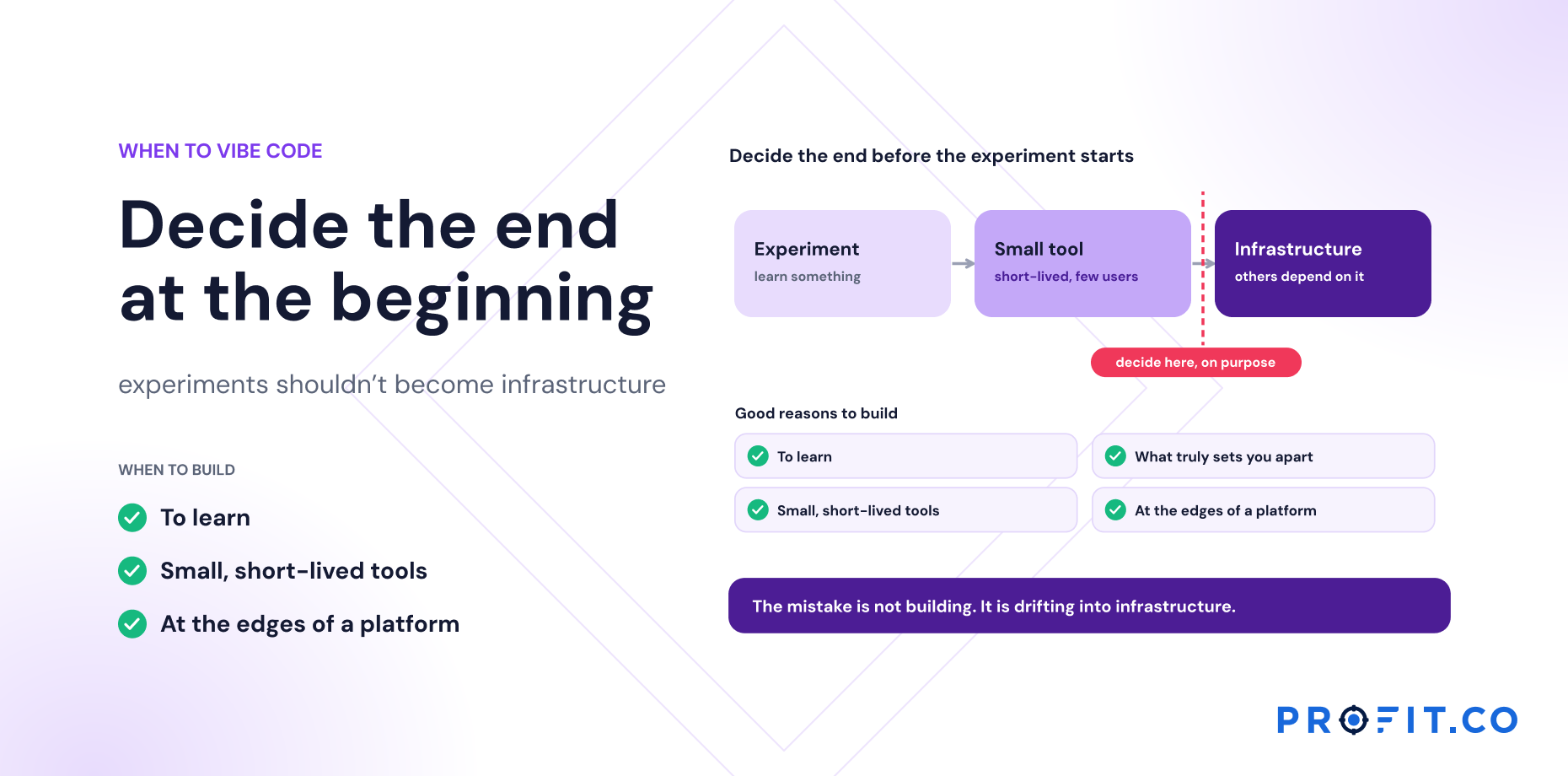
The mistake is not building. It is letting an experiment become infrastructure without deciding that it should.
In this guide
- Vibe Coding Is Genuinely Transformative
- Build to Learn
- Build When It Is Small and Short-Lived
- Build What Truly Sets You Apart
- Build at the Edges
- Watch for the Signs That a Tool Has Outgrown Its Category
- Decide the End at the Beginning
- A Simple Rule of Thumb: When to Build, When to Buy
- Frequently Asked Questions
Key Takeaways
- →Before AI tools, most small software needs simply went unmet. That change is real, and organizations that discourage it will fall behind those that channel it.
- →The strongest case for building is learning. Users react to something real rather than to a document, and requirements emerge in days instead of weeks.
- →Edge tools have small blast radiuses. If one breaks, the core system and its data are untouched; if one is unnecessary, it retires without disruption.
- →Five warning signs mean a tool has changed category: users spreading, sensitive data, decisions depending on it, requests for permissions and history, and escalating outages.
- →Decide the end at the beginning. Set a lifespan, define the conditions for retiring or funding it, and name an owner. This costs nothing and prevents most of the problem.
Vibe Coding Is Genuinely Transformative
Vibe coding fits five situations: building to learn what you need, tools that are small and short-lived, workflows that genuinely differentiate you, the edges around a specialist platform, and anything low-risk enough that failure is merely inconvenient. Everything long-lived, widely used or sensitive is better bought.
This series has spent seventeen articles on the costs and risks of building strategy software. A reader could fairly conclude that the argument is simply: never build, always buy. That would be wrong, and it would undermine everything else the series has said.
AI-assisted development is one of the most important changes in how organizations work. Used well, it lets people solve problems in days that would once have waited months for engineering time. The question is not whether to use it, but where it belongs. Being clear about that is what makes the rest of the argument credible.
Before AI coding tools, most small software needs went unmet. A team that wanted a simple tool to track a process, analyze a dataset, or automate a report had to justify it to an engineering department with other priorities. Usually, the answer was no, and the team made do with spreadsheets and manual work.
Vibe coding changes that. People with modest technical skills can now build tools that genuinely help them. Engineers can test ideas in hours. Organizations can learn by building rather than by speculating. This is a real gain in productivity and creativity, and organizations that discourage it will fall behind those that channel it well.
It also changes the relationship between business teams and engineering. Instead of waiting in a queue, people closest to a problem can prototype a solution themselves and bring something concrete to the conversation. Even when the prototype is later replaced, the organization has learned faster and argued less.
Build to Learn
The strongest case for vibe coding is learning. When an organization is unsure what it needs, building a working prototype is often the fastest way to find out. Users can react to something real rather than to a document. Requirements that would have taken weeks to agree emerge in days.
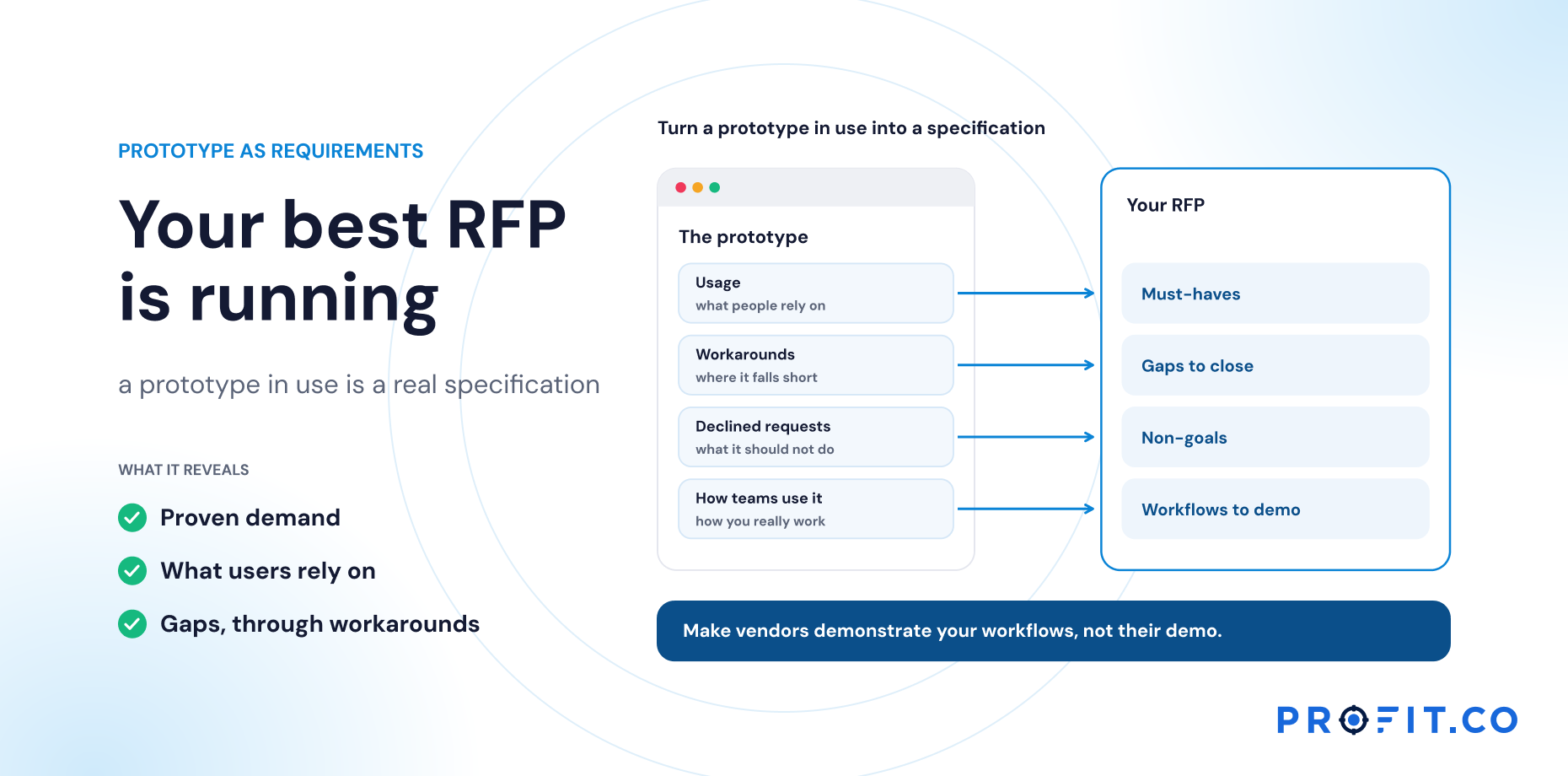
This is exactly what happened in the example that runs through this series: a prototype with hundreds of users proved demand and revealed what mattered. The prototype was not a mistake. It was valuable research. The next article explores how to turn that research into a better buying decision.
Build When It Is Small and Short-Lived
Some needs are temporary by nature: a tool to support a one-time project, a tracker for a specific initiative, an analysis for a particular decision. When a tool will be retired in weeks or months, almost none of the ownership costs described in this series apply. There is no roadmap to fund, little compliance exposure, and limited key-person risk.
The same is true for tools used by a single small team, holding no sensitive data, where failure would be inconvenient rather than serious. For these, vibe coding is often the best option available, faster and cheaper than any purchase.
Build What Truly Sets You Apart
There is also a strategic case for building. If a workflow is a genuine source of competitive advantage, something your customers value and competitors cannot easily copy, and no available product supports it, building may be the right long-term choice. In that situation, the costs of ownership are an investment in what makes the business distinctive.
The test is demanding, though. Strategy execution mechanics, such as setting goals, tracking progress, and running reviews, are rarely a source of advantage in themselves. The strategies are distinctive. The machinery for executing them usually is not. That is the core-versus-context distinction applied to the one case where building genuinely wins.
Build at the Edges
The most valuable use of vibe coding in an enterprise may be at the edges of established platforms. A specialist platform holds the system of record, handles compliance, and carries the roadmap. Around it, teams use AI-assisted development to build the specific views, reports, automations, and integrations that fit their particular needs.
Edge tools have small blast radiuses. If one breaks, the core system and its data remain intact. If one becomes unnecessary, it can be retired without disruption. This combination, explored in a later article, captures most of the benefits of building while avoiding most of the costs of owning.
That is how teams extend Profit.co. A tool built against Profit.co MCP or one of its integrations reads goals, check-ins and portfolio data from the platform rather than storing its own copy, so a team-specific dashboard or meeting summary can be retired the day it stops being useful, with nothing to migrate.
See the Core You Would Build the Edges Around
Watch for the Signs That a Tool Has Outgrown Its Category
The risk arises when a tool built for one of these purposes gradually becomes something else. The warning signs are consistent. Users are spreading beyond the original team. The tool holds sensitive data, especially about people. Decisions about budgets, priorities, or pay depend on it. People ask for permissions, history, or integrations. Outages produce escalations.
Any of these means the tool is moving from experiment toward infrastructure. That is the moment to make a deliberate decision, rather than letting the transition happen by default.
A deliberate decision at this point is not necessarily a decision to stop. It may be to fund the tool properly, with an owner, security review, and a roadmap. It may be to retire it. It may be to replace it with a platform. Any of these can be right. What is rarely right is continuing as before while the tool quietly takes on responsibilities it was never built for.
Decide the End at the Beginning
A simple discipline prevents most of the problems this series describes: decide at the start what will happen to a tool if it succeeds. Set an expected lifespan. Define the conditions under which it will be retired, properly funded, or replaced with a platform. Name an owner who is accountable for that decision.
This does not slow vibe coding down. It simply ensures that the speed of building does not quietly turn into an unplanned commitment. The best organizations will encourage rapid building and be equally disciplined about what happens next.
A Simple Rule of Thumb: When to Build, When to Buy
A few questions capture most of the decision. How long will this tool be needed? How many people will rely on it, and across how many teams? Does it hold sensitive data or inform decisions about people? Does it set the business apart from competitors? And will someone be accountable for it in three years?
Seven Questions, and Which Way They Point
| Question | Points to vibe coding | Points to buying |
|---|---|---|
| How long will it be needed? | Weeks or months, then retired | Years, with no end date in sight |
| How many people, across how many teams? | One small team | Spreading across functions and regions |
| Does it hold sensitive data? | No | Yes, especially data about people |
| Does it inform decisions about people? | No | Budgets, priorities, pay or promotion depend on it |
| Does it set the business apart? | A genuine advantage competitors cannot copy | Generic mechanics: goals, tracking, reviews |
| What happens if it fails? | Inconvenient | Serious, and visible to leadership |
| Who is accountable in three years? | Nobody needs to be. It will be gone | Someone must be named, and usually is not |
Short-lived, small, low-risk, or truly distinctive tools are good candidates for vibe coding. Long-lived, widely used, sensitive, or generic systems are better bought from specialists, with vibe coding used to extend them. Most organizations will need both, and the skill is in telling them apart.
Vibe coding and specialist platforms are not opponents. They are tools for different jobs. The organizations that get the most from AI-assisted development will use it boldly where it fits and resist using it where ownership costs outweigh the benefits of speed.
And for organizations that have already built something successful, there is good news. Their prototype may be the most valuable buying tool they have.
Build Boldly at the Edges. Buy the Middle.
Frequently Asked Questions
For experiments and learning, tools that are small and short-lived, single-team needs holding no sensitive data, the rare workflow that genuinely differentiates the business, and the edges around a specialist platform. In those cases it is usually faster and cheaper than any purchase.
A specialist platform holds the system of record, compliance and the roadmap, while teams use AI-assisted development for the specific views, reports, automations and integrations they need. Edge tools have small blast radiuses: if one breaks, the core and its data are untouched.
Five signs: users spreading beyond the original team, sensitive data especially about people, decisions about budgets or pay depending on it, requests for permissions, history or integrations, and outages that produce escalations. Any one means it is moving toward infrastructure.
No. It means making a deliberate decision. Fund it properly with an owner, a security review and a roadmap; retire it; or replace it with a platform. Any of those can be right. What is rarely right is continuing as before while it takes on responsibilities it was never built for.
Decide the end at the beginning. Set an expected lifespan, define the conditions under which the tool will be retired, funded properly or replaced, and name an owner accountable for that decision. It costs nothing and does not slow building down.
Only if the workflow itself is a genuine competitive advantage that no product supports. The test is demanding: setting goals, tracking progress and running reviews are rarely advantages in themselves. The strategies are distinctive; the machinery for executing them usually is not.