Your customers will never choose you because of your internal goal tracker.
In this guide
- What Is Core vs Context?
- Mission-Critical Does Not Mean Core
- Vibe Coding Blurs the Distinction
- Your Best Engineers Are the Ones Who Build These Apps
- Opportunity Cost Is the Real Cost
- Specialists Exist Because Context Is Someone Else’s Core
- When Is an Internal Tool Actually Core?
- A Simple Test: Core or Context?
- Frequently Asked Questions
Key Takeaways
- →Mission-critical and core are different things. Payroll must run flawlessly and no customer buys from you because of it. Strategy software sits in the same square.
- →The cost of building used to force the core-or-context question. Removing the cost removed the question, so effort flows to context without anyone deciding.
- →The engineers who build internal tools are usually your most capable and curious ones, which is exactly who you least want maintaining context.
- →Your strategy content is core. The machinery for setting goals, tracking progress and running reviews is context.
- →Two questions settle it: would a customer choose us for this, and how bad is it if it fails? No and serious means mission-critical context.
What Is Core vs Context?
Core activities differentiate a company in the eyes of its customers. Context is everything else it must do, often very well, but is not chosen for. Moore’s argument was to concentrate the best people on core and hand context to specialists for whom it is core.
Every organization has more valuable work than it has engineers. Product teams have backlogs that never shrink. Operations teams have processes waiting to be automated. Leaders have ideas they cannot staff. Engineering capacity is one of the scarcest resources in a modern company.
So it is worth asking, plainly, why some of that capacity is being spent maintaining an internal goal-tracking app. In most cases, the answer is not that someone weighed the options and chose it. The app was built quickly, it worked, people started using it, and the engineers who built it became its owners by default.
Geoffrey Moore, best known for Crossing the Chasm, popularized a useful distinction between core and context. Core activities are the ones that differentiate a company in the eyes of its customers, the things that win business. Context is everything else a company must do, often very well, but which customers do not choose it for.
Moore’s argument was that companies should concentrate their best people and resources on core, and manage context as efficiently as possible, often by handing it to specialists for whom it is core. The framework is decades old, and it applies with particular force to the build-or-buy question that vibe coding has reopened.
Mission-Critical Does Not Mean Core
Moore also distinguished between activities that are mission-critical and those that are not. Some context is low-risk: if it goes wrong, little harm is done. Other context is mission-critical: it does not differentiate the company, but if it fails, the consequences are serious. Payroll is the classic example. Every company must run it flawlessly, and no customer buys from a company because of its payroll.
Strategy execution software belongs in this category. A strategy system that fails disrupts planning, reviews, and potentially performance management. But no customer chooses your company because your internal goal tracker is better than a competitor’s. It is mission-critical context, and mission-critical context needs to be run reliably by people for whom it is core.
Where Things Land
| Example | Would a customer choose you for it? | Consequence if it fails | Where it belongs |
|---|---|---|---|
| Your own product | Yes. It is what wins the business | Serious | Core. Your best engineers, invested in heavily |
| Payroll | No. Nobody buys from you because of it | Serious. It must run flawlessly | Mission-critical context. Hand it to a specialist |
| Strategy execution software | No. Not better than a competitor’s tracker | Serious. Disrupts planning, reviews and performance management | Mission-critical context. Hand it to a specialist |
| Low-risk internal admin | No | Little harm done | Context. Minimize the effort spent on it |
The third row is the one organizations get wrong, because the seriousness of failure reads like evidence of importance. It is evidence of criticality, which is a different thing, and it argues for reliability rather than ownership.
Vibe Coding Blurs the Distinction
Before AI coding tools, the high cost of building forced organizations to think about whether a system was core. Few would have funded a nine-month project to build their own strategy software when specialist products existed.
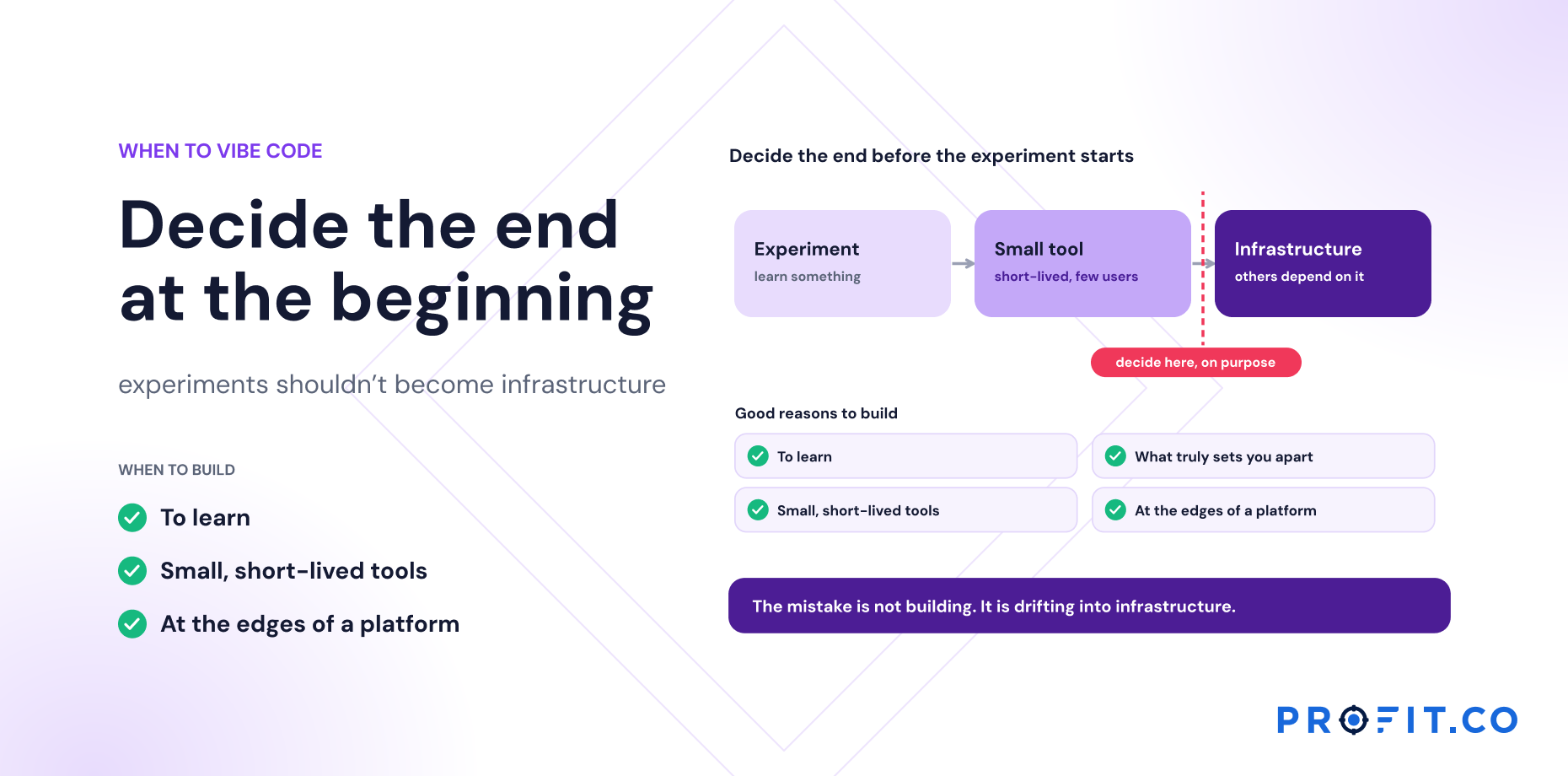
Vibe coding removes that friction. Because the first version is cheap, the question of whether this is the right work for the organization is skipped. The result is that engineering effort flows toward context without anyone deciding it should, and stays there because the app has users who depend on it.
Once an app has users, the decision becomes harder to revisit. Removing it means disruption, so it is easier to keep maintaining it. Each month of maintenance adds to the sense that the organization has invested too much to stop. Without a deliberate decision point, context work that began as a weekend experiment can quietly become a permanent claim on engineering capacity.
Your Best Engineers Are the Ones Who Build These Apps
There is an uncomfortable pattern in who builds internal tools with AI. It is rarely the least capable engineers. It is usually the most capable and curious ones: people who see a problem, have the skills to solve it quickly, and enjoy doing so.
That initiative is valuable. But it means the engineers who end up maintaining internal context systems are often exactly the people the organization most needs on its core products. Every week they spend on goal-tracking features, access requests, and compliance fixes is a week they are not spending on work that customers pay for.
Price the Capacity You Are Spending on Context
Opportunity Cost Is the Real Cost
As an earlier article in this series discussed, the salaries of the engineers maintaining an internal app are only the visible part of its cost. The largest part is what they would otherwise be building.
Ask what two of your strongest engineers could achieve in a year on your core product. A significant new capability, a faster and more reliable platform, an automation that saves thousands of hours. Then compare that with what they will achieve maintaining an internal strategy app. The difference is the true price of keeping it.
Specialists Exist Because Context Is Someone Else’s Core
The logic of buying context is that somewhere, a company has made your context its core. For a specialist strategy execution vendor, the strategy platform is not a side project. It is the entire business. Its best engineers, product managers, and researchers spend all their time on exactly the problems your engineers are working on part-time.
That concentration of effort produces better results. It also aligns incentives: the vendor succeeds only if its platform helps customers execute strategy well. Your organization succeeds by being excellent at something else.
Profit.co is one of those companies. Strategy execution is its whole product: OKRs, the Balanced Scorecard, Hoshin Kanri, performance reviews and project portfolios on one platform, recognized across G2’s Fall 2026 reports. The goal tracker your engineers maintain part-time is the system its teams build full-time.
Buying mission-critical context from a specialist is not a sign of weakness or a lack of technical ambition. It is a sign of focus. The most effective technology organizations are often the most disciplined about what they choose not to build, precisely because they understand how valuable their engineering capacity is.
When Is an Internal Tool Actually Core?
This argument has limits, and they are worth stating. Sometimes a tool that looks like context is actually core. If the way your organization executes strategy is itself a source of competitive advantage, and genuinely cannot be served by any available platform, building may be justified.
That situation is rarer than it seems. Most organizations’ strategy processes are important and distinctive in their content, the strategies themselves, but not in the mechanics of setting goals, tracking progress, and running reviews. The content is core. The machinery is context.
A Simple Test: Core or Context?
To decide where an internal app belongs, ask two questions. Would any customer choose us, or stay with us, because this system is better than a competitor’s? And if this system failed during a critical period, how serious would the consequences be?
If the first answer is no and the second is serious, the app is mission-critical context. That is precisely the kind of work best handed to a specialist, with your engineers redirected to the work only they can do.
Vibe coding has made it easy for talented engineers to solve problems that are not their organization’s core business. That is a gift for experimentation and a trap for ownership. The organizations that benefit most from AI-assisted development will be the ones that point it at what differentiates them, and buy everything else from people for whom it is core.
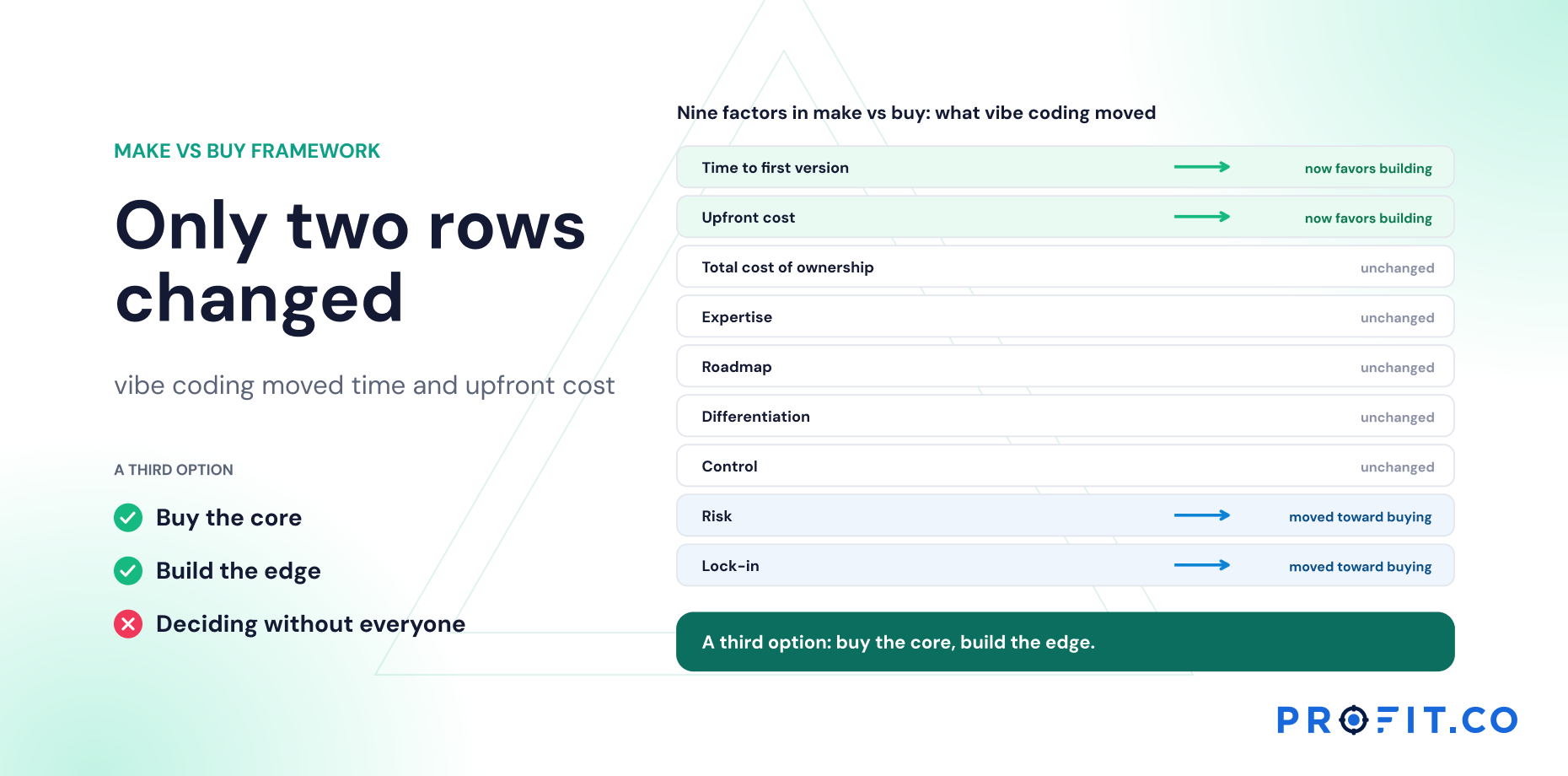
This series has now covered the costs and risks of building in detail. The next article steps back to the classic make-versus-buy framework, and asks why vibe coding feels like it changed the answer.
Give Your Engineers Back to Your Core
Frequently Asked Questions
Core activities differentiate a company in the eyes of its customers and win business. Context is everything else it must do, often very well, but which customers do not choose it for. Geoffrey Moore’s argument was to concentrate the best people on core and hand context to specialists.
No. Payroll is the classic counter-example: every company must run it flawlessly, and no customer buys from a company because of its payroll. Mission-critical context has serious consequences when it fails, which argues for reliability rather than for owning it.
Mission-critical context for almost every organization. A failure disrupts planning, reviews and potentially performance management, but no customer chooses your company because your internal goal tracker beats a competitor’s. Your strategy content is core; the machinery is context.
When the way your organization executes strategy is itself a competitive advantage and genuinely cannot be served by any available platform. That is rarer than it seems. Most strategy processes are distinctive in their content rather than in the mechanics of goals, tracking and reviews.
Two questions. Would any customer choose us, or stay with us, because this system is better than a competitor’s? And if it failed during a critical period, how serious would the consequences be? No to the first and serious to the second means mission-critical context.
The opposite. It is a sign of focus. The most effective technology organizations tend to be the most disciplined about what they choose not to build, precisely because they understand how scarce and valuable their engineering capacity is.