A dashboard only has to be useful. Evidence has to be defensible.
In this guide
- The Moment Strategy Data Becomes Evidence
- Every Number Needs a History
- Every Change Needs an Author and an Approval
- Every Calculation Must Be Consistent
- What Rights Do Employees Have to Their Performance Data?
- Automated Decisions Attract Extra Scrutiny
- Disputes Test the Whole System at Once
- What Does a Defensible Performance System Need?
- Frequently Asked Questions
Key Takeaways
- →The shift from management tool to evidence happens gradually, in steps that each seem small. By the time a dispute arrives, the data has been evidence for months.
- →Storing current state is the obvious design and works perfectly for tracking progress. It fails completely when someone needs to reconstruct the past.
- →An audit trail an administrator can alter without a trace offers little protection at the moment its accuracy is questioned.
- →Calculation drift is invisible until someone compares outcomes closely, which is precisely what happens in a dispute.
- →Acting fairly is not enough if you cannot prove it. The cultural cost lands on everyone watching, not just the person who complained.
The Moment Strategy Data Becomes Evidence
Performance data compliance is what strategy data must meet once it informs pay, promotion or ratings. At that point it stops being a management tool and becomes evidence, examined by HR, employee representatives and sometimes lawyers or a tribunal, and evidence is held to a higher standard.
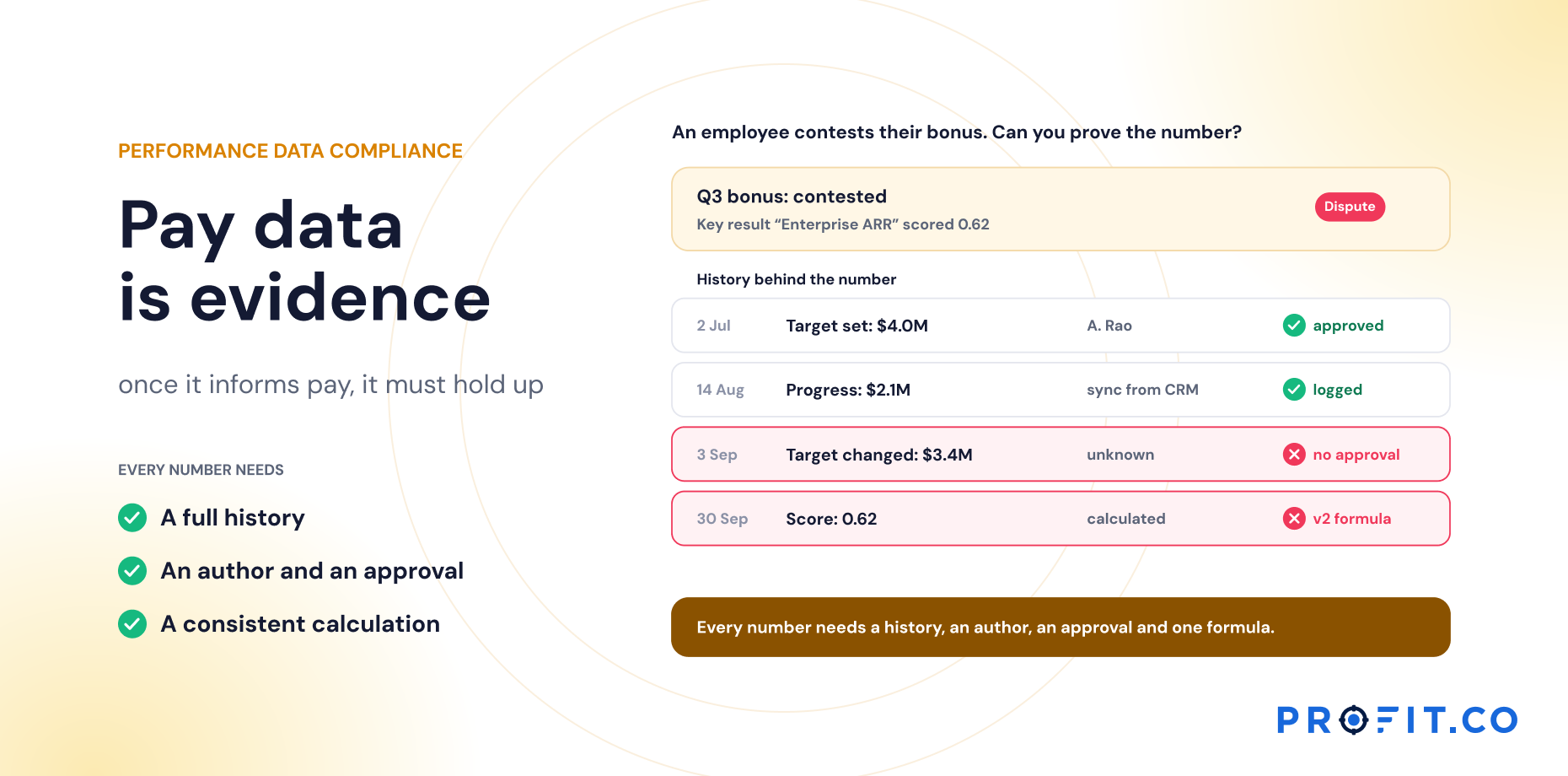
Picture a common situation. An employee receives a smaller bonus than they expected. The bonus was partly based on goal attainment recorded in the company’s internal strategy app. The employee believes one of their key targets was raised after the quarter began, making it harder to reach, and that colleagues in another team were measured differently. They raise a formal complaint.
Human resources now needs to answer some precise questions. What was the target at the start of the quarter? Who changed it, when, and with whose approval? How was the final score calculated, and was the calculation the same for everyone? For an app built quickly to track goals, these questions may have no reliable answers.
Most of the time, strategy data is used to steer the business. Teams set goals, track progress, and adjust. Precision matters, but small inconsistencies rarely cause harm.
That changes when the same data starts to inform decisions about people. Once goal attainment affects pay, promotion, or performance ratings, the data stops being only a management tool and becomes evidence. It may be examined by HR, by managers in a calibration meeting, by employee representatives, and in the worst case by lawyers, regulators, or an employment tribunal. Evidence has to meet a higher standard than a dashboard does.
This shift often happens gradually. A company starts with goals that are purely developmental. A year later, leaders begin referring to goal attainment in performance conversations. Then someone suggests linking a portion of variable pay to it. Each step seems small, and nobody revisits whether the app underneath was built to carry that weight. By the time a dispute arises, the data has been treated as evidence for months.
Every Number Needs a History
The first requirement is history. It must be possible to see not only the current value of a goal or target, but every earlier value and when it changed. A system that simply overwrites old values with new ones cannot show what a target was at the start of the quarter, because it no longer knows.
This is one of the most common gaps in quickly built apps. Storing the current state is the obvious design, and it works perfectly for tracking progress. It fails completely when someone needs to reconstruct the past.
Every Change Needs an Author and an Approval
History alone is not enough. A defensible record shows who made each change and whether it was approved through the proper process. If a target was raised mid-quarter, the organization needs to show whether that was agreed with the employee, approved by the right manager, and applied consistently.
That requires the app to understand roles, approvals, and workflows, not just data. It also requires that records cannot be quietly edited after the fact. An audit trail that an administrator can alter without a trace offers little protection when its accuracy is questioned.
Every Calculation Must Be Consistent
When scores contribute to rewards, employees reasonably expect that the same rules apply to everyone in comparable roles. If one team’s progress is calculated differently from another’s, or if the calculation changed partway through a period, the organization may struggle to explain why outcomes differ.
In a vibe-coded app, calculation logic can drift in ways nobody notices. A fix for one team’s request changes how scores round. A regenerated component handles partial progress slightly differently. Each change seems harmless. Together they can produce inconsistencies that only surface when someone compares outcomes closely, which is exactly what happens in a dispute.
That drift is the practical cost of regenerating code nobody fully understands, arriving in the one place where an unexplained difference becomes a legal problem rather than a cosmetic one.
What Rights Do Employees Have to Their Performance Data?
In many jurisdictions, employees have legal rights to access the personal data an employer holds about them. Under the EU’s GDPR, for example, an individual can request a copy of their personal data, and the organization generally has one month to respond. Performance records, goal histories, and managers’ comments can all fall within scope.
Responding properly requires being able to find all of the data relating to one person, across goals, check-ins, comments, and scores, and present it in an understandable form. For a system built without this in mind, that can mean an engineer manually querying databases under a legal deadline, with no confidence that the result is complete.
Automated Decisions Attract Extra Scrutiny
As apps add AI features to assess progress, suggest ratings, or summarize performance, a further question arises. Some data protection laws give people specific protections when significant decisions about them are based solely on automated processing, including the right to human involvement and to an explanation of the logic involved.
An organization needs to know where AI is used in its performance processes, how it influences decisions, and how a person can challenge it. A team that adds AI features to an internal app quickly, because it is now easy to do, may be creating obligations it has not identified.
See a Record That Holds Up Under Challenge
Disputes Test the Whole System at Once
A dispute is a stress test for every quality discussed in this series. It tests the audit trail, the permissions model, the consistency of calculations, the ability to retrieve data, and the understanding of the people who maintain the system. If the app’s builder has left, or nobody fully understands the code, the organization may be unable to explain how its own numbers were produced.
Even when the organization ultimately acted fairly, being unable to prove it is a serious problem. It weakens the organization’s position, damages trust with employees, and can turn a straightforward complaint into a prolonged one.
There is a cultural cost as well. Employees who see a colleague’s complaint go unresolved because the records are incomplete draw their own conclusions about whether the system is fair. That perception undermines the very program the app was built to support. People who believe goals can be changed behind their backs set safer goals, update less honestly, and engage less with the strategy process altogether.
The two failure modes it tests hardest have their own articles in this series: what happens when the person who knows the system leaves, and the audit and permission requirements nobody prompts for.
What Does a Defensible Performance System Need?
A strategy and performance system that can withstand scrutiny keeps a complete, tamper-resistant history of goals, targets, and scores. It records who changed what, when, and with whose approval. It applies calculations consistently and documents them. It can retrieve all data about an individual quickly and completely. And it is clear about where automation or AI influences outcomes.
Defensible Versus Quickly Built
| Requirement | A defensible system | A quickly built app |
|---|---|---|
| History of every value | Keeps every earlier value and the moment it changed | Overwrites the current state, so the past is simply gone |
| Authorship | Records who made each change and when | Records the new value and nothing about who set it |
| Approval | Shows the change went through the proper route, with the right manager | Has no concept of approval at all |
| Tamper resistance | Records cannot be quietly edited after the fact | An administrator can alter the trail without leaving a trace |
| Consistent calculation | The same rules for comparable roles, documented | Logic drifts as fixes and regenerated components land |
| Subject access | Retrieves everything about one person across goals, check-ins, comments and scores | An engineer queries databases by hand against a legal deadline |
| AI transparency | Clear where automation influences an outcome and how a person can challenge it | AI features added because they were easy, obligations unidentified |
These are not glamorous capabilities, and none of them appears in a demo. They exist in specialist platforms because vendors have learned, across many customers, what happens when they are missing.
In Profit.co, performance reviews are tied to OKR outcomes the platform already holds, and 1:1 notes link to the performance record, so a review cites the same data a manager saw during the quarter. Its Self and Manager Assessment agent drafts review comments from recorded work history when an employee opens a self-assessment, and the person still writes the final word. The data sits inside SOC 2 Type II and ISO 27001 controls, with GDPR right-to-be-forgotten requests supported. Test the history and approval rows against your own policies in a demo.
The question to ask of any internal app is not whether it tracks goals well today. It is whether, a year from now, it could help the organization explain a decision to an employee who believes they were treated unfairly. If the answer is uncertain, the risk is already there, waiting for the first complaint.
All of this is a great deal of work to do well. The next question is whether it is the right work for your organization to be doing at all.
Be Able to Show Your Work
Frequently Asked Questions
As soon as goal attainment affects pay, promotion or performance ratings. It may then be examined by HR, by managers in calibration, by employee representatives and, in the worst case, by lawyers or a tribunal. Evidence has to meet a higher standard than a dashboard does.
Because a dispute asks what the target was at the start of the quarter. A system that overwrites old values with new ones no longer knows. Storing current state is the obvious design and works for tracking progress, but it fails completely at reconstructing the past.
It records who made each change, when, and whether it went through the proper approval, and it cannot be quietly edited afterward. A trail an administrator can alter without leaving a trace offers little protection at exactly the moment its accuracy is questioned.
In many jurisdictions, yes. Under the EU’s GDPR an individual can request a copy of their personal data and the organization generally has one month to respond. Performance records, goal histories and managers’ comments can all fall within scope.
They can. Some data protection laws give people specific protections where significant decisions are based solely on automated processing, including the right to human involvement and to an explanation of the logic involved. You need to know where AI influences decisions and how a person can challenge it.
It weakens your position, damages trust and can turn a straightforward complaint into a prolonged one. There is a cultural cost too: colleagues who watch a complaint go unresolved because records were incomplete set safer goals and update less honestly afterward.