












Most hoshin literature describes the method as practiced by very large manufacturers, with strategy offices, multi-level cascades and full toolkits. A mid-sized company can get most of the value from a fraction of the tools, introduced in the right order.
In this guide
Key Takeaways
- →The people who run hoshin also run the business. A full toolkit consumes the time the method is meant to focus.
- →Five tools: X-matrix, bowler, countermeasure column, monthly review format, A3s for persistent gaps.
- →Year two adds graded correlations, the four-quadrant view, a quarterly review and a second level.
- →Skip the full seven planning tools, strategy A3s for every objective, and cascades beyond one level.
- →The failure mode is an impressive first cycle and a review rhythm that fades by summer.
- →Software tends to pay off at the second site, not at the first.
Why the full toolkit backfires
Mid-sized companies rarely have a strategy office. The people who run hoshin also run the business. A full toolkit, every planning tool, strategy A3s for every objective, three levels of cascade, introduced at once, consumes the very leadership time the method is meant to focus.
The result is predictable: an impressive first planning cycle and a review rhythm that fades by summer.
The minimum viable toolkit
| Tool | Why it’s essential |
|---|---|
| X-matrix | The plan on one page: few objectives, few priorities, named owners |
| Bowler chart | Monthly plan against actual |
| Countermeasure column | Turns red cells into actions |
| Monthly review format | Exceptions first, decisions logged |
| A3 for persistent gaps | Real problem-solving when a row stays red |
Five tools, used every month, beat fifteen tools used at the planning offsite.
Each of the five has an article of its own: X-Matrix Template for Hoshin Kanri: What a Good One Includes, Bowler Chart Template for Hoshin Kanri: Structure, Formulas, Colors, Countermeasure Sheets in Hoshin Kanri: Tracking Actions on Off-Track Objectives, Hoshin Kanri Review Templates: Monthly and Quarterly Formats and When a Red Bowler Row Needs an A3 in Hoshin Kanri.
What to add in year two
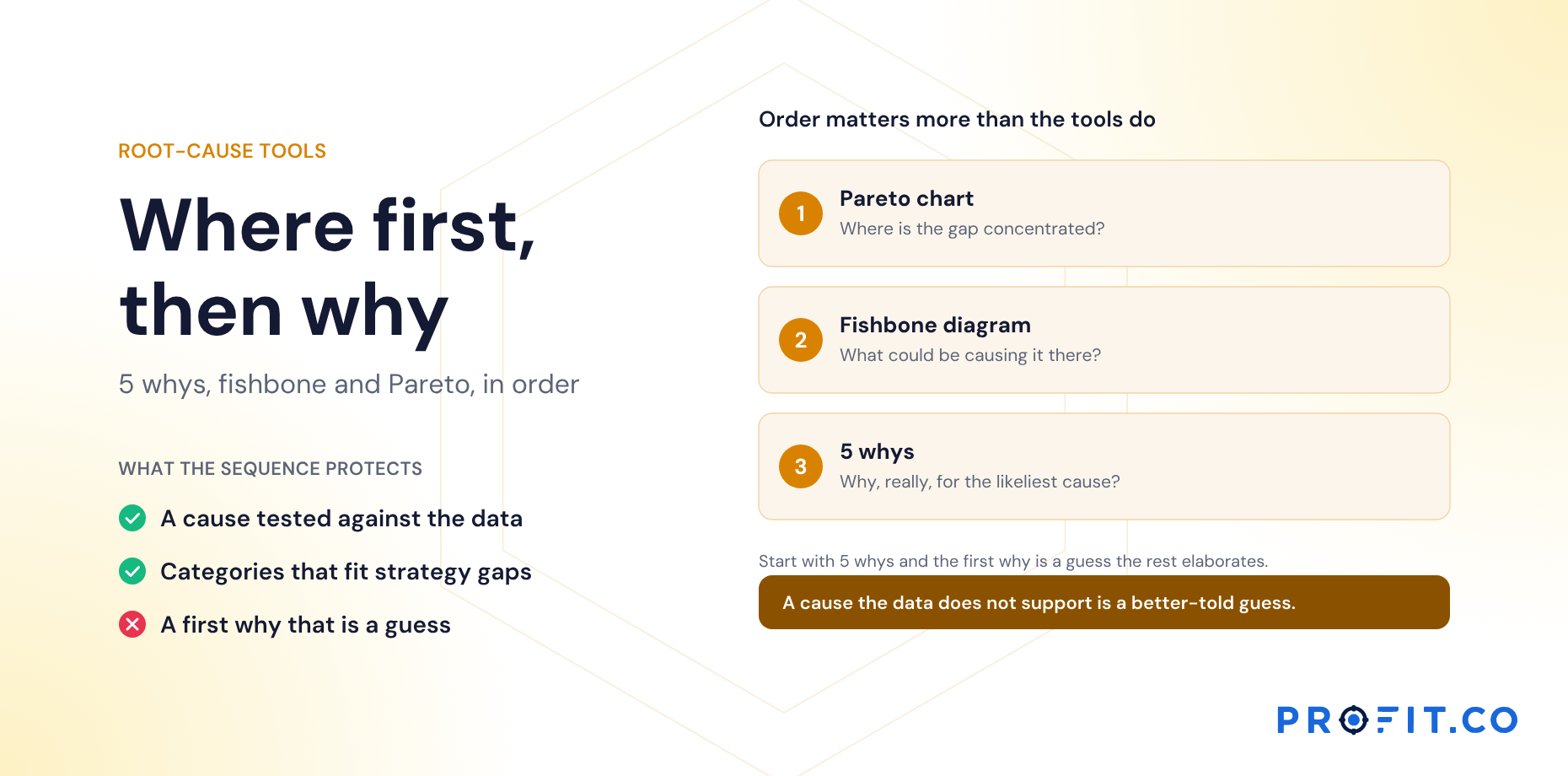
- Graded correlations and a correlation record, once the team has seen which bets held. See Primary, secondary, partial: grading X-matrix correlations.
- The four-quadrant view, to make outcome lag visible.
- A quarterly review, separate from the monthly one, for changing the bets.
- A second level, such as functions or a second site.
- A prioritization matrix for planning, once candidate priorities outnumber capacity.
What to skip for now
- The full set of seven management and planning tools. Use one or two where planning gets vague. See The Seven Management and Planning Tools in Hoshin Kanri.
- Strategy A3s for every objective. Write them only for the few objectives with real uncertainty.
- Cascades deeper than one level below the leadership team.
A worked example: a 400-person manufacturer
| Year | Toolkit | Format |
|---|---|---|
| Year 1 | X-matrix (3 breakthroughs, 7 priorities), bowler, countermeasure column, monthly review, 4 A3s | Spreadsheet and whiteboard |
| Year 2 | Adds graded correlations, quarterly review, four-quadrant view, one site’s matrix | Moves to software when the second site joins |
| Year 3 | Adds prioritization matrix in planning; team OKRs under two priorities | Same software |
Illustrative.
The move to software happened when the second site joined, the point at which the same few people could no longer carry the links between files. Profit.co suits that step: the X-matrix, bowler and four-quadrant chart on the same objectives, with OKRs available underneath when teams are ready. See the Hoshin Kanri software page and Your First Hoshin Kanri Planning Cycle: A Guide for Newcomers.

When the spend starts paying off
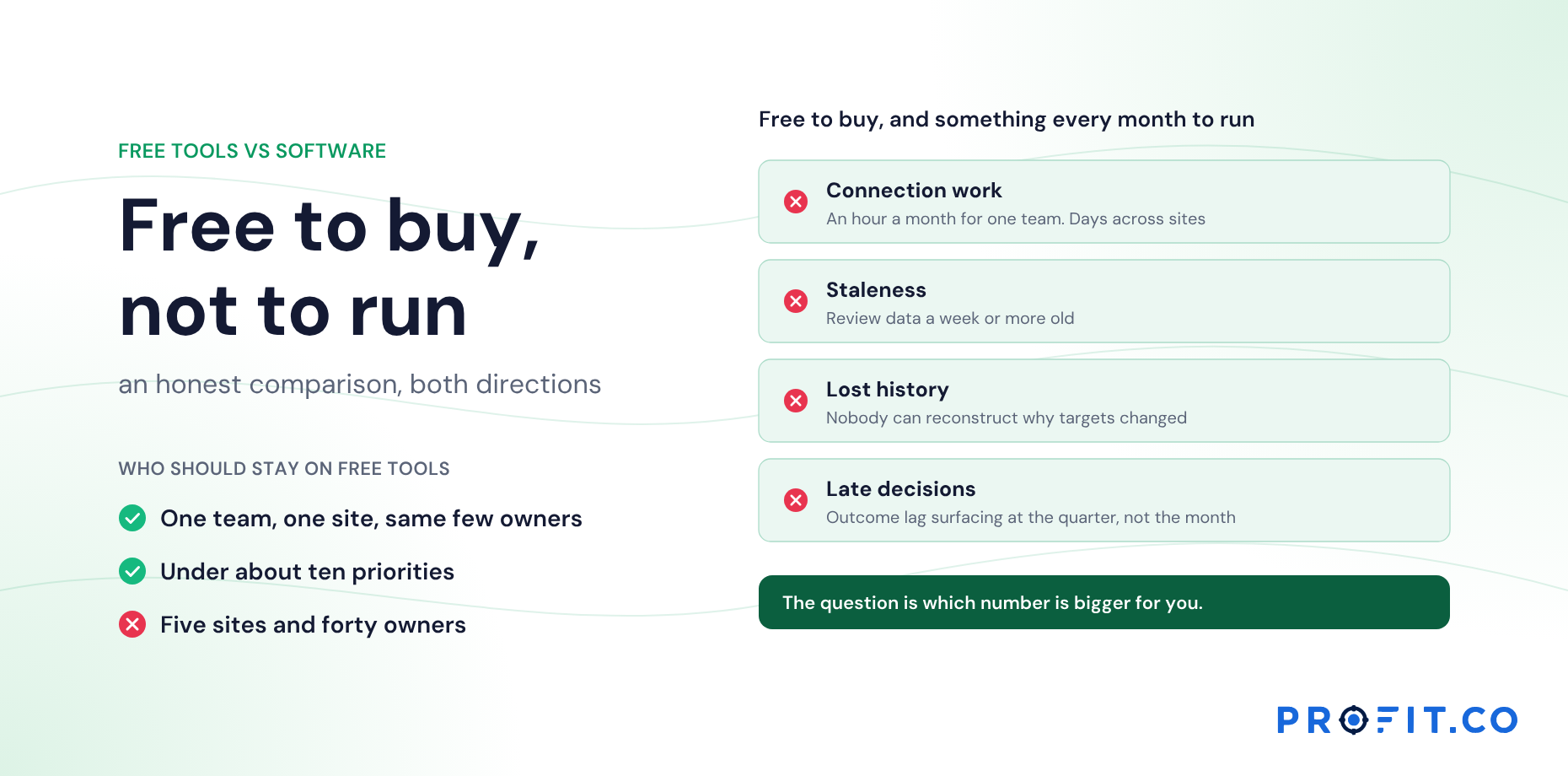
Year one in the example costs nothing but time, and that is the right answer. A single site with seven priorities and one leadership team can hold the links in a spreadsheet and a couple of heads, and paying for software at that point buys structure the program does not yet need.
Year two is where the arithmetic turns, and the trigger is the second site rather than a headcount or a revenue number. Two sites means two matrices that have to agree on KPI definitions, two bowlers rolling into one review, and a cascade that nobody owns full time. That is when the connection work stops being an hour and starts being a day.
Among published alternatives at that point, OnStrategy lists $200 per month for unlimited users. i-nexus publishes a free Starter tier for up to five users and $28 per user per month at its Standard tier. For a mid-sized company the seat question is sharper than for a large one: the owners are also the operators, so a model that charges per person taxes exactly the people the method needs to involve.
Profit.co publishes two plans, Essentials and Enterprise, quoting against modules and scale rather than a public seat rate. Hoshin Kanri sits in Essentials alongside OKRs and Goals, Balanced Scorecard and Strategy Roadmap, which is what makes year three’s step, team OKRs under two priorities, an addition rather than a second system. What drives the cost of hoshin kanri software lists the rest to total, and the 30-day free trial is long enough to run one real monthly review before deciding.
Free Product Demo
Start with the five tools that matter
A 30-minute walkthrough, tailored to your team.
Book a free demo
What happens in the call
How your teams set goals, track progress and review results.
Strategy, performance, projects and engagement on one platform, with AI.
A practical path to align teams, execute faster and drive results.
Questions this article answers
An X-matrix, a bowler chart, a countermeasure column, a monthly review format and A3s for persistent gaps.
Not always at first. It tends to pay off when a second site or level joins and the same people can no longer keep files connected.
The full set of planning tools, strategy A3s for every objective and deep cascades, until the basics run without effort.
Because there is no strategy office. The people running hoshin also run the business, so introducing every tool at once consumes the leadership time the method is meant to focus.
Graded correlations with a correlation record, the four-quadrant view, a separate quarterly review, a second level, and a prioritization matrix once candidates outnumber capacity.
A second site or level joining. That is the point at which the same few people can no longer carry the links between files by hand.