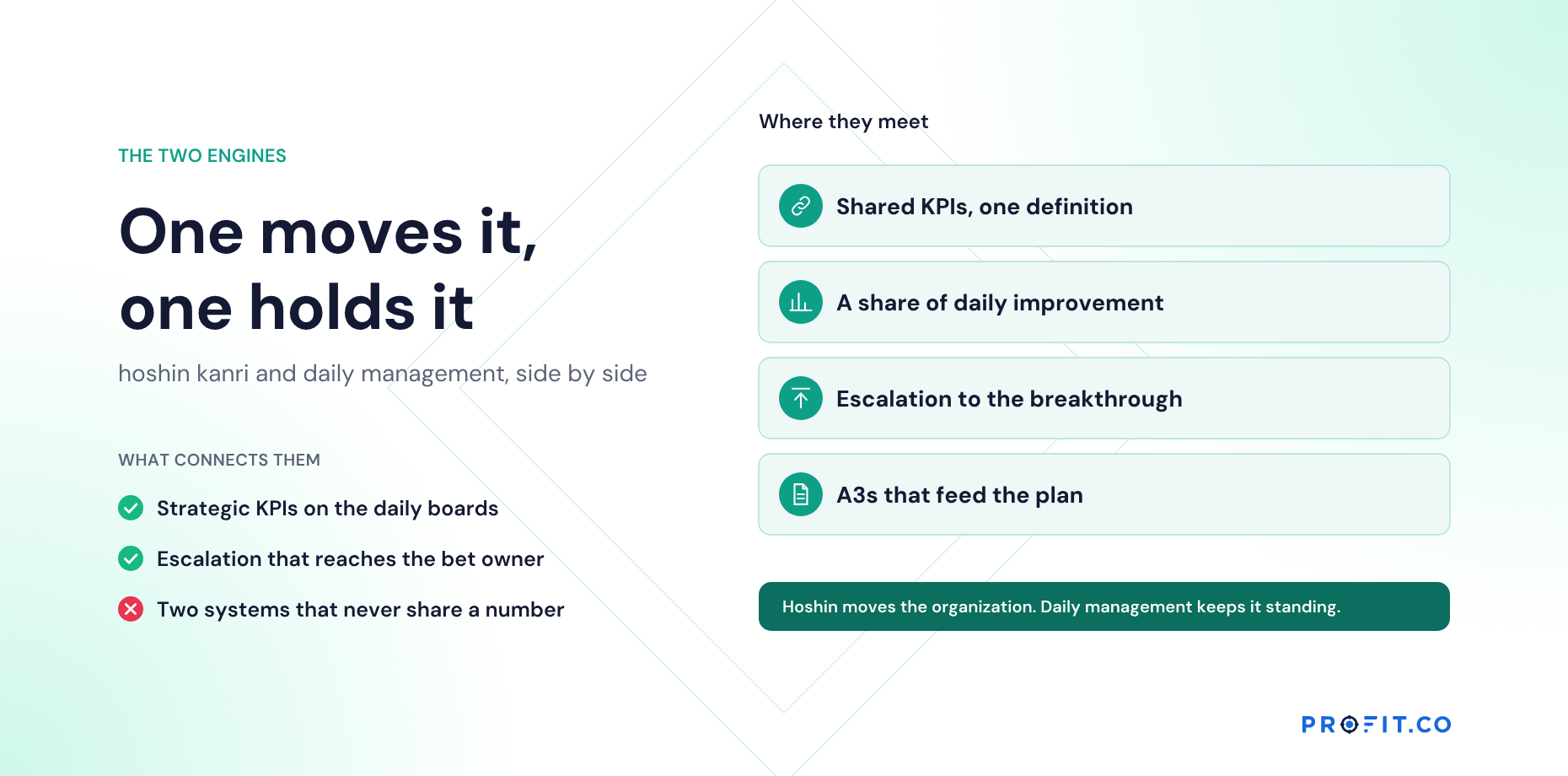













Lean software demos tend to show one engine: a beautiful X-matrix, or a busy kaizen board. The test of lean strategy software is the connection between them, and that only shows up when you run your own scenarios.
In this guide
- Six tests
- A demo script
- Who should evaluate
- What to bring
- Integration questions to ask
- Scoring and red flags
- What a passing demo of scenario A looks like
- A two-week evaluation plan
- Questions for reference customers
- A worked example: a scored evaluation
- What the options cost
- Questions this article answers
Key Takeaways
- →Six tests, of which three are must-pass: one KPI at every tier, linked improvement, escalation to the bet.
- →Scenario A separates lean strategy software from a kaizen counter or an X-matrix editor.
- →The front-line supervisor is the evaluator most often left out, and predicts adoption best.
- →Bring one real escalation that took too long, and one A3 that never changed the plan.
- →If a vendor exports to a spreadsheet to answer scenario A, the connection isn’t in the product.
- →Two excellent one-engine tools can still be the right purchase, as long as it’s a conscious choice.
Six tests
Each test below is something you can watch happen in a demo, on your own data, rather than something a feature list can claim.
Tests 1, 2 and 4 are the ones to treat as must-pass. The other three are about how well the connection is built; those three are about whether it exists at all.
| Test | Pass condition |
|---|---|
| 1. One KPI at every tier | The strategic KPI on the daily view is the same definition as on the bowler and the matrix |
| 2. Improvement linked to strategy | Improvement work can name the KPI it should move; effort by KPI is visible |
| 3. Huddles at every cadence | Daily to quarterly reviews on the same objectives and KPIs |
| 4. Escalation to the bet | A problem flagged at a huddle reaches the owner of the affected strategic objective |
| 5. Connected problem-solving | A persistent gap opens an A3 that can change the plan |
| 6. Effort beside effect | Improvement activity appears beside the movement of the KPI it targeted |
A demo script
Scenario A: busy and flat
“Our site completed 120 kaizens last quarter. On-time delivery, our main strategic KPI, didn’t move. Show us how we’d see where those kaizens pointed and whether any targeted delivery.”
Scenario B: the floor knows first
“A line huddle flags missing supplier parts for the third day running. Show us the route from that huddle to the person who owns on-time delivery, and what they see.”
Scenario C: the gap persists
“The problem continues for two months. Show us how an A3 is opened, who has to agree to it, and how its findings reach the hoshin plan.”
Scenario A is the one that separates lean strategy software from a kaizen counter or an X-matrix editor.
Who should evaluate
| Evaluator | Why |
|---|---|
| OpEx or CI lead | Owns the improvement system and its connection to strategy |
| Strategy or hoshin owner | Owns the bets the improvement should serve |
| A site manager | Runs tier 3 huddles; tests escalation |
| A front-line supervisor | Runs tier 1; tests whether daily use is practical |
The front-line supervisor is the evaluator most often left out, and the one whose view predicts adoption best.
What to bring
- Your strategic KPIs, with definitions.
- A quarter of improvement records, even a spreadsheet export.
- Your huddle structure, tiers and timings.
- One real escalation that took too long to reach the right person.
- One A3 whose findings never changed the plan.
The last two items are the ones vendors rarely see, and the ones that make a demo honest. A tool can be shown handling a clean hypothetical escalation; showing it handling the one that actually went wrong at your site is a different conversation.
Integration questions to ask
Many lean organizations already have physical boards, an idea system or a CI project tool. Ask each vendor directly:
- Does the tool replace our boards or idea system, sit alongside them, or integrate with them?
- If it doesn’t integrate, how are strategic KPIs kept current? How much effort is that?
- What is the minimum we need to move into the tool for the connection to work?
Honest answers here matter more than features. A tool that claims to replace everything usually fails at tier 1.
Scoring and red flags
Treat tests 1, 2 and 4 as must-pass: without one KPI at every tier, linked improvement and an escalation route, the two engines stay disconnected however good each one looks. Weight the rest with practical fit.
Red flags
- The demo shows only the X-matrix, or only the kaizen board.
- Escalation means an email or a comment.
- Success is shown as kaizen counts or savings, never as KPI movement.
- Front-line use requires long forms.
What a passing demo of scenario A looks like
| Step | A tool that passes | A tool that fails |
|---|---|---|
| Open the site’s improvement record | Shows the 120 kaizens grouped by the strategic KPI each targeted, plus base and local | Shows a count and a list |
| Ask about on-time delivery | Shows how many kaizens targeted it, beside the KPI’s movement | No way to connect the list to the KPI |
| Ask what to do next quarter | Shows which driver of on-time delivery is weakest, and which sites put least effort there | A suggestion to run more kaizens |
If a vendor needs to export data to a spreadsheet to answer scenario A, the connection doesn’t exist in the product.
A two-week evaluation plan
| Days | Activity |
|---|---|
| 1 to 2 | Prepare strategic KPIs, a quarter of improvement records, huddle structure, one escalation and one A3 |
| 3 to 8 | Demos on your data with the same four evaluators, running all three scenarios |
| 9 | Trial: a front-line supervisor runs a mock tier 1 huddle in each shortlisted tool |
| 10 | Score, check references, compare cost and fit |
Day 9 is unusual and worth doing. A tool that the person running tier 1 finds awkward will not be used at tier 1, whatever it does above.
Questions for reference customers
- What share of your improvement work is linked to strategic KPIs, and how did that change after adoption?
- How long does a flagged problem take to reach the owner of the strategic objective?
- Do front-line supervisors use it daily, or does someone enter their numbers for them?
- Name a strategic bet that changed because of something learned at a huddle.
The fourth question is the one worth pressing on. A reference who cannot name a single bet that changed has bought a reporting system, whatever the contract called it.
A worked example: a scored evaluation
Here are three hypothetical vendors scored against six tests, some of them marked must-pass:
| Test | Vendor A | Vendor B | Vendor C |
|---|---|---|---|
| 1. One KPI at every tier (must pass) | Pass | Fail | Pass |
| 2. Improvement linked (must pass) | Pass | Pass | Fail |
| 3. Huddles at every cadence | Pass | Pass | Fail |
| 4. Escalation to the bet (must pass) | Pass | Fail | Fail |
| 5. Connected A3 | Pass | Fail | Pass |
| 6. Effort beside effect | Pass | Fail | Fail |
Vendor B is an excellent idea system; vendor C an excellent hoshin tool. Neither connects the engines. That may still make one of them the right purchase alongside another tool, but it should be a conscious choice.
What the options cost
Price is the last column of the scorecard, not the first, because a tool that fails a must-pass test is not cheap at any number. It is a second system to keep current, with the connection still done by hand. That said, the published figures are worth having before the demos, so cost is a comparison rather than a surprise at the end.
Among published alternatives, OnStrategy lists $200 per month for unlimited users, which suits an organization that wants every huddle leader in the tool without counting heads. i-nexus publishes a free Starter tier for up to five users and $28 per user per month at its Standard tier, which fits a strategy office evaluating before a wider rollout. In both cases, price the scenario rather than the seat: tests 1, 2 and 4 are only real if the front line is actually licensed to use the thing.
Profit.co publishes two plans, Essentials and Enterprise, quoting against modules and scale rather than a public seat rate, which is the usual arrangement when tier 1 populations are large and read-mostly. Hoshin Kanri, OKRs and Goals and Balanced Scorecard sit in Essentials, and the 30-day free trial covers the two-week plan above twice over, which is enough to run scenario A on real records rather than a sandbox.
Profit.co is built for the connection: the hoshin plan with catchball and the exception queue, customizable huddles from daily to quarterly on the same KPIs, improvement ideas linked to strategic KPIs, escalation to objective owners and countermeasure A3s. It doesn’t integrate natively with other CI or board tools; strategic KPIs are kept current through check-ins. See the lean strategy software page.
Where a CI tool is already in place and staying, the comparison that matters is in Lean Strategy Software vs Continuous-Improvement and Idea-Management Software. If the boards are the sticking point, the split is set out in Lean Management Systems: What to Digitize and What to Keep on the Board.
Free Product Demo
Run the three scenarios on your data
A 30-minute walkthrough, tailored to your team.
Book a free demo
What happens in the call
How your teams set goals, track progress and review results.
Strategy, performance, projects and engagement on one platform, with AI.
A practical path to align teams, execute faster and drive results.
Questions this article answers
Connect strategy and daily improvement in both directions: one KPI definition at every tier, improvement linked to strategic KPIs, huddles at every cadence, escalation to the bet’s owner, connected A3s and effort shown beside effect.
The OpEx or CI lead, the strategy or hoshin owner, a site manager and a front-line supervisor.
Whether it can show where improvement effort pointed and whether it moved the strategic KPI, rather than just counting kaizens.
About two weeks: two days to prepare your own data, six for demos with the same four evaluators, one for a front-line supervisor to run a mock tier 1 huddle, and one to score.
Only the X-matrix or only the kaizen board on screen, escalation that means an email, success shown as kaizen counts rather than KPI movement, and long forms at the front line.