











Continuous-improvement software is built to make improvement easy: capture an idea, route it, track it, celebrate it. Lean strategy software is built to make improvement count toward the strategy. Many organizations need both, and the question is how they connect.
In this guide
- Two questions
- Where they overlap
- When you need which
- Connecting them without an integration
- A worked example: the same quarter, two systems
- Who owns what
- Questions to ask if you already own a CI tool
- Common objections
- What a second tool costs
- Profit.co and your CI tools
- Questions this article answers
Key Takeaways
- →CI tools ask how much you are improving; lean strategy software asks whether it is moving the strategy.
- →The overlap is real: both hold ideas, track progress and may offer A3s.
- →New improvement culture: CI tool first. Strong participation, flat KPIs: a strategy layer.
- →Connecting the two takes a few numbers a month, not an integration project.
- →Two or more “no” answers about your CI tool suggest adding a layer, not replacing it.
- →Both reports can be true at once. You need the second to act on the first.
Two questions
The two categories look similar on a feature list and behave differently in a review meeting. The quickest way to tell them apart is to ask which question the product is organized to answer.
Note the last two rows especially. Each tool is weak exactly where the other is strong, which is why the comparison so often ends in buying both rather than choosing.
| Measure | CI and idea-management software | Lean strategy software |
|---|---|---|
| Core question | How much are we improving, and is it flowing? | Is our improvement moving the strategy? |
| Unit managed | Ideas, kaizens, projects | Strategic objectives, KPIs, bets |
| Typical measures | Ideas per person, cycle time, savings, participation | Strategic KPIs against trajectory; effort by KPI |
| Users | Everyone who improves | Leaders, KPI owners, huddle leaders |
| Strong at | Engagement, workflow, recognition | Direction, connection, learning upward |
| Weak at | Strategic direction and effect | Detailed idea workflow |
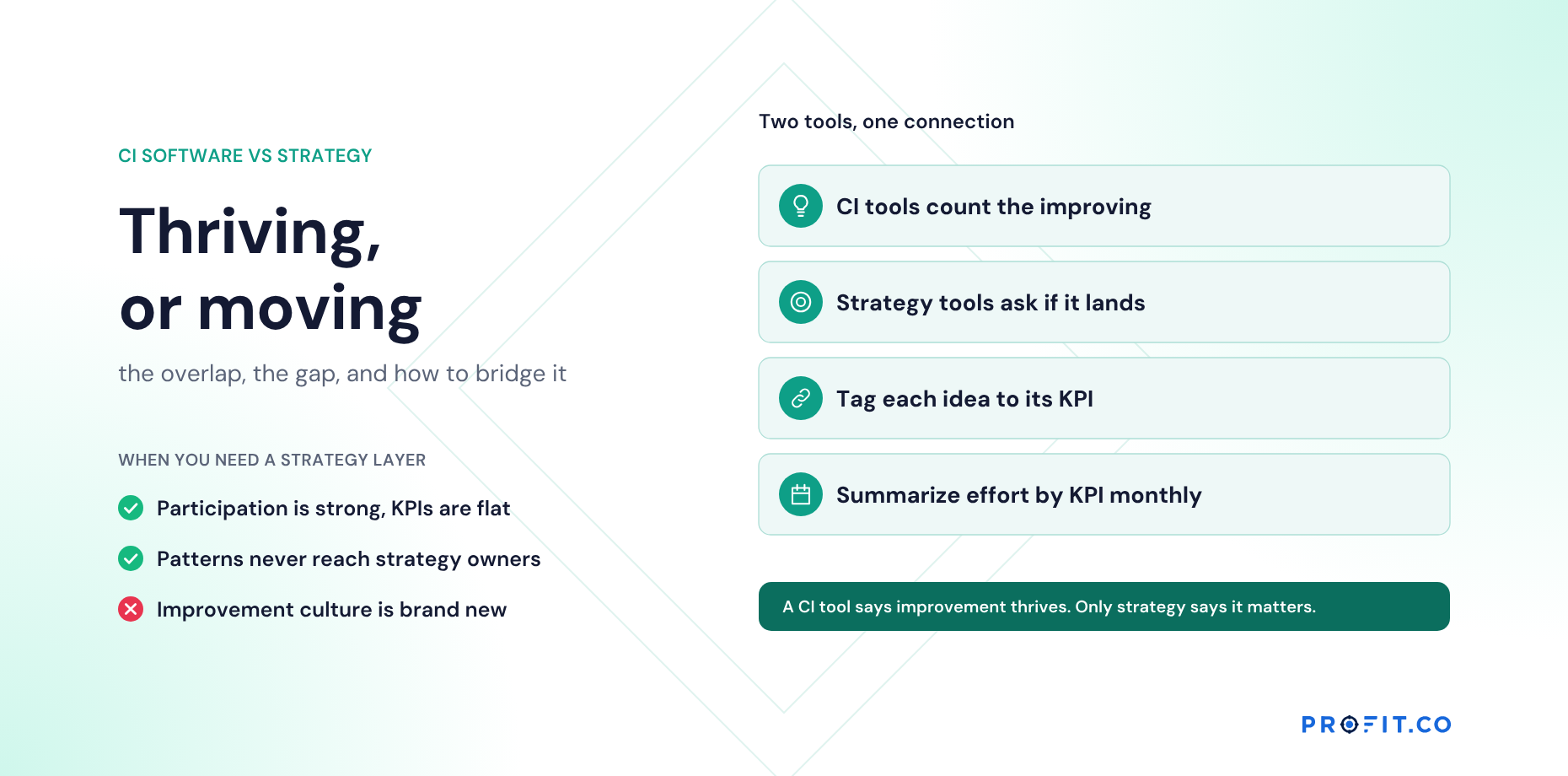
A CI tool can tell you that improvement is thriving. Only a connection to the strategy can tell you whether it matters.
Where they overlap
Both can hold improvement ideas, both track progress, and both may offer A3s or problem-solving templates. The overlap is real, which is why buyers compare them. The difference is in what happens to an idea once it’s captured: a CI tool routes it to completion; a lean strategy tool asks which strategic KPI it serves and shows its effect beside that KPI.
When you need which
| Situation | Likely need |
|---|---|
| Improvement culture is new; participation is the main goal | CI or idea-management software first |
| Participation is strong; strategic KPIs aren’t moving | Lean strategy software |
| Large idea volumes with complex routing and savings validation | Both |
| Small volumes; strategy and improvement reviewed together | Lean strategy software with its own idea capture may be enough |
Connecting them without an integration
- Agree the strategic KPIs once, with definitions both tools use.
- Tag ideas in the CI tool with the strategic KPI they serve.
- Summarize monthly: improvement effort by strategic KPI, entered as a check-in on each KPI’s objective.
- Link major projects as initiatives under the strategic objectives they serve.
- Review together quarterly, with the strategic KPI movement beside the improvement summary.
It’s manual, but it’s a few numbers a month, not a duplicate system. For many organizations that’s enough to connect the engines.
A worked example: the same quarter, two systems
Here is a hypothetical quarter reported two ways, through a CI tool and through a lean strategy view:
| Dimension | CI tool report | Lean strategy view |
|---|---|---|
| Headline | 1,240 ideas, 88% implemented, participation 71% | On-time delivery 89% vs 92% plan |
| Detail | Savings 0.9 million; top site recognized | Ideas tagged to on-time delivery: 9%; to scrap: 22% |
| Insight | Improvement culture is healthy | Improvement isn’t pointed at the KPI most behind |
| Action | Celebrate | Make on-time delivery the focus KPI at the three weakest sites |
Both reports are true. The organization needs the second to act on the first.
Who owns what
| Activity | CI or OpEx team | Strategy owners | Front line |
|---|---|---|---|
| Running the idea system | Leads | Informed | Contribute |
| Choosing strategic KPIs | Consulted | Lead | Informed |
| Setting focus KPIs per site | Facilitates | Agree | Consulted |
| Tagging ideas to strategic KPIs | Coaches | Informed | Do it |
| Monthly effort-by-KPI summary | Prepares | Review | Informed |
| Acting on patterns | Supports | Lead | Hear back |
Questions to ask if you already own a CI tool
- Can it show improvement effort by strategic KPI? If not, steering is guesswork.
- Can it show effort beside the KPI’s movement? If not, you can’t tell whether improvement matters.
- Do patterns of ideas reach strategy owners? If not, frontline learning stops at the site.
- Do the same KPIs appear on huddle boards and the strategy? If not, the tiers don’t connect.
Two or more “no” answers suggest adding a strategy layer, not replacing the CI tool.
Common objections
| Objection | Response |
|---|---|
| “Our CI tool already has an A3 and a strategy page.” | Check whether improvement effort can be shown beside strategic KPI movement. That’s the connection that matters. |
| “Our people won’t tag ideas.” | One field, picked by the person raising the idea, takes seconds. Make it optional at first and report the share tagged. |
| “Two systems means double entry.” | Only a few numbers a month need to cross: effort by KPI and the KPIs themselves. |
| “Strategy should stay out of kaizen.” | Most kaizen should stay local. A visible share pointed at strategy doesn’t change that. |
What a second tool costs
Running both is cheaper than it sounds, because the two tools license very different populations. A CI tool is priced to put everyone who might have an idea inside it, which is the whole workforce. A strategy layer is used by leaders, KPI owners and huddle leaders, which in most organizations is a small fraction of that. Buying a second full-workforce licence is the mistake to avoid; buying a second system scoped to the people who steer is the normal shape.
Among published alternatives for the strategy layer, OnStrategy lists $200 per month for unlimited users, which removes the seat question entirely. i-nexus publishes a free Starter tier for up to five users and $28 per user per month at its Standard tier, which is workable for a strategy office of a dozen. Set against either, the cost worth weighing is not the subscription but the year of improvement capacity that a healthy CI report quietly misdirects.
Profit.co publishes two plans, Essentials and Enterprise, quoting against modules and scale rather than a public seat rate, which fits the asymmetry above. Hoshin Kanri, OKRs and Goals and Balanced Scorecard sit in Essentials, and the 30-day free trial covers one monthly summary cycle, which is exactly the mechanism this article recommends testing.
Profit.co and your CI tools
Profit.co is lean strategy software: the hoshin plan, catchball, the exception queue, customizable huddles from daily to quarterly, countermeasure A3s and improvement ideas linked to the strategic KPIs they should move. For organizations with modest idea volumes, its own idea capture may be all they need.
It doesn’t integrate natively with other CI or idea-management tools. Where a CI tool stays in place, the connection runs through the monthly summary and quarterly review above. See the lean strategy software page and How to Evaluate Lean Strategy Software.
If the question behind this comparison is really about huddle boards rather than idea systems, the division of labor is set out in Lean Management Systems: What to Digitize and What to Keep on the Board.
Free Product Demo
Connect your CI tool to your strategy
A 30-minute walkthrough, tailored to your team.
Book a free demo
What happens in the call
How your teams set goals, track progress and review results.
Strategy, performance, projects and engagement on one platform, with AI.
A practical path to align teams, execute faster and drive results.
Questions this article answers
CI and idea-management software captures and tracks improvement ideas and projects. Lean strategy software connects that improvement to the strategy and shows whether it moves the strategic KPIs.
Organizations with large idea volumes and complex routing often do. Smaller programs may manage with a lean strategy tool that includes idea capture.
Agree strategic KPIs, tag ideas with the KPI they serve, summarize effort by KPI monthly into the strategy tool, link major projects as initiatives, and review both quarterly.
It is one field, picked by the person raising the idea, and takes seconds. Make it optional at first and report the share tagged rather than mandating it.
Usually not. Where idea volumes are large and routing is complex, the CI tool is doing work a strategy tool is not built for. Add the layer and connect the two.