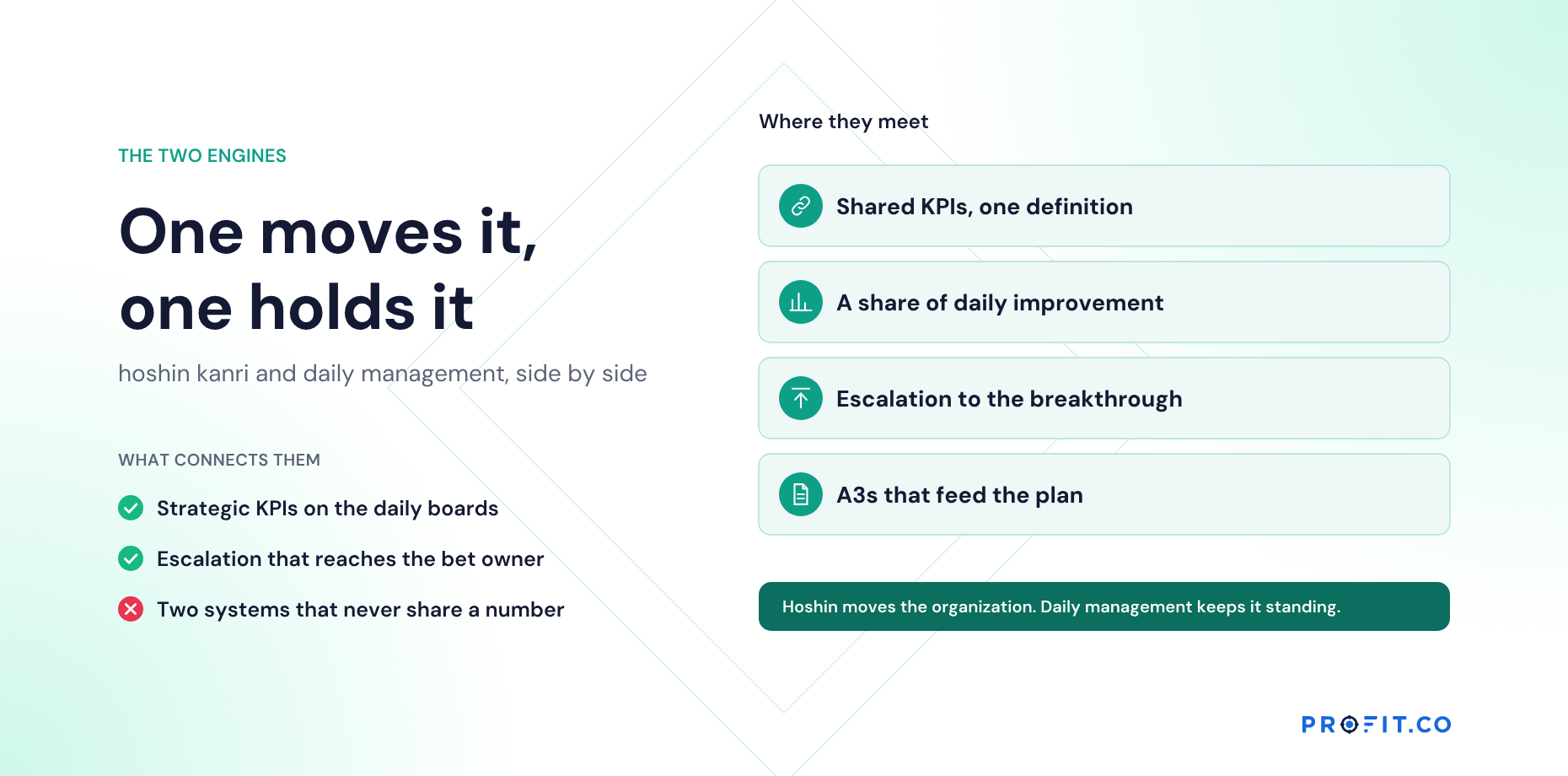













Lean has spread well beyond the factory, into hospitals, banks, insurers and public services. The two engines still apply. What changes is the vocabulary, the KPIs, and how little time front-line staff have for anything that isn’t the work.
In this guide
Key Takeaways
- →Both engines apply outside manufacturing; the vocabulary and the KPIs change.
- →Clinical and service time is scarce, so huddles run five to ten minutes.
- →Use KPIs the front line recognizes: waiting times, harm events, turnaround.
- →Demand and case mix drive much of the variation, not the process alone.
- →Capturing an improvement idea has to take seconds, not a form.
- →The unit that owns a KPI is often not the unit that can move it.
What changes outside manufacturing
Everything structural about the two engines survives the move out of the factory. Five practical things do not.
The front-line time row is the one that decides whether any of this lands. A thirty-minute tier 1 huddle is normal on a production line and impossible on a ward at handover, and a design that ignores that will be abandoned politely within a month.
| Aspect | Manufacturing | Healthcare and services |
|---|---|---|
| Product | Physical goods | Care, cases, transactions, decisions |
| Typical strategic KPIs | On-time delivery, scrap, cost per unit | Patient wait times, harm events, turnaround time, first-contact resolution |
| Front-line time | Shift-based huddles are normal | Clinical and service time is scarce; huddles must be very short |
| Variation | Mostly process-driven | Demand and case mix drive much of it |
| Regulation | Product safety | Patient safety, data protection, sector regulators |
Adapting the two engines
Hoshin-style strategy works the same way: a few breakthroughs, negotiated targets, monthly reviews. Daily management adapts most. Huddles are shorter and often built around safety and flow. Improvement ideas come from staff who have little discretionary time, so capturing them must take seconds, and steering must feel like focus, not extra work.
In a hospital ward, a ten-minute huddle is a big ask. Every minute of it should connect to something that matters.
What helps
- Strategic KPIs the front line recognizes, such as waiting time or harm events, not abstract indices.
- Huddles of five to ten minutes, with strategic KPIs on the board.
- A one-tap way to flag that a problem affects a strategic goal.
- Quarterly focus KPIs instead of mandated improvement quotas.
- Respect for regulation and data protection in what is recorded and where.
The third item carries more weight here than anywhere else in this series. A nurse or a case handler will not fill in a form about a strategic bet. They will tap once to say this problem is about flow, and that single tap is what lets a pattern assemble across four wards.
A worked example: emergency department flow
Here is a hypothetical emergency department, from the strategic objective to the result after one quarter:
| Level | Content |
|---|---|
| Strategic objective | Reduce average emergency department length of stay from 6.5 to 4.5 hours over two years |
| Driver measures | Time to first assessment; time waiting for a bed; discharge before noon on wards |
| Daily huddle finding | Ward huddles repeatedly flag late discharge paperwork; beds free up in the afternoon |
| Escalation | Pattern across four wards reaches the flow objective’s owner in week two |
| Improvement focus | Discharge-before-noon becomes the quarterly focus KPI for medical wards |
| Result after a quarter | Length of stay down 0.4 hours; the driver that moved was bed waits |
The emergency department couldn’t fix its own length of stay. The wards could, and the connection between their huddles and the hospital’s strategic objective is what made it happen.
That split between the unit that owns a KPI and the units that can move it is the normal case in services, not the exception. It is also why pressure applied to the owning department alone tends to produce exhaustion rather than improvement.
What a disconnected ward costs
In a service organization the cost of a disconnected improvement system is paid in the scarcest resource there is: the discretionary minutes of clinical and front-line staff. A ward team that raises the same flow problem for six weeks and hears nothing has spent those minutes twice over, once on noticing and once on explaining, and has learned that noticing is unpaid. The second cost is larger than the first and takes far longer to undo.
Among published alternatives, OnStrategy lists $200 per month for unlimited users, which matters in a hospital where the people who should see a flow KPI number in the hundreds across wards and shifts. i-nexus publishes a free Starter tier for up to five users and $28 per user per month at its Standard tier, which suits a central improvement team rather than ward-level access. Either way, test the one-tap flag with a real ward team at handover before anything else, and ask each vendor directly about hosting location and data-protection terms for your sector.
Profit.co publishes two plans, Essentials and Enterprise, quoting against modules and scale rather than a public seat rate, which fits wide, shallow ward-level access. Hoshin Kanri, OKRs and Goals and Balanced Scorecard sit in Essentials, and the 30-day free trial is enough for one ward to run real ten-minute huddles against it and say whether the ten minutes held.
Huddles that fit the work
In Profit.co, huddles are customizable in cadence and length, strategic KPIs are shared across tiers, problems can be escalated to the owner of a strategic objective, and improvement ideas link to the KPI they serve. Organizations should check hosting and data-protection requirements for their sector as part of any evaluation. See the lean strategy software page.
The tests to run on any candidate, including the escalation route the ward example depends on, are in How to Evaluate Lean Strategy Software. Where ward boards are staying exactly as they are, the division of labor is in Lean Management Systems: What to Digitize and What to Keep on the Board.
Free Product Demo
Connect ward or service huddles to your strategy
A 30-minute walkthrough, tailored to your team.
Book a free demo
What happens in the call
How your teams set goals, track progress and review results.
Strategy, performance, projects and engagement on one platform, with AI.
A practical path to align teams, execute faster and drive results.
Questions this article answers
Yes. The two engines, hoshin-style strategy and daily management, apply, with shorter huddles, front-line KPIs such as waiting times and harm events, and very light improvement capture.
KPIs center on turnaround, quality and customer experience, demand drives much of the variation, and front-line time for huddles and improvement is scarce.
Typically five to ten minutes, focused on safety, flow and the strategic KPIs the team can influence.
That is the normal case in services. An emergency department cannot fix its own length of stay if the constraint is ward discharge, so the focus KPI has to sit with the units that hold the driver.
Treat it as part of the design: decide what is recorded and where before rollout, and check hosting and data-protection requirements for your sector with each vendor during evaluation.