












Organizations adopting lean often ask when to introduce hoshin kanri. Too early, and the strategy has nothing to stand on. Too late, and years of improvement go unsteered. There’s a sequence that works for most, with room to overlap.
In this guide
Key Takeaways
- →Stabilize, connect, deploy, learn: four phases that overlap but rarely reorder.
- →Hoshin usually fits in the second year, once tiers share a KPI definition.
- →The readiness test for each phase is behavioral, not a date on a plan.
- →Hoshin on an unstable base turns a plan into a document.
- →Daily management with no direction burns years of improvement capacity.
- →Name one or two strategic KPIs from day one, long before full hoshin.
Four phases
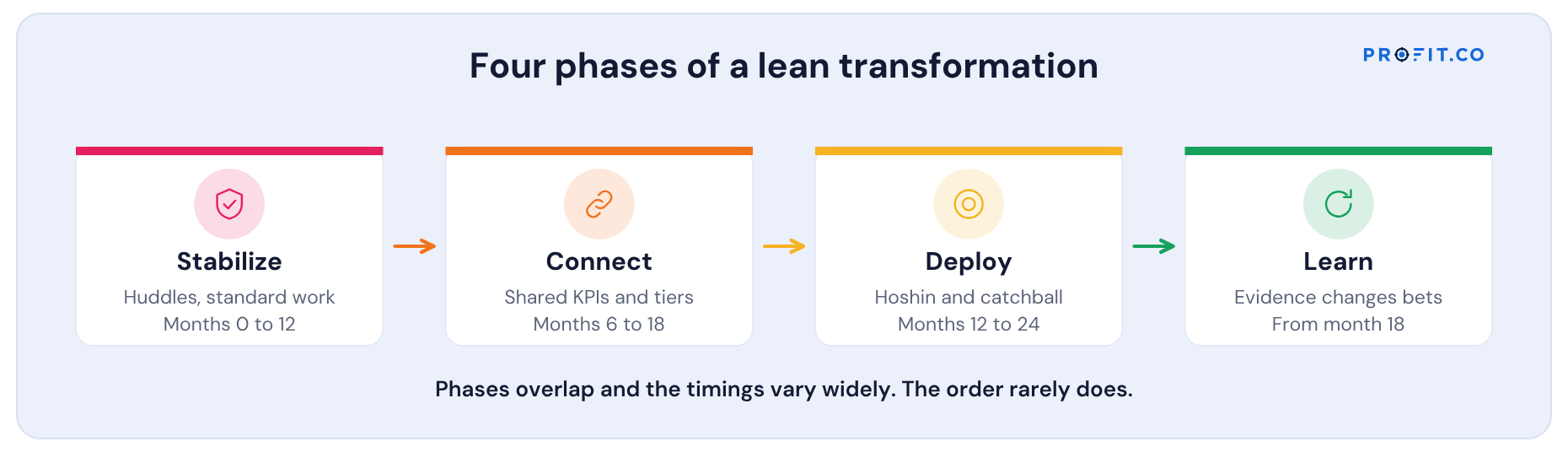
What rarely varies is the order. The pace does: two organizations can run the same four phases three years apart and both be exactly on schedule for their size and starting point.
Read the last column first. Each phase ends on a behavior, not a date: huddles that run without being chased, a KPI that reads the same at every tier, targets that were negotiated. A program that moves on because the calendar says so inherits the previous phase’s gap and spends the next phase working around it.
| Phase | Focus | Typical timing | Ready to move on when |
|---|---|---|---|
| 1. Stabilize | Daily huddles, standard work, basic problem-solving | Months 0 to 12 | Huddles run without being chased |
| 2. Connect | Shared KPIs and tiers; KPI trees | Months 6 to 18 | A strategic KPI reads the same at every tier |
| 3. Deploy | Hoshin: breakthroughs, catchball, monthly reviews | Months 12 to 24 | Targets are negotiated and reviewed monthly |
| 4. Learn | Steering improvement; evidence up; A3s that change the plan | From month 18 | Bets change on evidence from the front line |
Phases overlap; timings vary widely.
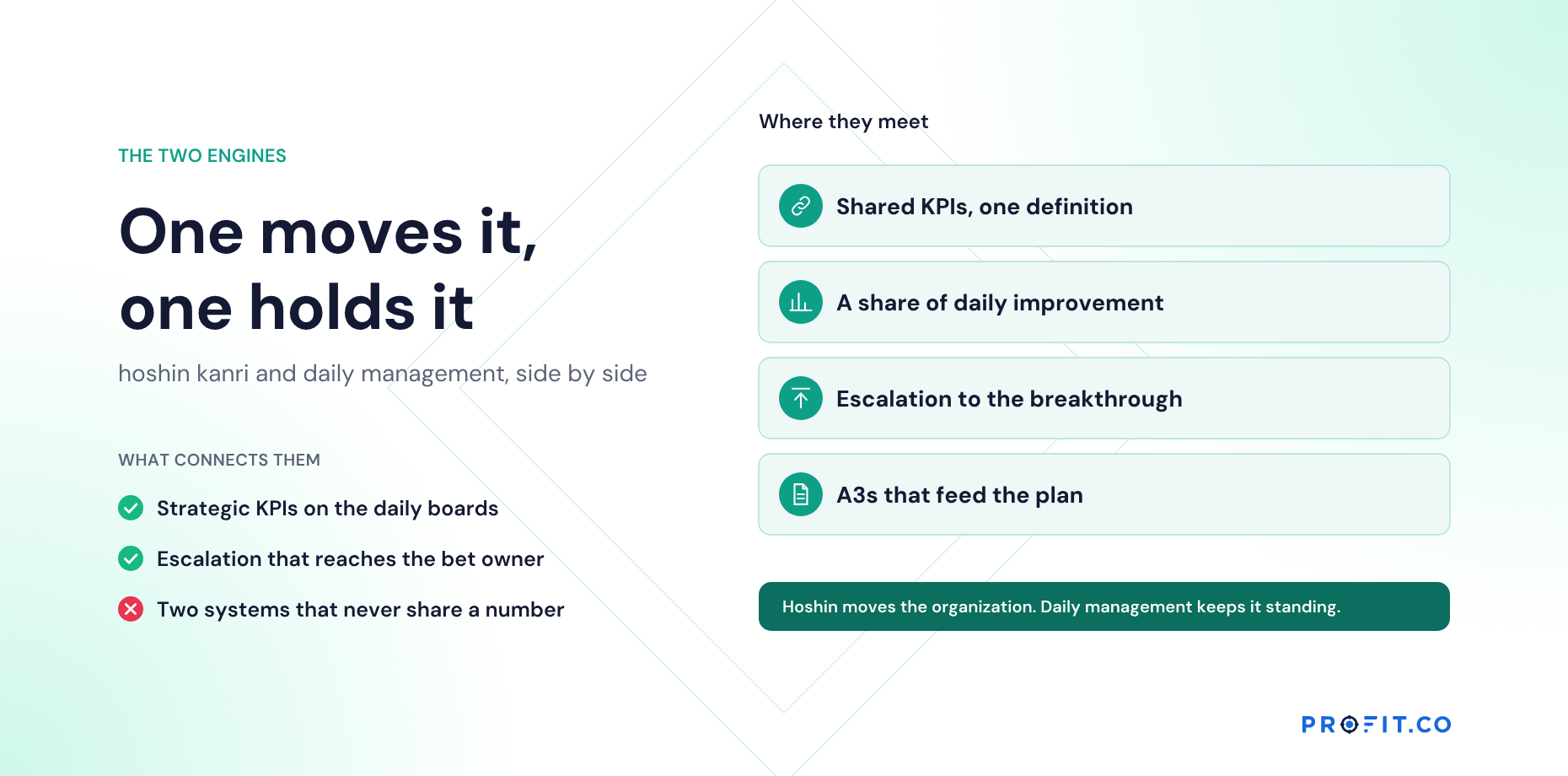
Hoshin needs a stable base to deploy into. Daily management needs a direction to improve toward.
Two common sequencing mistakes
Hoshin first, on an unstable base
A strategy office builds a beautiful X-matrix before daily management exists. Targets cascade to sites that have no huddles to review them and no problem-solving habit to act on gaps. The plan becomes a document.
Daily management for years, no direction
Daily management matures, kaizen thrives, and nobody points it anywhere. After a few years, leadership asks why so much improvement hasn’t changed the business. See Hoshin Kanri and Continuous Improvement: Integrating Daily Kaizen with Strategic Goals.
The two mistakes feel opposite and are usually made by the same organization, a year apart. The strategy office builds the matrix, watches it fail to land, concludes that deployment is premature, and leaves the improvement system to run unsteered while the base is rebuilt. The sequence is what prevents both.
A light strategic focus from day one
- Name one or two strategic KPIs early, even before hoshin.
- Put them on the first huddle boards, with one definition.
- Encourage some improvement toward them, without mandates.
- Introduce full hoshin once tiers connect.
Two KPIs is the right order of magnitude, and the single definition matters more than the choice. A measure that means something slightly different at tier 1 and tier 3 has to be renegotiated in phase 2, and renegotiating a number people have been looking at for a year is far harder than agreeing it once at the start.
A worked example: a three-year roadmap
Here is a hypothetical three-year roadmap, with the daily engine and the strategy engine built side by side:
| Period | Daily engine | Strategy engine |
|---|---|---|
| Year 1, H1 | Tier 1 huddles at two pilot sites | Two strategic KPIs named: on-time delivery and scrap |
| Year 1, H2 | Tiers 1 to 3 at all sites; first kaizens | KPI trees for both; on all boards |
| Year 2 | Kaizen linked to strategic KPIs; focus KPIs per site | First hoshin cycle: three breakthroughs, catchball, monthly reviews |
| Year 3 | Escalations reach bet owners; A3s on strategic gaps | Quarterly reviews change bets on frontline evidence |
Notice that the two columns never run far apart. Each half-year, the strategy engine asks for roughly what the daily engine has just become able to supply, which is why nothing in this roadmap needs a mandate to hold.
What each sequencing mistake costs
Getting the order wrong is expensive in two distinct ways. Deploying too early spends a planning season, a consulting engagement and a year of executive credibility on a plan that the sites cannot act on, and the credibility is the part you cannot re-buy: the second attempt is met by people who have already seen one X-matrix come and go. Deploying too late spends something larger and quieter, which is a few years of a fully functioning improvement system pointed at whatever was locally annoying.
Among published alternatives for the deploy phase, OnStrategy lists $200 per month for unlimited users and i-nexus publishes a free Starter tier for up to five users with $28 per user per month at its Standard tier. The sequencing question has a direct buying consequence: a tool bought for phase 3 and switched on in phase 1 gets judged on how well it runs huddles, which is not what it was for. Ask instead whether the same system can hold phase 1 records and still be the place phase 3 happens, without a migration in between.
Profit.co publishes two plans, Essentials and Enterprise, quoting against modules and scale rather than a public seat rate, which matches a transformation that adds capability a phase at a time. Hoshin Kanri, OKRs and Goals and Balanced Scorecard sit in Essentials, and the 30-day free trial is enough to test the phase you are actually in rather than the one you are planning for.
One system across all four phases
Profit.co can support every phase: huddles customizable from daily to quarterly for phase 1, shared KPIs and contributing key results for phase 2, the hoshin X-matrix and catchball for phase 3, and linked improvement, escalation, the exception queue and A3s for phase 4. See the lean strategy software page, and Your First Hoshin Kanri Planning Cycle: A Guide for Newcomers.
Carrying one set of records across the phases is worth more than it sounds, because the usual tax on a transformation is re-keying:
- Phase 2 is a definition, not a data migration. The KPI the pilot sites have been running since month three becomes the shared one, with its history attached.
- Phase 3 inherits a baseline. Catchball on a target is a different conversation when both sides are looking at eighteen months of the same measure.
- Phase 4 has something to learn from. Correlations can only be judged against history, so the value of phase 4 is set by what phases 1 and 2 quietly recorded.
Where this roadmap most often comes apart is described in Why Lean Strategy Deployment Stalls in Year Two, and the measures that tell you phase 4 is real are in Leading Indicators for a Lean Strategy.
Free Product Demo
Place your organization on the roadmap
A 30-minute walkthrough, tailored to your team.
Book a free demo
What happens in the call
How your teams set goals, track progress and review results.
Strategy, performance, projects and engagement on one platform, with AI.
A practical path to align teams, execute faster and drive results.
Questions this article answers
Usually once daily management is stable and strategic KPIs connect across tiers, often in the second year, with a light strategic focus from the start.
Stabilize daily management, connect KPIs across tiers, deploy strategy through hoshin, and learn in both directions.
Targets cascade to sites with no huddles or problem-solving habits to act on them, and the plan becomes a document.
By a behavior, not a date: huddles that run without being chased, a strategic KPI that reads the same at every tier, targets that were negotiated rather than assigned.
Yes, heavily, and the timings vary widely. What rarely changes is the order, because each phase depends on a capability the one before it builds.