













In this guide
- Do You Have One Performance Framework or Three?
- What Decisions Does a Performance Framework Actually Settle?
- Which Framework Shape Fits Your Organization?
- Should Performance Ratings Be Connected to Pay?
- Where Do Goals and Competencies Collide?
- What Does the Annual Cycle Look Like?
- What Breaks When You Change the Framework?
- Where Does the Data for This Come From?
- Frequently Asked Questions
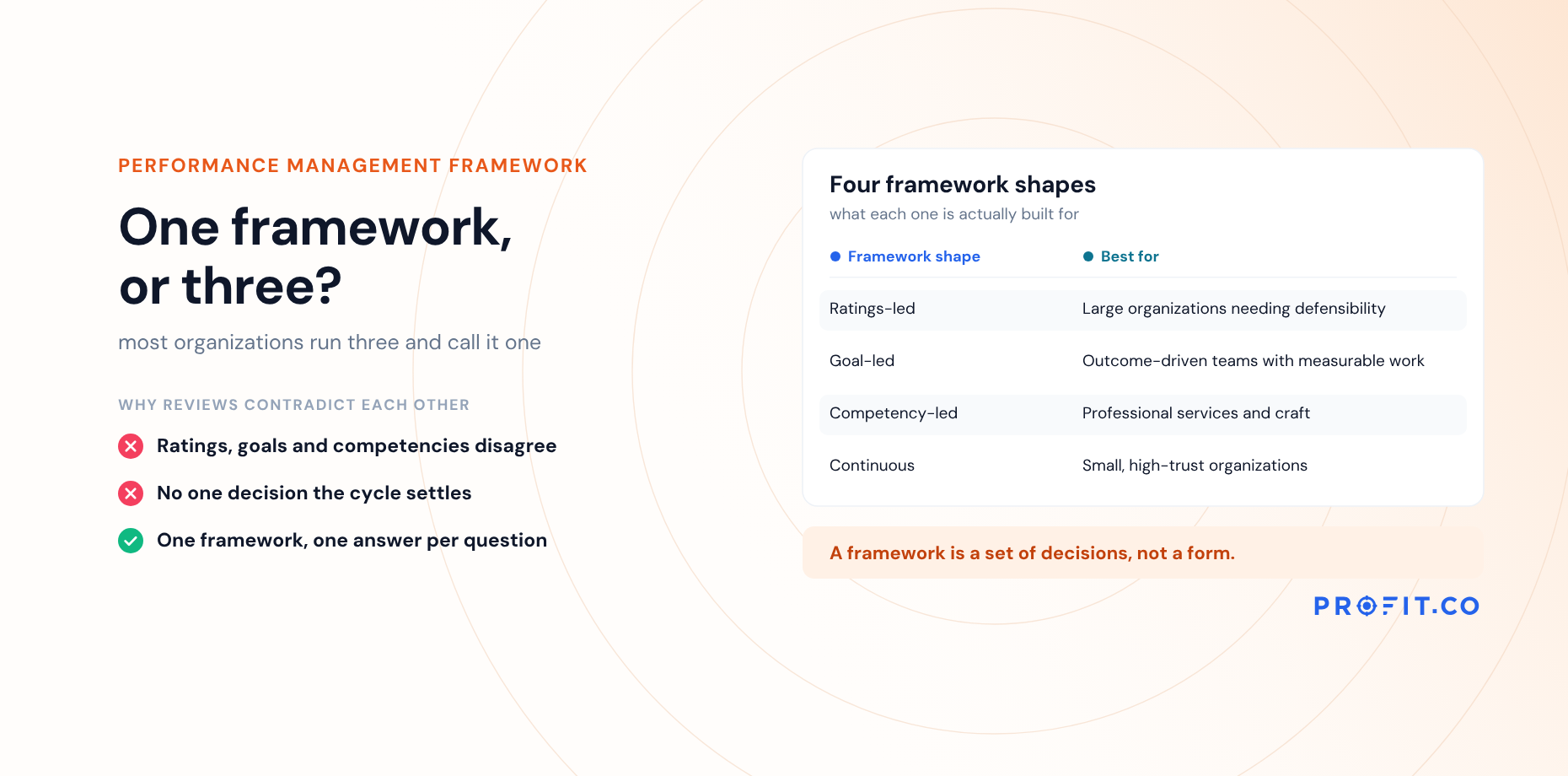
Few organizations lack a performance framework. Most have three, adopted in different years by different people, and nobody has ever made them agree.
Do You Have One Performance Framework or Three?
A performance management framework is the set of decisions that define how performance is measured, judged, reviewed and acted on. It is not a diagram. The test of whether you have one is whether a manager and an employee would independently give the same answer to what good performance means here.
Run that test and the usual finding is three frameworks running at once. There is a goals framework, adopted when the company started setting OKRs, which says performance means moving agreed numbers. There is a competency framework, inherited from HR, which says performance means demonstrating behaviors at the right level. And there is a ratings framework, which exists because compensation needs a number by November and neither of the others produces one.
Each is defensible. Together they produce the familiar December experience: an employee who hit every goal, scored moderately on competencies, and received a rating that matched neither, delivered by a manager who could not fully explain how the three combined. The employee concludes the rating was decided first and justified afterwards, which is sometimes true and always corrosive.
Designing a framework is mostly deciding which of the three leads and how the others attach to it. That is a smaller job than inventing a new system, and it is the job most organizations skip.
What Decisions Does a Performance Framework Actually Settle?
Six. If these have answers everyone can state, you have a framework. If they do not, no amount of process documentation will substitute.
- What counts as performance? Outcomes achieved, behaviors demonstrated, or both in a stated proportion. “Both” without a proportion is how the three-framework problem starts.
- Who judges it? The direct manager alone, the manager plus calibration with peers, or a multi-rater input. Each produces different fairness and different cost.
- How often is it judged? Separate the conversation cadence from the decision cadence. Monthly conversations with one annual decision is a coherent answer; so is quarterly both. Monthly conversations that never produce a decision is not.
- What is it connected to? Pay, promotion, development, or nothing. This single decision changes how honestly everyone behaves, and it is covered in its own section below.
- What happens at the bottom? If sustained underperformance has no defined path, managers will avoid low ratings entirely and the whole distribution drifts upward. A defined performance improvement plan route is what makes honest ratings possible.
- Who owns the framework? A named function that can change it. Frameworks owned by nobody accumulate exceptions until each business unit has its own, which is how you get three in the first place.
Which Framework Shape Fits Your Organization?
Four shapes cover most of the field. None is universally better; they fail differently, and the right choice depends on what your organization can actually sustain.
Four Framework Shapes Compared
| Dimension | Ratings-Led | Goal-Led | Competency-Led | Continuous |
|---|---|---|---|---|
| Performance means | A calibrated score against peers | Outcomes delivered against agreed targets | behaviors demonstrated at a defined level | Sustained progress discussed in the open |
| Decision cadence | Annual | Quarterly or annual | Annual, often with a promotion cycle | Continuous, with a light annual summary |
| Who judges | Manager, then calibration panel | Manager against recorded results | Manager plus multi-rater input | Manager, with employee self-assessment |
| Connects to pay | Directly, by design | Indirectly, or teams sandbag | Through promotion more than merit pay | Loosely, decided outside the cycle |
| Best for | Large organizations needing defensible pay decisions | Outcome-driven teams with measurable work | Professional services, craft and engineering ladders | Small, high-trust organizations |
| Manager time per person | High at year end, low in between | Moderate and spread across the year | High, especially gathering multi-rater input | Highest in total, lowest per occasion |
| Fails when | Ratings become a distribution exercise and lose meaning | Goals go stale and the review judges the wrong year | Levels are vague, so judgment becomes taste | No decision is ever made, so nothing changes |
The practical advice is to pick a lead and make the others subordinate, explicitly. A goal-led framework can carry competencies as a secondary lens that informs development rather than the rating. A competency-led framework can carry goals as evidence. What does not work is weighting them equally and hoping the arithmetic resolves a disagreement about what the organization values.
Should Performance Ratings Be Connected to Pay?
This is the genuinely contested decision, and most framework documents duck it by saying ratings “inform” pay without specifying how. That ambiguity is itself a choice, and usually the worst one available.
The case for connecting them is that pay decisions get made regardless, and a documented rating makes the basis visible and challengeable. Disconnect them and the decision does not disappear; it moves somewhere less transparent, usually a conversation between managers that the employee never sees.
The case against is that the moment a number determines money, people optimize the number. Goals get set conservatively, risks are avoided in the final quarter, and the honest self-assessment that development depends on becomes unaffordable. You cannot ask someone to reflect candidly on weaknesses in a document that sets their raise.
The workable resolutions are not a compromise between the two, but a separation:
- Separate the conversations in time. Development discussion in one month, compensation decision in another, with different documents. Costs more calendar and buys genuine candour in the first conversation.
- Rate the outcome, not the person. Goal achievement feeds pay; competency and growth feed development. Each input goes to one decision rather than both.
- Use ratings for the distribution only. A rating determines which band someone falls into for a budget allocation, and the development conversation never refers to it.
In practice
Linking on purpose
Nuts.com debating how far OKRs should shape performance reviews. They chose to connect them openly, with check-ins through the year so nobody is surprised in December.
“Linking OKRs directly to the performance review and bonus structure has proven very effective. This connection clarifies the purpose and importance of OKRs.”

Joey D Siddens
Payroll & HRIS Manager, Nuts.com

What reliably fails is the unstated middle: telling managers that ratings are developmental while everyone knows they determine the merit pool. Employees work out the real rule within one cycle and respond to that one. If the framework is moving away from ratings entirely, replacing ratings with OKR data covers what fills the gap.
Where Do Goals and Competencies Collide?
The collision is specific and predictable: goals measure what someone achieved, competencies measure how they achieved it, and the two frequently disagree.
The high performer who hit every number while leaving collaboration damage behind scores high on goals and low on competencies. The steady contributor who mentored half the team through a reorganization did the opposite. Both cases are real, both are common, and a framework that averages them produces a middling rating that describes neither person.
Three ways to handle it, in descending order of how well they work:
- Make one a gate rather than a score. Competencies set a floor: below the expected level in a core behavior, no rating above the middle regardless of results. Above the floor, outcomes decide. This matches how most organizations actually behave and makes it explicit.
- Route them to different decisions. Goals to compensation, competencies to promotion and development. Clean, and it requires leadership to accept that a high achiever may not be promotable yet.
- Weight them and average. The most common and the weakest, because a weighted average of two genuine disagreements produces a number nobody can explain to either person.
If you do combine the scores, make the weighting visible to everyone being rated. In Profit.co, the review summary shows how goal, competency and OKR scores are calculated and weighted into the overall result.
Whichever you choose, the goals themselves have to be current for the comparison to mean anything, which is why tracking goals through the year is a prerequisite rather than a nice-to-have. A framework judging December against January goals is measuring the wrong thing precisely.
What Does the Annual Cycle Look Like?
A worked cycle for a goal-led framework with a competency floor, which is the most common shape in organizations that have deliberately chosen one.
| Period | What happens | Who is involved | Produces |
|---|---|---|---|
| January | Goals set and aligned to team objectives; competency expectations confirmed for the level | Manager and employee | 3 to 5 goals with targets, dates and data sources |
| Monthly | Short check-in: what moved, what is blocked, is this still right | Manager and employee | Updated values and named blockers |
| April | First formal keep, re-target, replace or drop decision | Manager and employee | A recorded goal change with its reason |
| Mid-year | Written progress summary and development conversation, deliberately with no rating | Manager and employee | Development actions, no score |
| September | Second change decision and a realistic call on what will finish | Manager and employee | Revised year-end expectation |
| November | Self-assessment, peer input where used, evidence gathered | Employee, peers, manager | Evidence pack for the review |
| December | Review against goal history and the competency floor, then calibration | Manager, then calibration group | A rating with a documented basis |
| January, following | Compensation decisions, in a separate conversation | Manager and employee | Pay outcome, referencing the rating |
Two features of this cycle do most of the work. The mid-year conversation produces no rating, which is what makes it safe enough to be useful. And compensation lands in a separate conversation in the following month, which keeps the December review about performance rather than about money. Both cost calendar time and both are routinely cut, which is one of the reasons performance management programs fail.
What Breaks When You Change the Framework?
Framework redesigns are usually announced as improvements and experienced as disruption. Knowing what breaks lets you sequence the change instead of absorbing all of it at once.
- Historical comparability. Change the rating scale and you cannot compare this year to last. Promotion cases built on three years of ratings become unreadable. Decide in advance whether you are keeping a mapping or accepting a clean break, and say which.
- Manager capability. A framework that asks managers to make finer judgments requires training them to make finer judgments. Rolling out a more sophisticated model to the same managers produces the same decisions with more paperwork.
- Trust, temporarily. Any change to how people are judged is read as a change to who will be judged favourably. Employees will ask what problem this solves, and “best practice” is not an answer that survives contact.
- The calibration habit. Calibration groups develop shared standards over years. Reorganizing them resets that, and the first cycle after a change is reliably less consistent than the last one before it.
- Pay linkage, if you move it. Changing what pay depends on changes behavior in the quarter the announcement lands, not the quarter the framework takes effect.
The practical sequencing: change one of the six decisions per cycle, not several. Organizations that redesign everything at once usually spend the following year explaining the new framework rather than using it, and the cost of that is a year of weaker decisions.
Key Takeaways
- →Most organizations run three frameworks at once: goals, competencies and ratings. Designing one is mostly choosing which leads and how the others attach.
- →A framework is six answered decisions, not a diagram: what counts, who judges, how often, what it connects to, what happens at the bottom, and who owns it.
- →On ratings and pay, the unstated middle is the worst option. Separate the conversations, or route each input to one decision, but say which you are doing.
- →Change one of the six decisions per cycle. Redesigning everything at once costs a year spent explaining the framework rather than using it.
Where Does the Data for This Come From?
From the year, rather than from memory in November. A framework only produces defensible decisions if the evidence was collected while it happened, which is a tooling question as much as a policy one. Profit.co’s performance management keeps goals, check-ins, feedback and review evidence on the same record.
| Framework need | Profit.co capability |
|---|---|
| Run different cycles for different teams | Annual, semi-annual, quarterly, monthly and project-based review cycles with their own templates |
| Combine goals and competencies deliberately | Review templates with rating scales, competency frameworks and goal-linked sections |
| Gather multi-rater input | Self, peer, manager, matrix manager and external reviewers in one Employee 360 Dashboard |
| Make calibration defensible | Score Calibration surfacing rating distributions and flagging statistical outliers before scores lock |
| Keep evidence from the whole year | Check-in history and continuous feedback captured at the time, surfaced in the review |
| Define the path at the bottom | Individual Development Plans and Performance Improvement Plans with status tracking |
See how Profit.co supports a framework your managers can actually run. Book a demo.
What customers report
Evidence from the year, not from memory
60% → 80%
Goal-setting participation at Toyota Connected India
40%
Reduction in review turnaround time at Toyota Connected India
“Now, with just a simple search by the person’s name, I can easily access historical information, making our review process much more streamlined and efficient.”

Kay Lynn Gabaldon
Head of People & Culture, Banyan Security
Free Product Demo
Make One Framework Out of Three
A 30-minute walkthrough, tailored to your team.
Book a DemoPrefer to look around first? Start your free trial.

What happens in the call
How your teams set goals, track progress and review results.
Strategy, performance, projects and engagement on one platform, with AI.
A practical path to align teams, execute faster and drive results.
Frequently Asked Questions
The set of decisions defining how performance is measured, judged, reviewed and acted on: what counts, who judges, how often, what it connects to, what happens at the bottom, and who owns it.
Ratings-led, goal-led, competency-led and continuous. They suit different organizations and fail differently. The key design choice is picking one to lead and making the others explicitly subordinate.
Either link them explicitly or separate them explicitly. The unstated middle, where ratings are called developmental but everyone knows they drive pay, produces the worst behavior in both conversations.
Make competencies a gate rather than a score, or route goals to compensation and competencies to development. Weighting and averaging them produces a number that explains neither person.
Change one of the six core decisions per cycle. Redesigning several at once breaks historical comparability and calibration habits, and usually costs a year spent explaining the framework.
