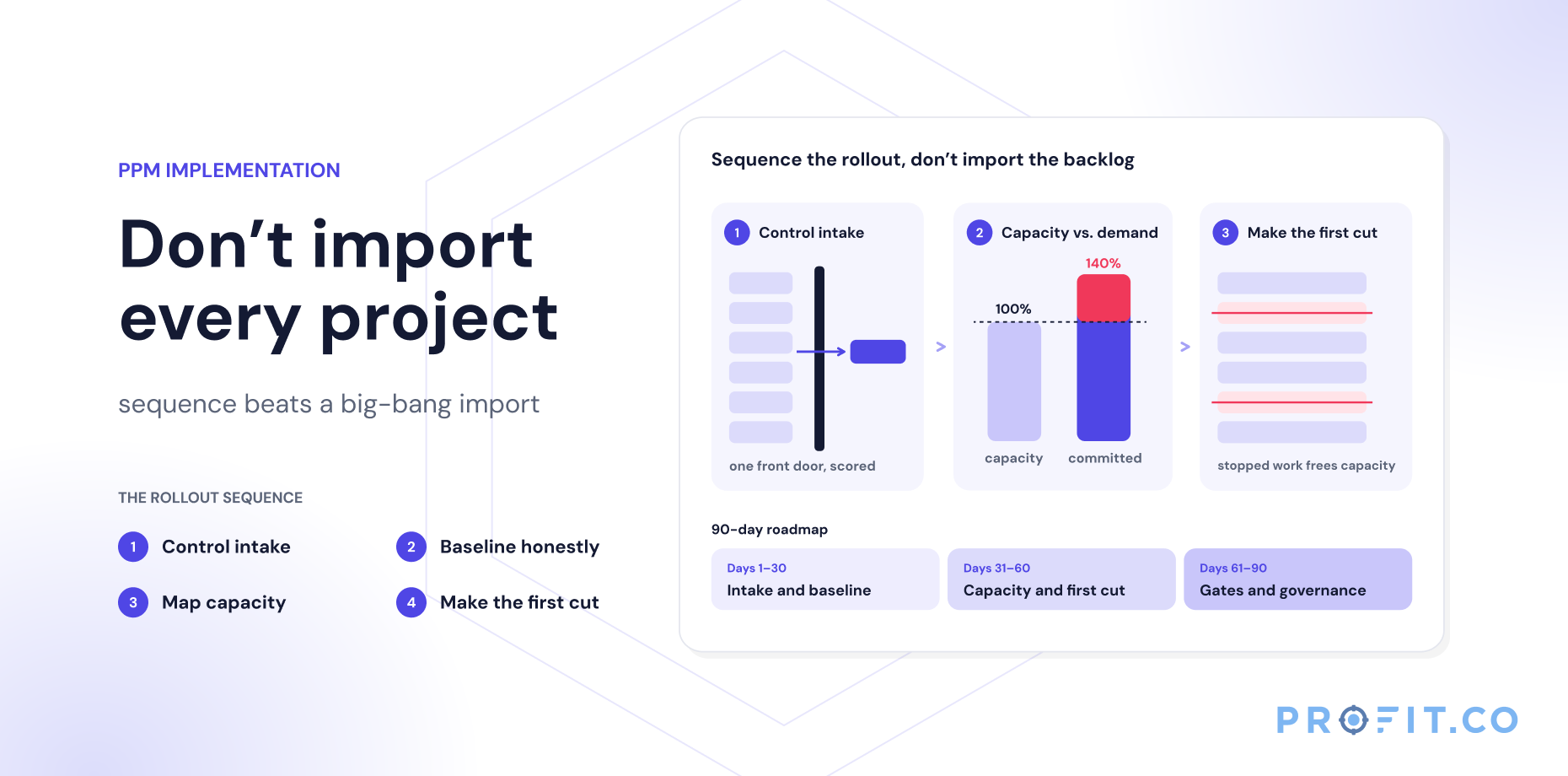
Most PPM rollouts begin by importing every existing project, which digitizes the overload instead of fixing it. Start with intake, because the portfolio you inherited is not the problem you can solve first.
In this guide
- What Is PPM Implementation?
- What Should You Decide Before PPM Implementation?
- What Are the Steps to Implement PPM?
- Should You Pilot PPM or Roll It Out Everywhere?
- What Does a PPM Implementation Roadmap Look Like?
- Why Do PPM Implementations Fail?
- How Do You Measure PPM Implementation Success?
- Where Should PPM Implementation Start?
- How Does Profit.co Support Each Step?
- Frequently Asked Questions
What Is PPM Implementation?
PPM implementation sets up intake, capacity, governance, and value tracking so an organization runs the right projects, not just more of them.
The distinction worth holding onto is that PPM implementation is an operating-model change that happens to involve software. Project management asks whether a given project is on time and on budget. Portfolio management asks a harder question: should this project exist at all, given everything else competing for the same people and money?
That question has an uncomfortable implication. A successful implementation will stop things. If a rollout finishes with the same projects running that were running before, nothing has been implemented except a new reporting surface. The organizations that get value from PPM are the ones that treat the first portfolio review as a decision meeting rather than a data-quality exercise.
What Should You Decide Before PPM Implementation?
These three get made either deliberately at the start or accidentally in month four. Deliberate is cheaper.
1. Who can say no?
Portfolio management is the authority to decline work. If no named person or forum can refuse a request from a senior stakeholder, you are building a tracking system, not a portfolio. Decide now whether that authority sits with a PMO, an executive committee, or a single accountable leader, and get it stated in writing before the first intake request arrives.
2. What is the portfolio’s unit of account?
Money, people, or both. Most organizations say money and manage people, which produces portfolios that are inside budget and impossible to staff. If engineering capacity is the real constraint, the portfolio should be denominated in engineering weeks and the budget conversation should follow it, not lead it.
3. What counts as a project?
Without a threshold, everything becomes a project and the portfolio drowns in items of two days’ effort. Set a floor (a common one is anything above four weeks of effort or crossing two teams) and let everything below it stay in ordinary task management where it belongs. A portfolio of 300 items is not visibility, it is noise. Running the PPM maturity assessment first is a useful way to establish where you are actually starting from.
What Are the Steps to Implement PPM?
The order matters more than the speed. Each step makes the next one possible.
- Control intake before anything else. Stand up a single front door through which every new request passes, with a required business case: the outcome, the sponsor, the estimated effort, and the strategic objective it serves. A structured intake process filters requests on business case criteria before they enter the portfolio, which is the only step that reduces inflow rather than organizing it. Build this in week one, even if the existing portfolio stays untouched for another month. See the project intake process guide for the criteria to use.
- Baseline the existing portfolio without cleaning it. List what is actually running, with sponsor, effort to date, effort remaining and the objective it serves. Resist the urge to tidy. The value of this list is that it is honest, and the first version will contain projects nobody can name a sponsor for, which is the finding you need.
- Map capacity against committed demand. Compare the effort remaining across all active projects to the people actually available. Many organizations discover they are committed well beyond their real capacity. A capacity heatmap showing over-allocated and under-utilized resources turns an abstract argument into a picture. This step pairs with demand and capacity planning.
- Hold the first prioritization decision. With intake controlled and the overcommitment visible, bring the portfolio to a decision forum and cut it to capacity. This is the moment the implementation either becomes real or becomes a dashboard. Expect it to be difficult, expect at least one escalation, and expect the organization to watch closely whether leadership holds the line.
- Add stage gates. Introduce gates so projects are reviewed at phase boundaries rather than only at the end. Gates give you scheduled opportunities to stop work, which is the main thing a portfolio needs and a project plan never provides. For how to decide at each gate, see go, hold, or stop tollgate decisions.
- Turn on governance tracking. Risks and blockers raised verbally recur next quarter. A governance log covering risks, issues, changes, actions, decisions, assumptions and blockers, each carrying its own identifier, means a concern raised in a review has an owner and a date instead of a shared memory.
- Connect financials and effort. Link timesheets so hours flow from tasks into project cost without re-entry, and track CapEx, OpEx and variance from one set of numbers. Once effort and spend sit on the same ledger, earned value metrics become available: cost and schedule performance indices across the portfolio, calculated rather than assembled by hand each month.
- Establish value realization. The final step closes the loop that most implementations never close. A value realization review compares the benefits a project promised at intake against what it actually delivered after go-live. Without this, intake business cases are fiction nobody is ever held to, and the portfolio slowly refills with optimistic estimates.
See Demand vs Capacity Before You Approve More Work
Should You Pilot PPM or Roll It Out Everywhere?
Three ways to sequence the organizational rollout, with genuinely different risk profiles.
The Three Rollout Models Compared
| Dimension | Pilot | Phased | Big-Bang |
|---|---|---|---|
| Scope at launch | One portfolio or department | One capability at a time, org-wide | Everything, everywhere |
| Time to first value | 4 to 6 weeks | 8 to 12 weeks | One quarter, if it lands |
| Main risk | Findings dismissed as “that team is different” | Momentum fades between phases | One bad month discredits the whole program |
| Best when | Sponsorship is uncertain and needs evidence | The organization is large and federated | A deadline or audit forces a single cutover |
| Data migration | One portfolio, manual, clean | Incremental, manageable | All historic projects at once, usually the point of failure (why PPM migrations stall) |
| Executive attention | Low until results appear | Sustained, which is the hard part | Intense but short |
| Recommended for | Most organizations starting out | Enterprises above roughly 1,000 people | Rarely; only with a forcing deadline |
Default to pilot. The argument for big-bang is usually that a partial rollout gives an incomplete portfolio view, which is true and less damaging than the alternative. A pilot that produces one genuine stop decision will do more for adoption than a complete dataset nobody trusts.
What Does a PPM Implementation Roadmap Look Like?
Days 1 to 30: intake and baseline
Stand up the intake form and route every new request through it. Baseline the running portfolio without cleaning it. Agree the three pre-start decisions in writing. Configure the fields you need once, at portfolio level, so they apply consistently rather than being re-specified per project. Deliverable at day 30: an honest list of what is running and a closed front door.
Days 31 to 60: capacity and the first cut
Load effort estimates and available capacity, and produce the overcommitment picture. Hold the first prioritization forum and cut the portfolio to capacity. Configure threshold alerts for budget, schedule and earned value metrics so breaches trigger alerts instead of waiting for the monthly review. Deliverable at day 60: a portfolio that fits, and at least one project formally stopped.
Days 61 to 90: governance and cadence
Introduce stage gates on projects already in flight, turn on governance tracking, and establish the standing portfolio review. Connect timesheets so effort and cost reconcile. Deliverable at day 90: a monthly portfolio review that makes decisions, backed by numbers nobody assembles by hand.
Why Do PPM Implementations Fail?
Six patterns account for most of it, and none of them are really about software. Choosing a method is rarely the problem either, though PPM frameworks matter once the basics hold.
- Importing everything on day one. Migrating 200 live projects into a new system before intake is controlled reproduces the overload with better charts. Control the inflow first.
- No authority to decline. If a senior stakeholder can bypass intake, intake does not exist. This fails on the first escalation, and everyone is watching that escalation.
- Treating it as a tooling project. A PPM rollout run by IT with no executive forum attached produces a well-configured system that changes no decisions. The standing review is the implementation; the software supports it.
- Capacity in money only. Budget approval does not create engineers. Portfolios denominated purely in cost approve work the organization cannot staff, and the gap surfaces three months later as slipped dates.
- Gates that never stop anything. A gate that always approves is a status meeting with extra paperwork. If no project has failed a gate in two quarters, the gate is decorative.
- No value loop. When nobody checks whether delivered projects produced the benefits claimed at intake, business cases inflate freely. The project closure process is where this is caught, and it is the step most often skipped under delivery pressure.
How Do You Measure PPM Implementation Success?
Four measures, readable within two quarters. Avoid judging on adoption statistics, which measure compliance rather than value.
- Projects stopped per quarter. The clearest single indicator. Zero means the portfolio is still a queue rather than a set of choices.
- Committed demand as a percentage of capacity. Should be trending toward 100% and ideally a little below, leaving room for the unplanned work every organization absorbs.
- Time from request to decision. Intake should make this faster, not slower. If a structured front door adds three weeks before anyone gets an answer, the criteria are too heavy.
- Benefits realized against benefits claimed. The hardest to measure and the most valuable. Even a rough ratio changes how business cases get written, because authors know someone will check. For a related view on presenting portfolio options to leadership, see why a PMO should bring three portfolio scenarios to budget meetings.
Where Should PPM Implementation Start?
Do the capacity arithmetic before you buy anything. Add up the remaining effort across every active project and compare it to the people you actually have for the next two quarters. The result is often well above 100%, and that single number does more to create appetite for portfolio management than any amount of explaining what portfolio management is.
Then control intake. It is the cheapest step, it can be done with a form and a weekly triage before any platform is configured, and it is the only one that reduces the size of the problem rather than describing it more precisely. Everything else in this guide gets easier once the inflow is governed, and nothing else works if it is not.
How Does Profit.co Support Each Step?
Profit.co runs the full implementation sequence in one platform, so intake, capacity, gates, and value tracking share the same data.
| Step | Profit.co capability |
|---|---|
| Control intake | Demand Management, with every request linked to an active key result |
| Map capacity | Resource capacity planning and utilization analytics |
| Add stage gates | Tollgates: each stage is reviewed and approved before the project moves on |
| Track governance | Risk and issue management, with a governance log covering risks, issues, changes, actions, decisions, assumptions and blockers |
| Connect financials | Earned value management across the portfolio |
| Realize value | Value Realization Office: budget to delivered benefits, with CapEx and OpEx splits |
Key Takeaways
- →Sequence beats speed. Intake, then capacity, then gates, then value. Importing the existing portfolio first digitizes the overload rather than fixing it.
- →Three decisions settle the outcome before configuration starts: who can decline work, whether the portfolio is denominated in money or people, and what counts as a project.
- →Projects stopped per quarter is the measure that matters. As the failure patterns show, a portfolio that never stops anything is a queue with better reporting.
- →Budget on 90 days to a working portfolio and two to three quarters before decisions visibly change. Pilot first unless a deadline forces a single cutover.
Run Your Whole Portfolio in One Place
Frequently Asked Questions
Control intake first, baseline the running portfolio honestly, map capacity against committed demand, hold a prioritization decision that cuts to capacity, then add stage gates, governance tracking, financial reconciliation and value realization in that order.
About 90 days to a working portfolio with controlled intake, a capacity picture and a standing review. Expect two to three quarters before portfolio decisions visibly change, since the operating-model shift takes longer than the configuration.
Project management asks whether a project is on time and on budget. Portfolio management asks whether it should exist at all given everything competing for the same people and money. Portfolio management is the authority to decline work.
Pilot, in almost every case. One portfolio reaching a genuine stop decision in six weeks builds more support than a complete org-wide dataset nobody trusts. Reserve big-bang rollouts for a forcing deadline such as an audit.
Most often because every existing project is imported before intake is controlled, or because no one has authority to decline work from a senior stakeholder. Both produce a reporting system rather than a portfolio.