











Strategy deployment didn’t start as a software category or a consulting framework. It grew out of Japanese quality management, traveled west as “policy deployment”, and picked up ideas from OKRs and the Balanced Scorecard along the way. Each era added something that still matters.
In this guide
Key Takeaways
- →Hoshin kanri combines hoshin, direction or policy, with kanri, management or control.
- →It emerged in the 1960s as an extension of total quality control: PDCA applied to direction, not just processes.
- →“Policy deployment” is the older translation; “strategy deployment” is preferred because policy suggests rules.
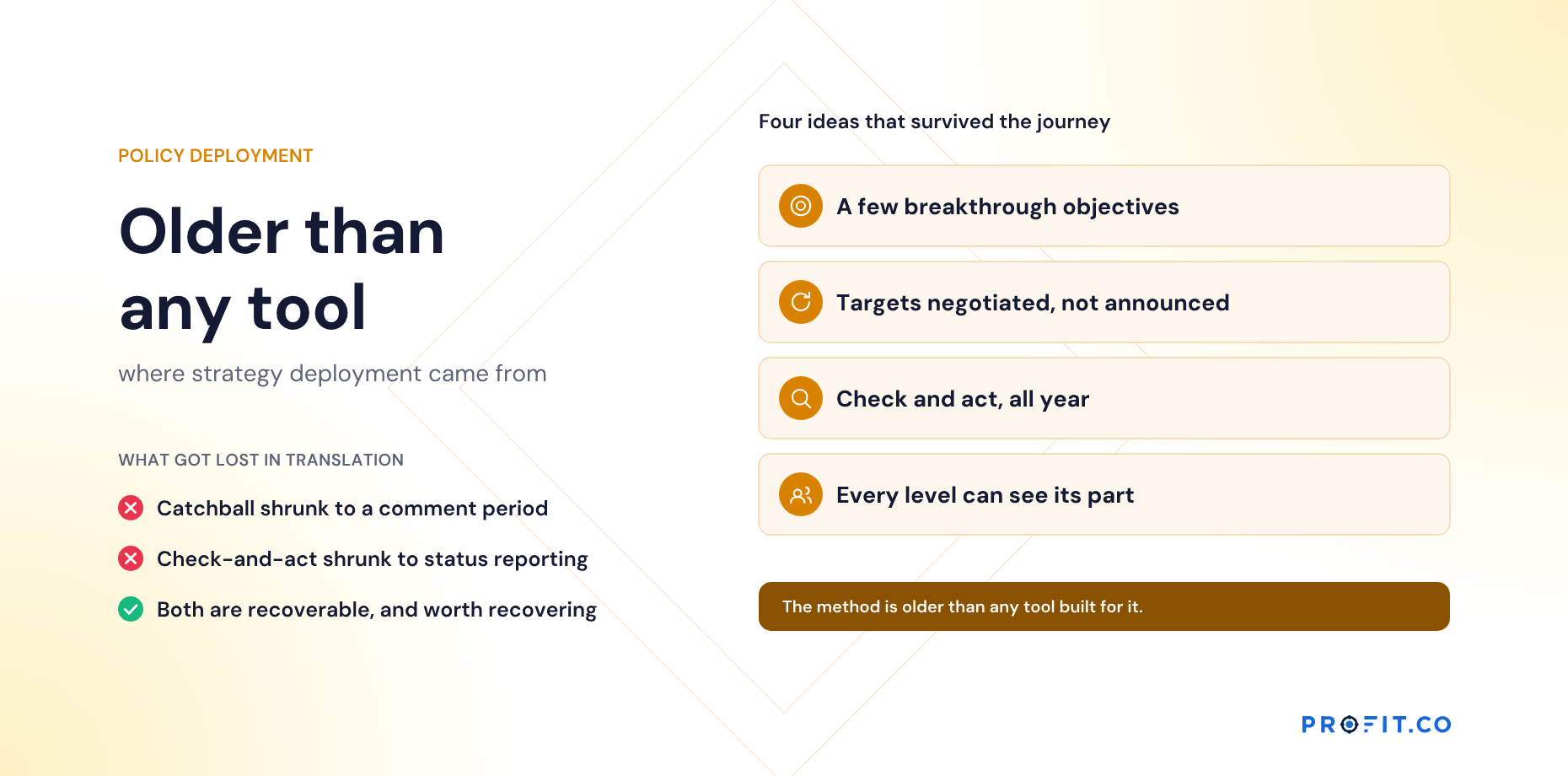
- →Four ideas survived: few breakthrough objectives, negotiated targets, check and act, and everyone’s work connected.
- →Two things were lost: catchball shrank to a comment period, and check-and-act shrank to status reporting.
- →The method is older than any tool built for it. Software should carry its ideas, not replace them with a cascade.
Hoshin kanri and the name
The Japanese term hoshin kanri combines hoshin, often rendered as direction or policy (the image is a compass needle), and kanri, management or control. It emerged in Japanese companies in the 1960s as an extension of total quality control: if quality methods could improve processes, the same plan-do-check-act discipline could steer the organization’s direction.
Yoji Akao’s Hoshin Kanri: Policy Deployment for Successful TQM brought the method to English readers and popularized “policy deployment” as the translation. “Strategy deployment” is the term many Western organizations now prefer, because “policy” suggests rules rather than direction.
The plain-language version of what the method does, stripped of both vocabularies, is in What Is Strategy Deployment? A Definition Without the Jargon.
What each era added
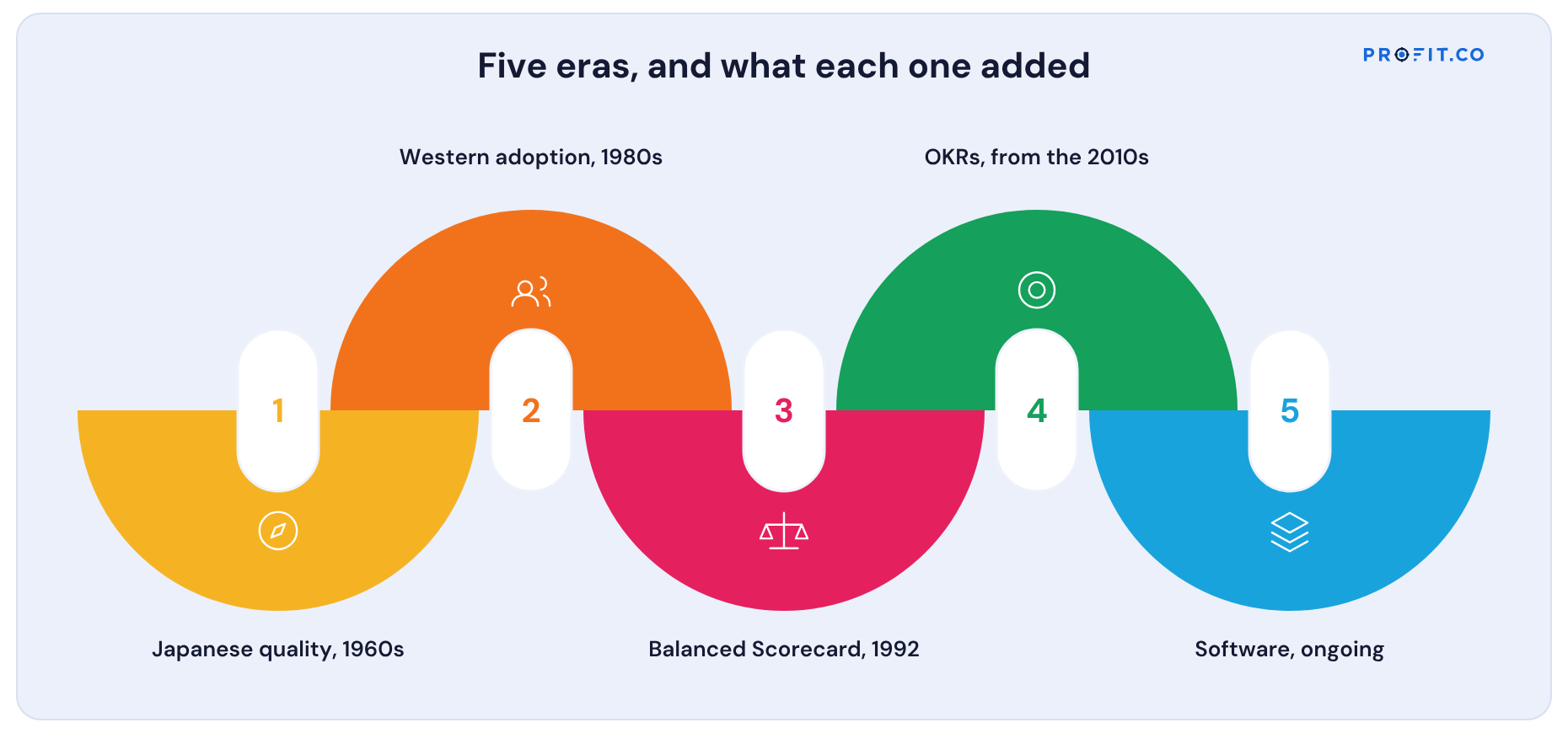
Five eras, each adding something the next one kept.
| Era | Contribution | Still matters because |
|---|---|---|
| Japanese quality management, 1960s onward | PDCA applied to strategy; a few breakthrough objectives; catchball between levels | Negotiated targets and check-and-act remain the core |
| Western adoption, 1980s and 1990s | Strategy deployment in large manufacturers and utilities; the X-matrix as a planning artifact | Showed the method works outside Japan and outside the factory |
| Balanced Scorecard, from 1992 | Balance across financial, customer, process and capability perspectives | Stops strategies that only watch financial outcomes |
| OKRs, popularized from the 2010s | Team-level objectives, frequent check-ins, ambitious targets | Brought deployment to every team, not just management |
| Software, ongoing | Live data, many levels, history kept | Makes the three directions practical at scale |
A simplified view; each method has a longer history of its own.
The ideas that survived
- Few breakthrough objectives. Focus on the handful of changes that matter, not a catalogue of goals.
- Negotiated targets. Catchball: the level that delivers a target helps set it.
- Check and act. The plan is a set of hypotheses, tested and corrected through the year.
- Everyone’s work connected. Every level can see how its work serves the direction.
The method is older than any tool built for it. Software should carry its ideas, not replace them with a cascade.
The first of those four is harder than it sounds in practice, and is worked through in Choosing the Vital Few: How Many Hoshin Priorities Is Too Many.
What got lost in translation
As the method spread, two parts tended to fall away. Catchball shrank into a comment period, so targets became cascaded rather than negotiated. And the check-and-act step shrank into status reporting, so the plan was monitored rather than tested. Most of the failures described elsewhere in this library, Cascading Goals vs Negotiating Them: Why Top-Down Cascades Fail and Alignment Isn’t Effect: Why Well-Aligned Plans Still Miss, trace to those two losses.
A worked example: the same idea in three vocabularies
Here are three hypothetical vendors tested against six must-pass checks, with one gate to clear:
Here is how Hoshin kanri, the Balanced Scorecard and OKRs name the same steps:
| Idea | Hoshin kanri | Balanced Scorecard | OKRs |
|---|---|---|---|
| Long-term direction | Breakthrough objectives | Strategic objectives and the strategy map | Company-level objectives |
| This year’s focus | Annual objectives and priorities | Initiatives | Quarterly objectives |
| Measures | KPIs on the X-matrix | Measures and targets per perspective | Key results |
| Agreement between levels | Catchball | Cascading scorecards | Alignment conversations |
| Check and act | Monthly bowler review; A3 | Strategy review meetings | Weekly check-ins; quarterly scoring |
The ideas are shared; the vocabulary differs. That’s why Profit.co runs hoshin kanri, the Balanced Scorecard and OKRs on one data model, so an organization can use the vocabulary each audience understands without splitting the plan. See the strategy deployment software page.
Where each one genuinely belongs, rather than which is better, is set out in Hoshin Kanri and OKRs on One Platform: Where Each Belongs and Hoshin Kanri and the Balanced Scorecard: Perspectives on the Matrix.
What running all three vocabularies costs
Most organizations of any size are already running two of the three: a scorecard the board reads, OKRs the teams write, and a hoshin plan for the operating units. The cost is rarely licensing. It is the quarterly reconciliation, when three versions of the same objective have to be matched by hand before anyone can report on them.
Among published alternatives, OnStrategy lists $200 per month for unlimited users. i-nexus publishes a free Starter tier for up to five users and $28 per user per month at its Standard tier. The question to put to either is whether a scorecard measure and an OKR key result can be the same record, or whether they are two records someone keeps in step.
Profit.co publishes two plans, Essentials and Enterprise, quoting against modules and scale rather than a public seat rate. Hoshin Kanri sits in Essentials with OKRs and Goals, Balanced Scorecard and Strategy Roadmap, so the three vocabularies are views of one plan rather than three subscriptions. What Drives the Cost of Hoshin Kanri Software lists the rest to total, and the 30-day free trial is enough to load one objective and see it in all three.
Three vocabularies, one plan, in Profit.co
Three things make that one data model work in practice:
- One objective, three views. A breakthrough objective, a scorecard objective and a company-level OKR can be the same record read three ways.
- Catchball is kept, not compressed. The negotiation is a session with a change table and agreement from each participant, rather than a comment box.
- Check and act is a step, not a status. An Act decision writes back to the correlation it questions, which is the part the method lost on its way west.
See the Hoshin Kanri software page, or How to Integrate Hoshin Kanri With Other Management Systems for how this sits beside what you already run.
Free Product Demo
Run your plan in the vocabulary each team uses
A 30-minute walkthrough, tailored to your team.
Book a free demo
What happens in the call
How your teams set goals, track progress and review results.
Strategy, performance, projects and engagement on one platform, with AI.
A practical path to align teams, execute faster and drive results.
Questions this article answers
A translation of hoshin kanri, the Japanese strategy deployment method that applies plan-do-check-act to an organization’s direction, with negotiated targets and a few breakthrough objectives.
Broadly, yes. Strategy deployment is the term many Western organizations prefer, because “policy” suggests rules rather than direction.
Both are ways of deploying strategy. The scorecard added balance across perspectives; OKRs brought deployment to every team with frequent check-ins.
It combines hoshin, direction or policy, with the image of a compass needle, and kanri, management or control. Together: managing the organization’s direction.
Two things. Catchball shrank into a comment period, so targets became cascaded rather than negotiated. And check-and-act shrank into status reporting, so the plan was monitored rather than tested.