













Profit.co governs every Balanced Scorecard user through one of three assigned roles, each unlocking a different mix of create, manage, and view privileges. These role assignments determine exactly which scorecards a person can edit and which they can only observe.
Table of Contents
What Is BSC Role-Based Access?
BSC role-based access is the permission layer that controls which Balanced Scorecard functionalities a user can reach once the module is enabled. Profit.co combines three privilege levels, Manage, Access, and View, into three named roles, so each role bundles a different mix of create, oversight, and visibility rights.
| Privilege | Description |
|---|---|
| Manage | Create, view, and oversee the entire module's progress. |
| Access | Create, view, and manage only the user's own department. |
| View | View-only privileges to the module, with no create or manage rights. |
| BSC Roles | Manage | Access | View |
|---|---|---|---|
| Balanced Scorecard Admin | ✅ | ✅ | ✅ |
| Balanced Scorecard User | ✅ | ✅ | |
| Balanced Scorecard Read Only | ✅ |
Balanced Scorecard Admin can create, view, and manage all scorecards across every department, giving this role comprehensive oversight and control. Balanced Scorecard User can create, view, and manage scorecards only for their own department, while other departments stay visible to them in view-only form. Balanced Scorecard Read Only can view the Balanced Scorecard and expand or collapse it for easier navigation, with no create or manage rights at all.
Note
These three roles are specific to the Balanced Scorecard module. They don't carry over to other Profit.co modules such as OKRs or Performance Reviews, which use their own separate role assignments.
Why Does BSC Role-Based Access Matter?
Without scoped roles, every user added to the Balanced Scorecard module would see the same create and manage controls regardless of department. The three-role structure routes Manage privileges to BSC Admins, Access privileges to department-level BSC Users, and View-only privileges to Read Only users, so each person's dashboard only surfaces what their responsibility actually requires.
This scoping also fixes accountability. Because only the Admin role can create scorecards across every department, there's a single identifiable owner for organization-wide scorecard changes, while each BSC User stays accountable for their own department's scorecard only. Read Only reviewers get full visibility to track progress without the ability to alter any scores.
How Do I Assign a BSC Role?
Step 1: Open User Management
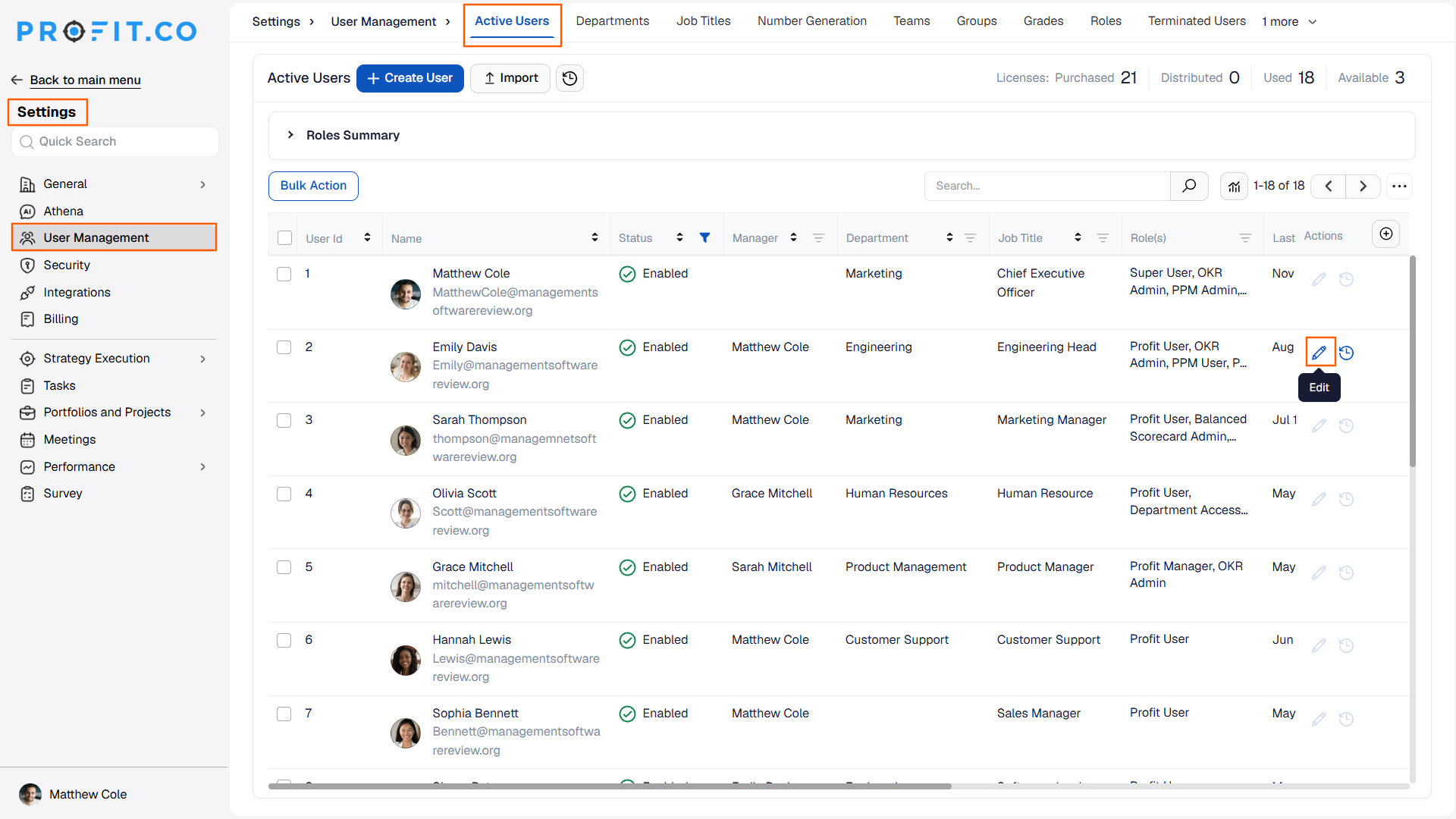
- Navigate to Settings → User Management from the left navigation panel
Step 2: Select the Employee
- On the Active Users page, select the employee you want to assign a role to
- Click the Edit icon to open their profile
Step 3: Add the Role
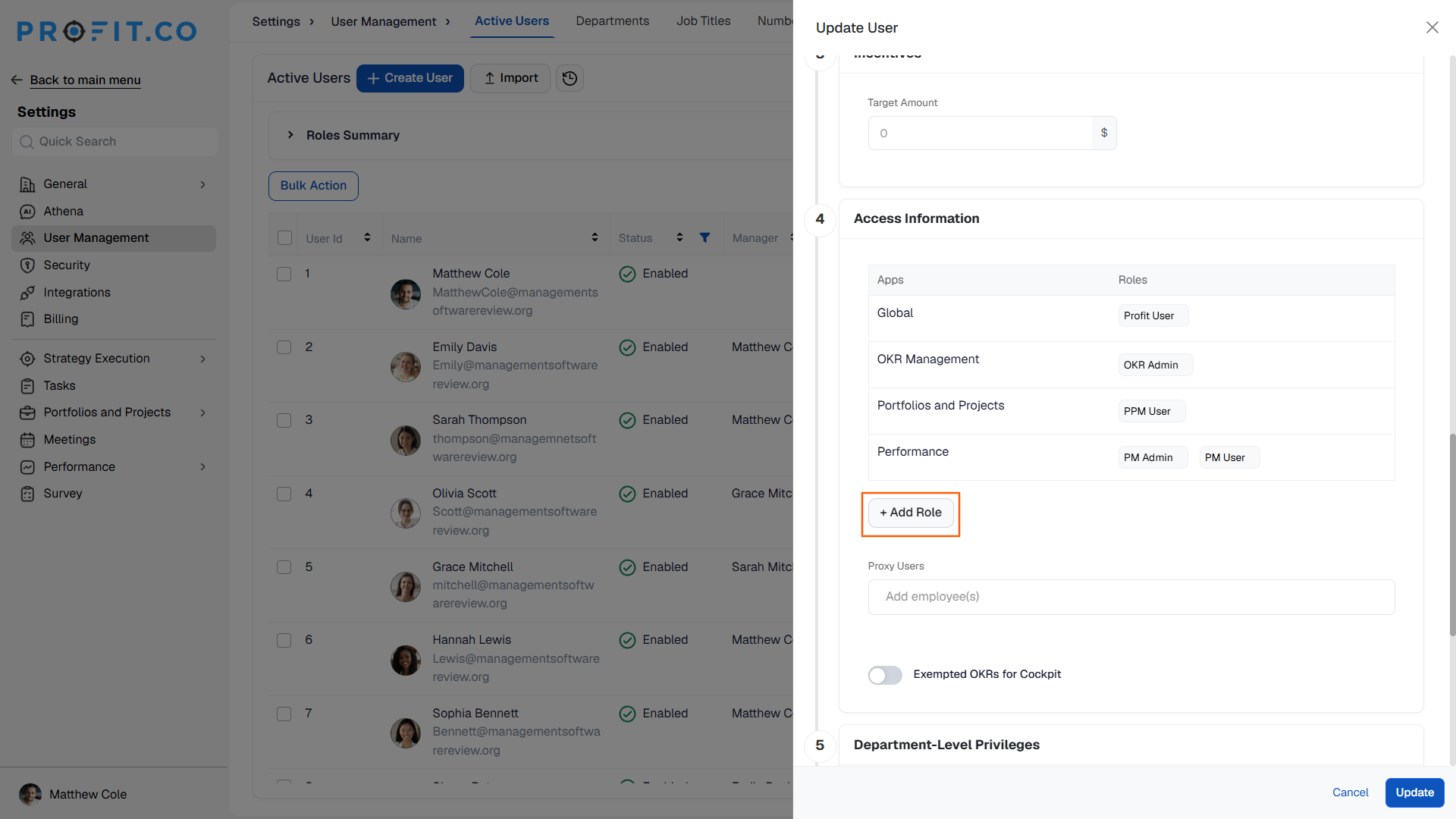
- Click the + Add Role button under the Access Information tab
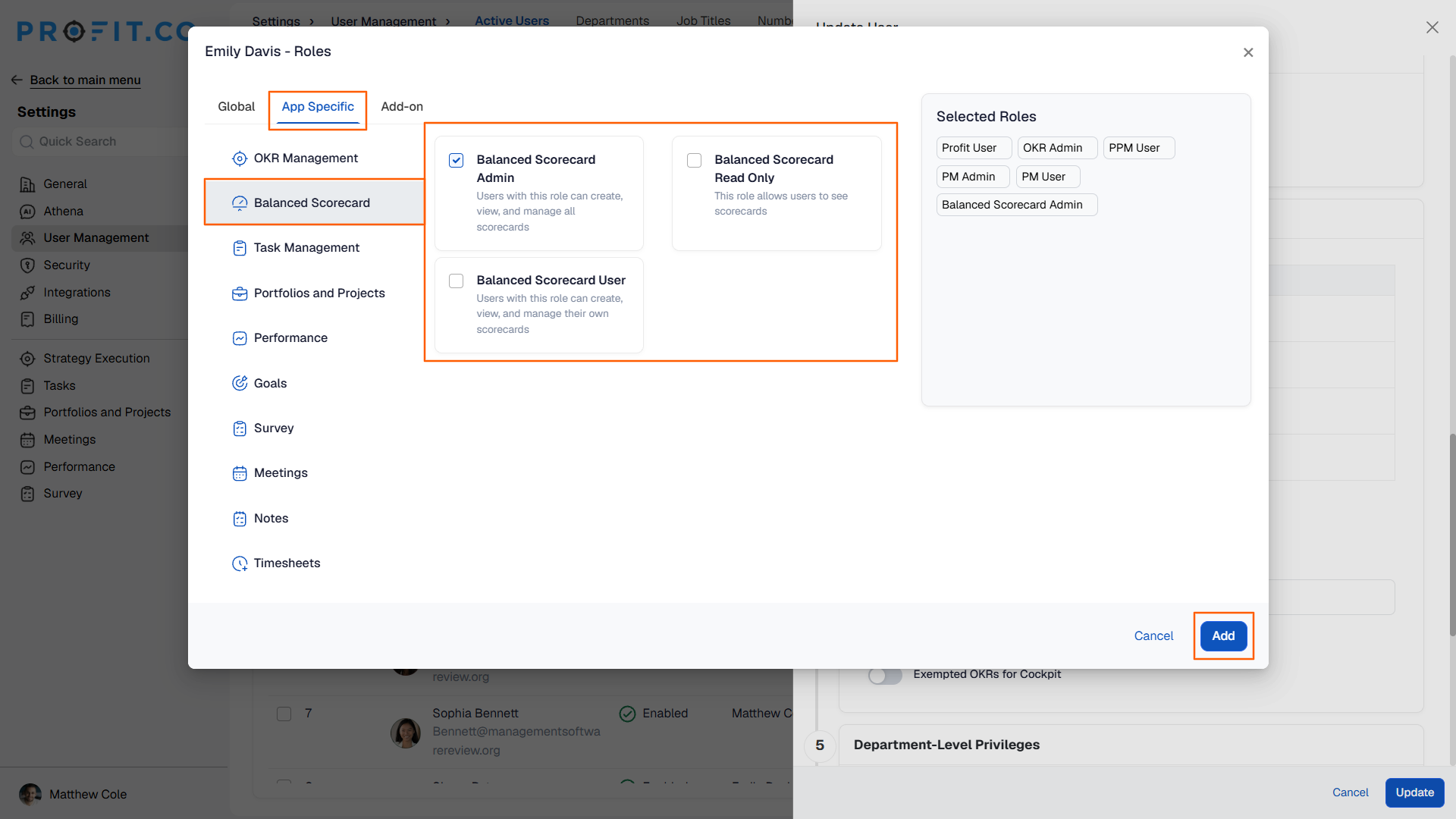
- Choose the required role (Admin, User, or Read Only)
- Choose the required module, and the required role
- Click Add to confirm
What Happens When You Assign a BSC Role?
| Scenario | What Happens |
|---|---|
| You assign the Balanced Scorecard Admin role. | Profit.co grants Manage, Access, and View privileges across every department, letting the user create and oversee all scorecards. |
| You assign the Balanced Scorecard User role. | Profit.co grants Access and View privileges only, limiting scorecard creation and management to the user's own department while other departments stay view-only for them. |
| You assign the Balanced Scorecard Read Only role. | Profit.co grants View privileges only, letting the user view and expand or collapse scorecards without create or manage access. |
What Are the Best Practices for Assigning BSC Roles?
- Assign Balanced Scorecard Admin sparingly, since it grants create and manage access to every department's scorecard, not just the assigning user's own area.
- Use Balanced Scorecard User for department leads who need to manage their own scorecard but don't require manage access into other departments.
- Reserve Balanced Scorecard Read Only for stakeholders who only need to track progress, since Manage and Access privileges are excluded from this role entirely.
- Confirm the correct role before clicking Add on the Access Information tab, since each role changes scorecard creation and management scope for that user immediately.
- Review existing role assignments periodically on the Active Users page, since Admin assignments concentrate scorecard authority across the whole organization if left unchecked.
Related Articles
- How to create a BSC in profit.co?
- How can I add a new employee to Profit.co?
- What are the various app-specific roles available for users in Profit.co?
What Are Some Frequently Asked Questions About BSC Roles?
Profit.co provides exactly three BSC roles: Admin, User, and Read Only. There's no additional tier between Admin and User.
Yes. The Read Only role includes the option to expand and collapse the Balanced Scorecard for easier navigation, even though it carries no create or manage rights.
No. BSC roles are specific to the Balanced Scorecard module. Access to other modules is controlled by that module's own separate role assignments.
Execute your strategy with confidence
Connect OKRs, tasks, and teams in one place with Profit.co
