The best vendor evaluation starts with something you already built.
In this guide
- You Are a Better-Informed Buyer Than Most
- Test One: Parity on What Your Users Rely On
- Test Two: What Your Prototype Could Never Do
- Test Three: A Clean Path for Your Data and People
- Test Four: Openness for Your Builders
- Test Five: Real Commitment to Your Success
- Run a Pilot With Your Real Users
- Make the Decision and Honor the Prototype
- Frequently Asked Questions
Key Takeaways
- →A working prototype makes you a better-informed buyer than most. Vendors cannot fall back on general claims when you can ask them to show your workflows.
- →Parity is necessary but not sufficient. If a platform matches your prototype and offers little beyond it, the case for moving is weak.
- →A vendor that treats migration as your problem is telling you how it will treat other problems later.
- →Have your own engineers build a small edge tool during the evaluation. That tells you more about openness than any documentation.
- →Moving to a platform is not an admission that building was a mistake. It is the natural next step for a successful experiment.
You Are a Better-Informed Buyer Than Most
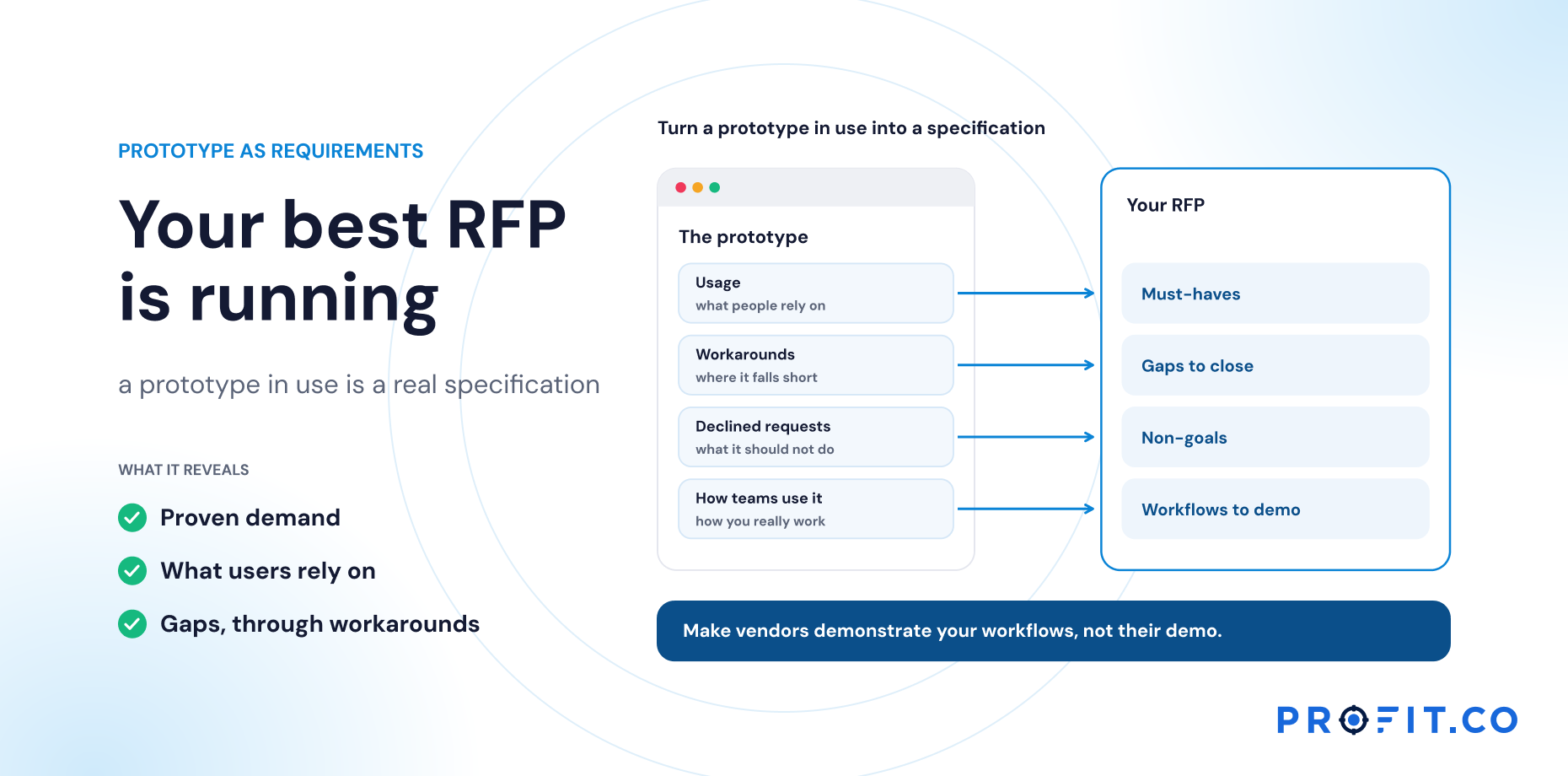
An organization with a working prototype evaluates platforms against something real rather than untested requirements. That turns a vendor evaluation into a precise test: vendors must demonstrate your workflows with your data, and the results can be compared directly with what your users already have.
Organizations that have already built a strategy app often approach vendor evaluation defensively. They have something that works, and they suspect a platform will be more expensive, less flexible, or simply different from what users know. Those concerns are reasonable.
They also hide an advantage. An organization with a working prototype knows its real needs better than almost any other buyer. Used well, that knowledge turns a vendor evaluation into a precise test. This final article sets out how to run it.
Most buyers evaluate strategy platforms against requirements they have never tested. You can evaluate them against something real: a system with users, data, history, and a record of what worked and what did not.
That changes the dynamic of the evaluation. Vendors cannot rely on general claims or polished demonstrations, because you can ask them to show your specific workflows and compare the results with what your users already have. The strongest vendors will welcome that. It lets them show where they go further.
The Five Tests, as a Scorecard
| Test | What to ask | What a good answer looks like |
|---|---|---|
| 1. Parity | Does every capability our users actually rely on have a clear equivalent? | Not identical, but users would feel they gained something rather than lost it |
| 2. Beyond the prototype | Multiple methods with one leadership view? Complete history with authors and approvals? Permissions, residency, subject access? Scale? Governed AI? | Concrete demonstrations rather than general claims. This is where vendors differ most |
| 3. Data and people | How do goals, measures and history come across? How are users provisioned? How long does it take? | A migration plan the vendor owns, not one treated as your problem |
| 4. Openness | Interfaces for reading and writing data, notifications, integrations, AI connections, export | Your own engineers build a small edge tool against it during the evaluation |
| 5. Commitment | References of similar size and region who also moved from an internal tool. What happens to our data if we leave? | Contract terms covering availability, support, data protection and renewal |
| The pilot | Do people update their goals? Do leaders find the reviews useful? Was the transition smooth? | A clear win over the prototype, described in users’ own words |
Test One: Parity on What Your Users Rely On
Begin with the capabilities your prototype provides that people actually use. Usage data identifies them, as the previous articles described. A platform that cannot match these will face resistance, however strong it is elsewhere.
Parity does not mean identical. A good platform may handle the same need in a better way. What matters is that every important use of the prototype has a clear and comfortable equivalent, and that users would feel they gained something rather than lost it.
Test Two: What Your Prototype Could Never Do
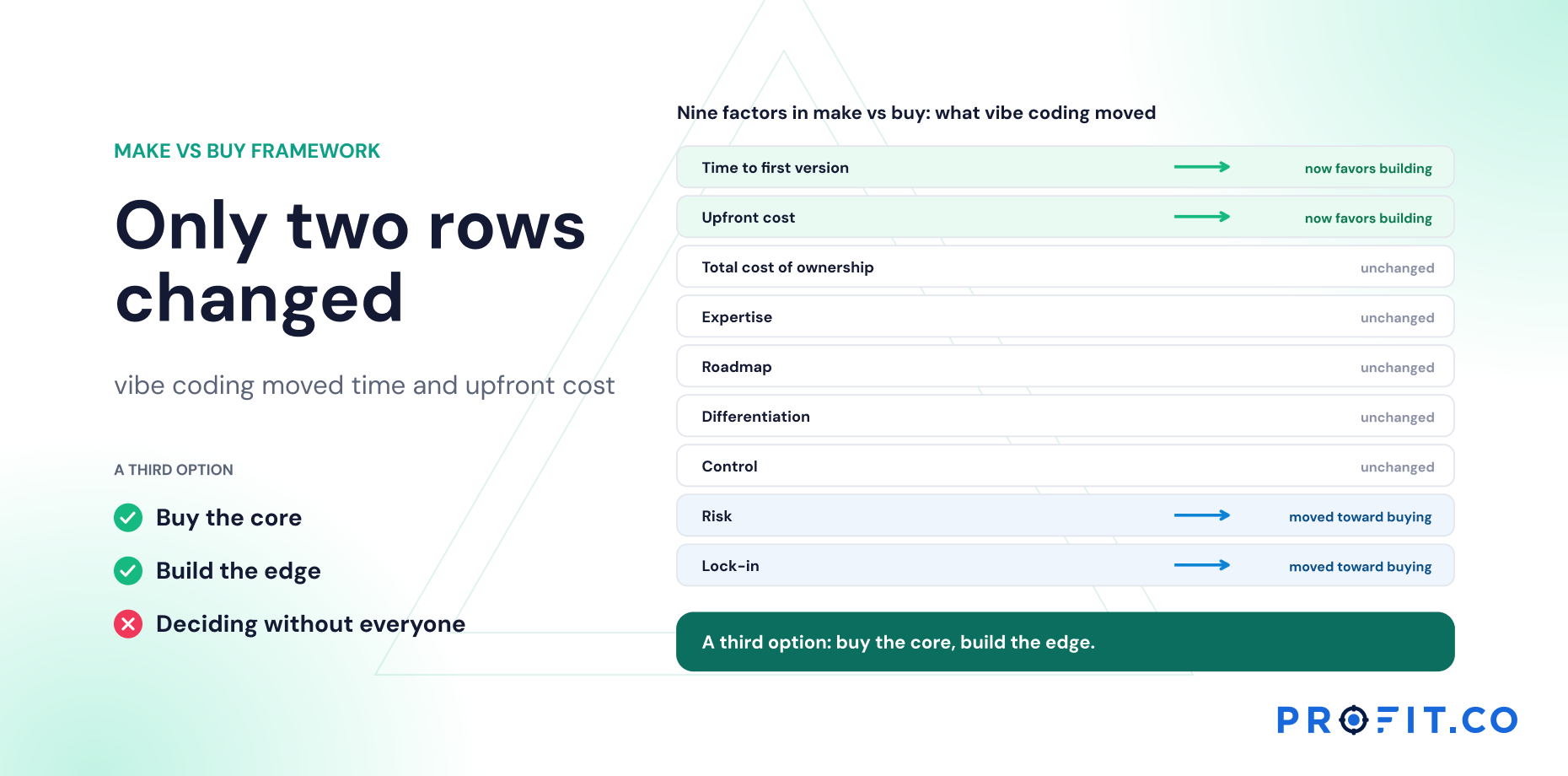
Next, test the capabilities your prototype lacks and would struggle to add, the subjects of most of this series. Can the platform run different strategy methods in different parts of the organization, with one leadership view across them? Does it keep a complete history of goals, targets, and scores, with authors and approvals?
Can it handle permissions for confidential initiatives, data residency and compliance across your regions, and an employee’s request for their data? Does it scale to your full organization? How does it use AI, and how is that governed? This is where the value of buying becomes concrete, and where vendors differ most.
Treat these capabilities as the reasons for buying, and weight them accordingly. Parity on everyday features is necessary but not sufficient. If a platform matches your prototype but offers little beyond it, the case for moving is weak. If it matches your prototype and removes the ownership burdens described throughout this series, the case is strong.
Here is what Profit.co brings to test two. OKRs, the Balanced Scorecard and Hoshin Kanri run on one data layer, with 400+ pre-built KPIs across the four scorecard perspectives. Performance reviews are tied to OKR outcomes. Data stays in the data center where it is stored, enterprise clients can run fully segmented databases, and the platform holds SOC 2 Type II and ISO 27001 certification. Ask to see each of these with your own data, and treat the history-and-approvals question the same way.
Test Three: A Clean Path for Your Data and People
Moving from a prototype to a platform should not mean starting again. Ask each vendor how it will bring across your existing goals, measures, and history, and how it will map your prototype’s data structure to its own. Ask how users will be provisioned through your identity system, and how long the transition will take.
Ask, too, how the vendor will support adoption. Users who liked the prototype need to see quickly that the new platform is better. A vendor experienced in migrations will have a clear plan. One that treats migration as your problem is signaling how it will treat other problems later.
Run the Five Tests Against Profit.co
Test Four: Openness for Your Builders
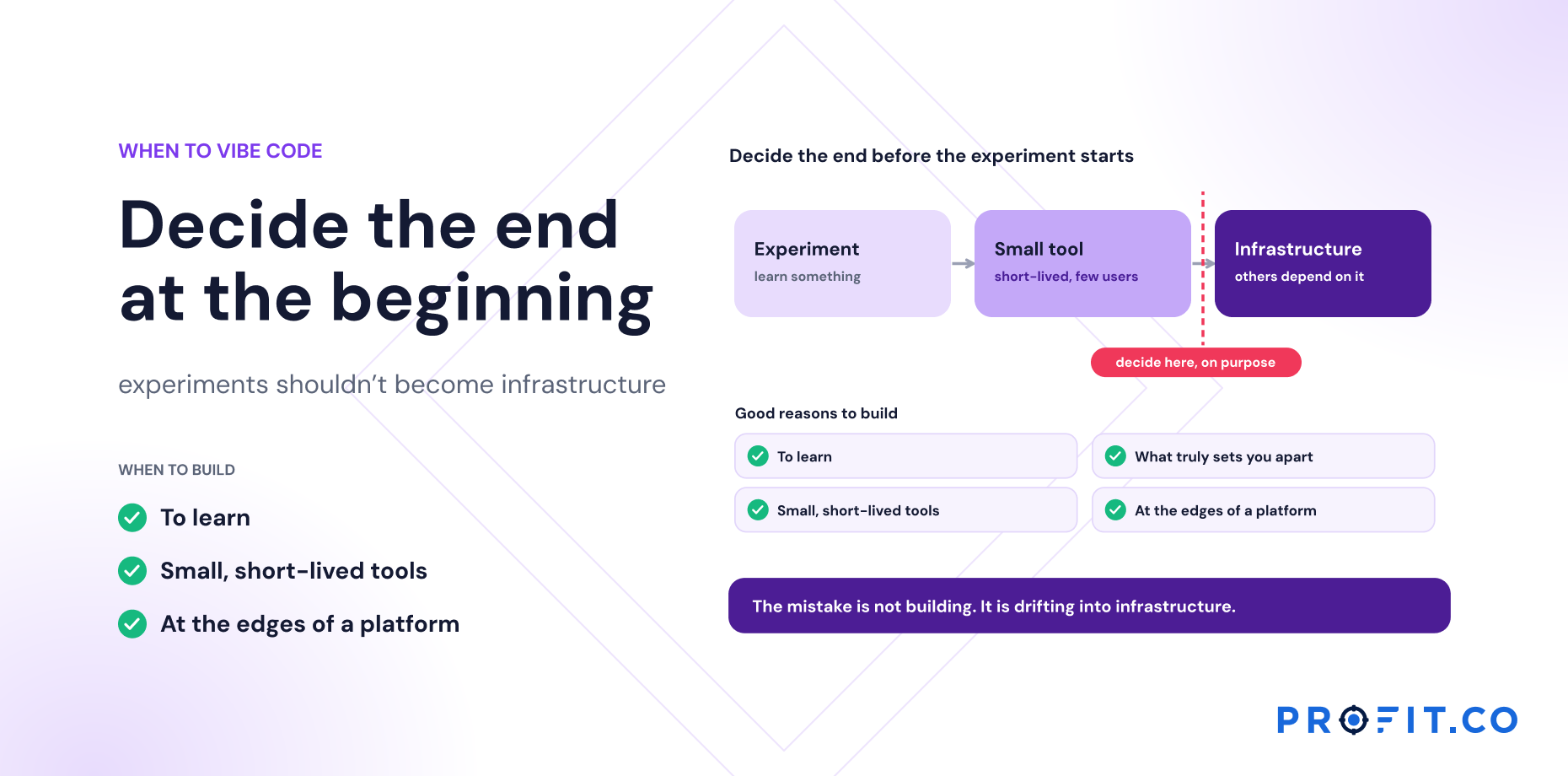
If you intend to buy the core and build at the edge, openness is essential. Examine the platform’s interfaces for reading and writing data, its support for notifications and integrations, its connections for AI tools, and its data export.
Better still, involve the engineers who built your prototype. Ask them to build a small edge tool against the platform during the evaluation. Their experience will tell you more about openness than any documentation, and their confidence in the platform will matter for adoption.
Test Five: Real Commitment to Your Success
Finally, test the relationship. Speak to reference customers of similar size, in similar regions, ideally ones who also moved from an internal tool. Ask how the vendor responds when things go wrong, how its customer success team works, and how its roadmap has evolved.
Ask what happens to your data if you leave, and review the contract terms that cover availability, support, data protection, and renewal. As the earlier article on commitment argued, the vendor’s incentives should align with your success, and the contract should turn those incentives into obligations.
Run a Pilot With Your Real Users
Demonstrations show what a platform can do. A pilot shows what it does for you. Choose a group of users who know the prototype well, including enthusiasts and skeptics, and run a real planning or review cycle on the leading platform.
Measure what matters: whether people update their goals, whether leaders find the reviews useful, whether the transition was smooth. Compare the results honestly with the prototype. A good platform should win clearly, and if it does not, that is important to know before committing.
Gather feedback in the users’ own words, not just in scores. Ask what they would miss from the prototype, what they would not want to lose from the platform, and what still feels awkward. These answers shape both the decision and the rollout that follows it.
Make the Decision and Honor the Prototype
When the evaluation is complete, communicate the decision in a way that respects what came before. The prototype proved the need, shaped the requirements, and made a better decision possible. The people who built it deserve credit, and their skills have an important role at the edges of the new platform.
Framed this way, moving to a platform is not an admission that building was a mistake. It is the natural next step for a successful experiment: the moment when the organization decides, deliberately, who should own its strategy system for the years ahead.
This series began with a simple question: why buy strategy software when you can vibe code it? The answer has never been that building is impossible. Anyone can bake bread. The answer is that owning a system your strategy depends on is a permanent commitment, and most organizations are better served by a specialist who has made that commitment its whole business.
Build to learn. Build at the edges. Build what truly sets you apart. And for the core of your strategy execution, choose a partner who is built to keep you.
Bring Your Prototype. We Will Take the Tests.
Frequently Asked Questions
Run five tests: parity on the capabilities users actually rely on, the capabilities your prototype could never offer, a clean path for your data and people, openness for your builders, and real commitment backed by contract terms. Then pilot the leading platform with real users.
No. Parity does not mean identical, and a good platform may handle a need better. What matters is that every important use has a clear, comfortable equivalent and that users would feel they gained something rather than lost it.
The capabilities your prototype could never offer: multiple methods with one leadership view, complete history with authors and approvals, permissions, residency and compliance, scale, and governed AI. Parity on everyday features is necessary but not sufficient reason to move.
Ask the engineers who built your prototype to build a small edge tool against the platform during the evaluation. Their experience tells you more than documentation, and their confidence in the platform will matter for adoption afterward.
Pick users who know the prototype well, enthusiasts and skeptics both, and run a real planning or review cycle. Measure whether goals get updated, whether leaders find the reviews useful, and whether the transition was smooth. Gather feedback in users’ own words, not just scores.
No. The prototype proved the need, shaped the requirements and made a better decision possible. Moving is the natural next step for a successful experiment, and the people who built it have an important role at the edges of the new platform.