Peer feedback is structured input from a colleague at a similar level – used in 360 performance reviews, project retrospectives, and team health assessments. Effective peer feedback is specific, behaviour-based, and forward-looking: “Riya consistently structures her written project updates so the team can act on them without a follow-up meeting.” That level of specificity determines whether feedback drives development or gets filed and forgotten.
In this guide
- What Is Peer Feedback and Why Does It Matter?
- How Do You Write Peer Feedback That Is Actually Useful?
- What Are Examples of Peer Review Feedback by Category?
- How Do You Give Constructive Peer Feedback Without Damaging the Relationship?
- How Should Organisations Use Peer Feedback in Performance Reviews?
- Frequently Asked Questions
Peer feedback fails before it reaches the performance review – not because people lack useful observations about their colleagues, but because they have no structure for translating those observations into actionable written feedback. This guide gives you that structure, with 30+ specific examples you can adapt immediately.
What Is Peer Feedback and Why Does It Matter?
Peer feedback is formal or informal input from colleagues who work alongside an employee – at the same level, on the same team, or in adjacent functions. It plays a role in performance management that managers alone cannot fill, because peers observe behaviours that managers rarely see: how someone handles conflict in a cross-functional meeting, how they respond when a project hits a blocker, how they support teammates outside of formal processes.
Organisations that include peer input in performance reviews consistently report higher engagement scores and faster skill development than those relying on manager feedback alone. The mechanism is not complicated: people receive feedback more readily from someone who works alongside them than from someone who evaluates them. Peer feedback, at its best, is the voice that says what the manager cannot see.
| Dimension | Manager Feedback | Peer Feedback |
|---|---|---|
| Observation scope | Outputs, deliverables, meeting behaviour | Daily collaboration, conflict, support, responsiveness |
| Frequency bias | More recent events dominate | Distributed across the working relationship |
| Credibility for receiver | High (positional authority) | High (experiential credibility – “they work with me”) |
| Risk of bias | Leniency bias, halo effect | Friendship bias, reciprocity bias |
| Best used for | Goal attainment, strategic contribution | Collaboration skills, communication, team impact |
| Anonymity | Rarely anonymous | Often anonymous – reduces reciprocity bias |
Peer feedback reveals who someone actually is in the room – not just what they deliver on paper.
How Do You Write Peer Feedback That Is Actually Useful?
Use the SBI model: Situation, Behaviour, Impact
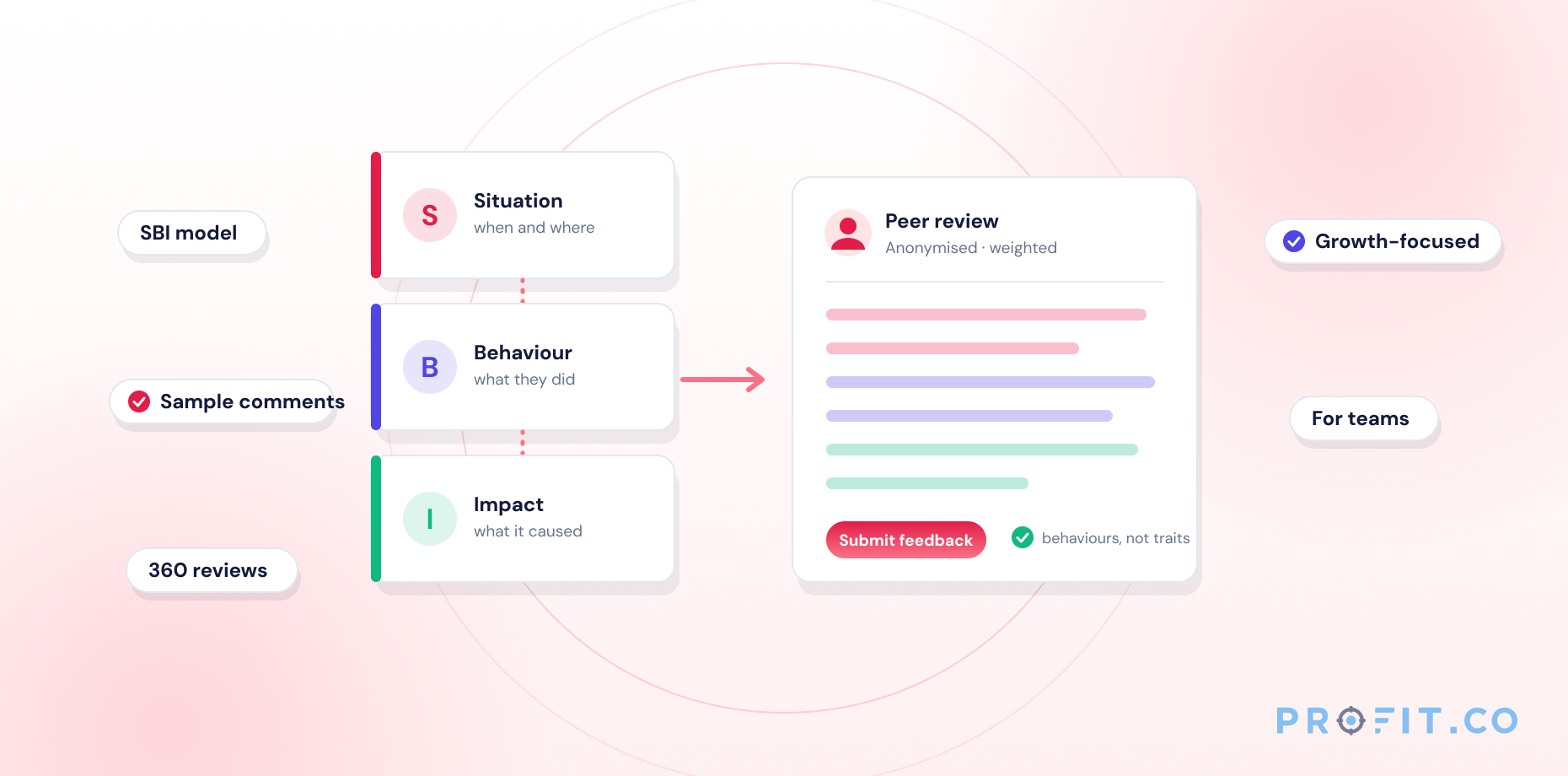
The SBI model is the most reliable structure for peer feedback. Situation: name the specific context (“During the Q2 product launch planning session”). Behaviour: describe the observable action (“Marcus identified a dependency we had missed and flagged it to both teams before it became a blocker”). Impact: state the result (“This prevented a two-week delay in the launch timeline”). Feedback written in SBI format is specific, non-personal, and directly useful.
Write about behaviours, not traits
“Priya is proactive” is a trait observation. “Priya sent a written stakeholder briefing three days before every major project milestone, without being asked” is a behaviour observation. Employees cannot change a trait – they can change a behaviour. Every piece of peer feedback should describe something the person did, not something they are.
Include one development observation, not just strengths
The most useful peer review includes both recognition and development input. A review with only positive feedback is incomplete – it tells the recipient what to keep doing but not what to work on. A single, specific development observation is more valuable than three paragraphs of general praise.
Write for the person, not the manager
The best peer feedback is written as if it will be read directly by the colleague – because it will. Avoid language that sounds like an HR report (“this individual demonstrates strong collaborative behaviours”). Write directly: “You consistently make it easier for the rest of the team to do their jobs.” For ready-to-use phrase structures, Profit.co’s performance review phrases and comments library covers 100+ formulations managers and reviewers can adapt directly.
What Are Examples of Peer Review Feedback by Category?
Collaboration and Teamwork
POSITIVE EXAMPLES
- “During the rebrand project, you proactively identified a naming conflict between our product line and a competitor’s recent launch and escalated it to the marketing lead before we finalised the assets. That saved us from a significant rework cycle.”
- “You consistently follow up on shared action items before the next sync – which means the team almost never revisits open items twice. This keeps our sprints moving and makes our meetings shorter.”
- “When two team members disagreed on the technical approach in our Q2 architecture review, you asked both sides a clarifying question that reframed the discussion as a constraint problem rather than a preference debate. The team reached a decision in 20 minutes instead of tabling it again.”
DEVELOPMENT EXAMPLES
- “One area to work on: when you take on a shared task, it is not always clear to the team what the status is until the deadline. A brief status update in the team channel mid-task would reduce the number of follow-up questions and help others plan their dependent work.”
- “You tend to resolve cross-functional issues bilaterally rather than documenting the outcome for the wider team. Sharing a one-sentence summary in the project channel after resolving a blocker would reduce duplicate conversations significantly.”
Communication
POSITIVE EXAMPLES
- “Your written project briefs are among the clearest on the team – every brief you write includes a decision timeline, a list of open questions, and a single sentence on what you need from each stakeholder. This makes it easy to give you a useful response.”
- “You adjust your communication style depending on the audience clearly – technical depth with the engineering team, outcome focus with the commercial team. This is a genuine skill that most people develop much later in their careers.”
DEVELOPMENT EXAMPLES
- “Your verbal ideas in meetings are strong, but they often lose some precision when written up – the written version would benefit from the same structure you use when you speak. One option: record a voice note immediately after the meeting and use that as the basis for the written follow-up.”
Leadership and Initiative
POSITIVE EXAMPLES
- “You identified a gap in our onboarding process for new contractors and built a one-page reference guide without being asked. It is now used by every new joiner and has reduced the number of repeat questions by a visible amount.”
- “When the project timeline compressed unexpectedly, you reorganised the workstream, communicated the change to stakeholders before anyone asked, and re-confirmed deliverables with the affected team members within 24 hours. That is the standard for handling scope changes.”
DEVELOPMENT EXAMPLES
- “You have strong ideas and clear opinions, but you sometimes present them as decisions rather than proposals in cross-functional settings. Framing them as ‘here’s my recommendation and here’s why’ – and explicitly inviting pushback – would help the team engage with the idea rather than react to the certainty.”
Reliability and Follow-Through
POSITIVE EXAMPLES
- “I cannot think of a single commitment you have made to this team that was not followed through or proactively flagged as at risk. That reliability changes how the whole team plans – we can build your output into our timelines with high confidence.”
- “You send meeting notes within two hours of every session with a clear action log attributed to named owners. This is the single most useful habit on the team for execution.”
DEVELOPMENT EXAMPLES
- “There have been two instances this quarter where a task you committed to in our Monday sync was not completed or flagged by Thursday. A brief note in our shared tracker when you identify a delay – before the deadline – would help the team replan without scrambling.”
360 PEER FEEDBACK + PERFORMANCE MANAGEMENT
The real value of peer feedback in a performance review is not the individual comments – it is the pattern that emerges when six or eight colleagues independently identify the same behaviour
A manager can observe that someone communicates well in one-on-ones. Only the team can confirm that they communicate well under pressure, in conflict, across functions, and at 4pm on a Thursday before a deadline.
Organisations that embed peer feedback into continuous performance management cycles – using Profit.co’s 360 review process to collect, anonymise, and surface these patterns automatically – give managers a complete performance picture that no single observer could produce alone.
Run 360 Reviews That Collect Peer Feedback Automatically
How Do You Give Constructive Peer Feedback Without Damaging the Relationship?
Peer feedback fails most reliably when it is vague, when it is personal, or when it arrives without context. The SBI structure prevents vagueness. Focusing on behaviours rather than traits prevents personalisation. Context – naming the specific situation – prevents the feedback from landing as a generalisation.
Two additional principles apply when the working relationship matters:
Separate the feedback from the relationship by naming the intent
Opening with “I’m sharing this because I think you’re doing important work and this would make it land more effectively” is not softening – it is context that the receiver needs in order to hear the feedback without defensiveness.
Deliver developmental feedback in person when possible, in writing for formal cycles
Behavioural feedback delivered verbally in a one-on-one conversation is more actionable than a written comment in an anonymous review – but formal review systems require written documentation. Profit.co’s Feedback Agent lets peers share feedback in real time outside the formal review cycle, so development input reaches the recipient when it is most relevant – not six months later.
How Should Organisations Use Peer Feedback in Performance Reviews?
Set a clear question framework before the cycle starts
Peer reviewers should answer 3-5 structured questions, not write an open-ended essay. Effective questions include: “Describe a specific situation where this person had a positive impact on the team or project.” “What one behaviour, if changed, would make this person significantly more effective?” “Would you choose to work with this person again on a complex project? Why?”
Anonymise the output – but not the process
Anonymity increases candour. Reviewers should know the system protects their identity in the written output. They should also know the review will be read by their manager and their colleague – which raises the quality of the feedback and prevents the anonymity from being used for unconstructive commentary.
Weight peer feedback appropriately in the overall review
Peer feedback should inform – not determine – performance ratings. The manager’s assessment of goal attainment, strategic contribution, and development trajectory should carry the primary weight. Profit.co’s pulse surveys also give managers a real-time read on team sentiment – context that complements peer review data and flags patterns before the formal cycle begins.
Share the synthesised output with the employee directly
Peer feedback retained only by the manager and HR has limited development value. The employee should receive a synthesised summary – with common themes called out and specific examples included – within one week of the review cycle closing.
Run Peer Review Cycles That Produce Real Development Insight
Frequently Asked Questions
Peer feedback in a performance review is structured input from colleagues who work alongside the employee – used alongside manager and self-assessments to provide a complete, multi-perspective view of performance. It captures collaboration behaviours, communication patterns, and team impact that a manager’s direct observation alone cannot cover.
Strong peer review feedback uses the SBI model – Situation, Behaviour, Impact. Example: “During the Q3 product launch (situation), you identified a cross-functional dependency and escalated it to both teams before it became a blocker (behaviour). This prevented a two-week delay in the launch timeline (impact).” Good peer feedback is specific, behaviour-based, and forward-looking.
State the intent at the start, name the specific behaviour rather than a trait, use the SBI format, and frame the development observation as an opportunity rather than a criticism. Avoid language like “always” or “never” – specificity protects the relationship.
The standard range for 360 reviews is 4-8 peer reviewers per employee – enough to surface a meaningful pattern while keeping the administrative burden manageable. At fewer than 4, individual biases dominate the output. At more than 8, the incremental value of additional reviewers diminishes and response quality drops. For a structured approach to the full review cycle, see Profit.co’s guide on how to conduct an effective annual review.
Profit.co’s 360 performance review module enables managers to select peer reviewers, send automated review requests, collect responses against structured question frameworks, and anonymise and synthesise the output into a development-focused report. The Feedback Agent also allows peer-to-peer feedback to be shared in real time outside the formal review cycle. See OKR examples for HR teams for goal structures that connect peer feedback development themes to quarterly OKR targets.