

Reflect/Reset lets teams review a completed OKR cycle, capture learnings, and carry Objectives and Key Results into the next period. The workflow now also supports exporting a department's full reflection cycle to PDF and optionally locking finalized key results against further edits.
Table of Contents
What is Reflect/Reset?
Reflect/Reset is a two-part workflow: Reflect lets teams answer configured questions to review a completed OKR cycle, and Reset carries Objectives and Key Results into the next period. Superusers enable the feature, build the reflection questions, and set the timeframe from Settings, and the same workflow applies to sub key results and child objectives, not just top-level items.
During reflection, a read-only OKR progress reference now sits alongside the questions in a split view, showing the objective, its key results, and linked initiatives filtered to the user's existing visibility. Department heads with reset/reflect access can also export a department's full reflection cycle as a single PDF, and administrators can optionally lock key results once they are finalized through Reset so the historical record can't be edited afterward.
Why Reflect/Reset Matters
Reflection answers used to rely on memory or leaving the screen to check progress elsewhere. The read-only OKR progress reference now sits alongside the reflection questions, so every answer is grounded in live data without leaving the screen, filtered to what the user can already see.
Before this update, teams also had to compile OKR hierarchy, next-quarter plans, and reflection responses manually across multiple screens to share a closed cycle with leadership. Department heads can now export all three into one structured PDF directly from the OKR list. Administrators can also lock a key result once it is finalized through Reset, so no user, regardless of role, can alter that period's historical data afterward.
How It Works
Method 1: Reflecting and Resetting an OKR
Step 1
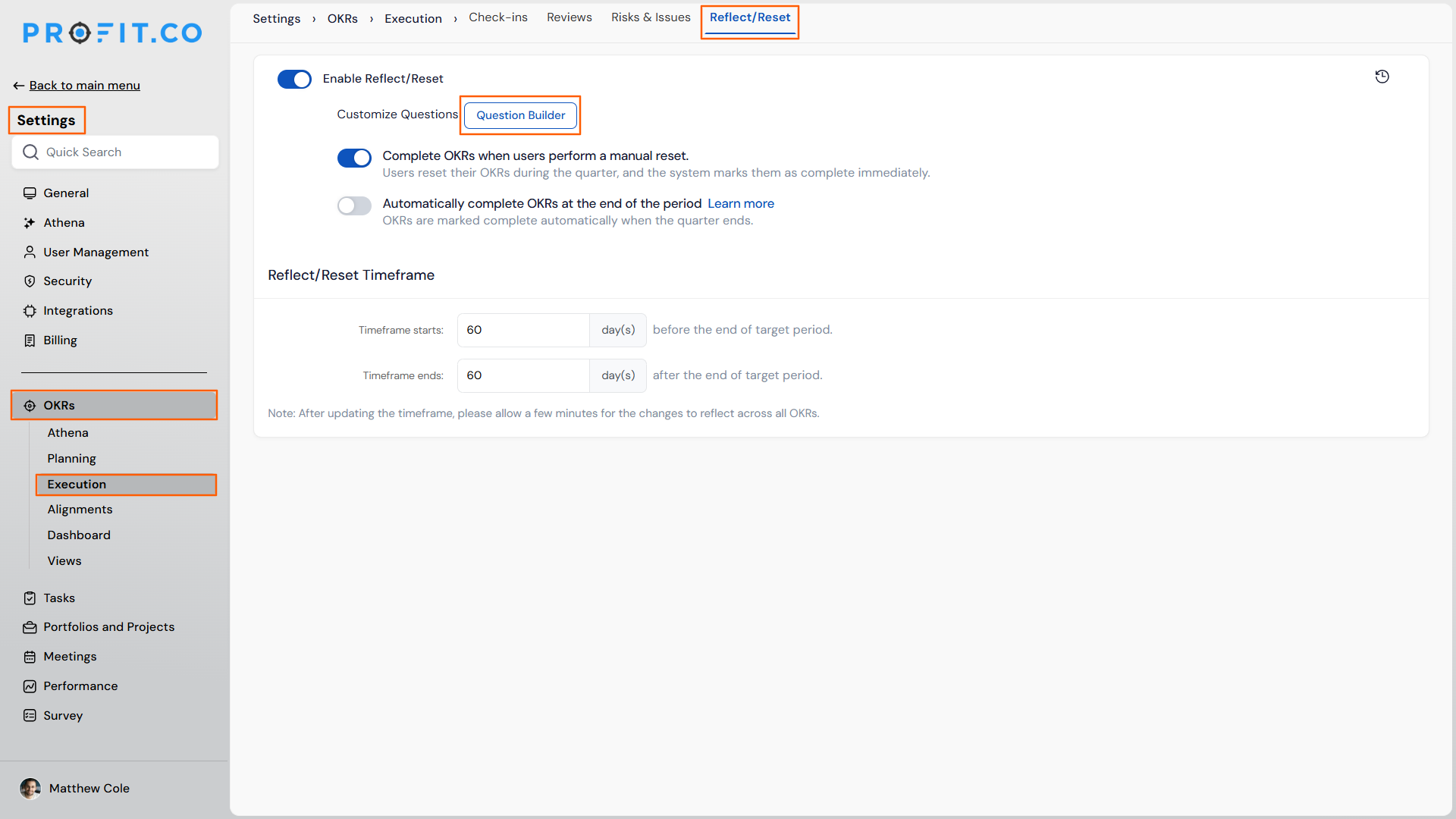
- Navigate to Settings → OKRs → Execution and switch to the Reflect/Reset tab.
- Enable the Enable Reflect/Reset toggle.
- Add reflection questions using Question Builder and set the Reflect/Reset Timeframe.
Step 2
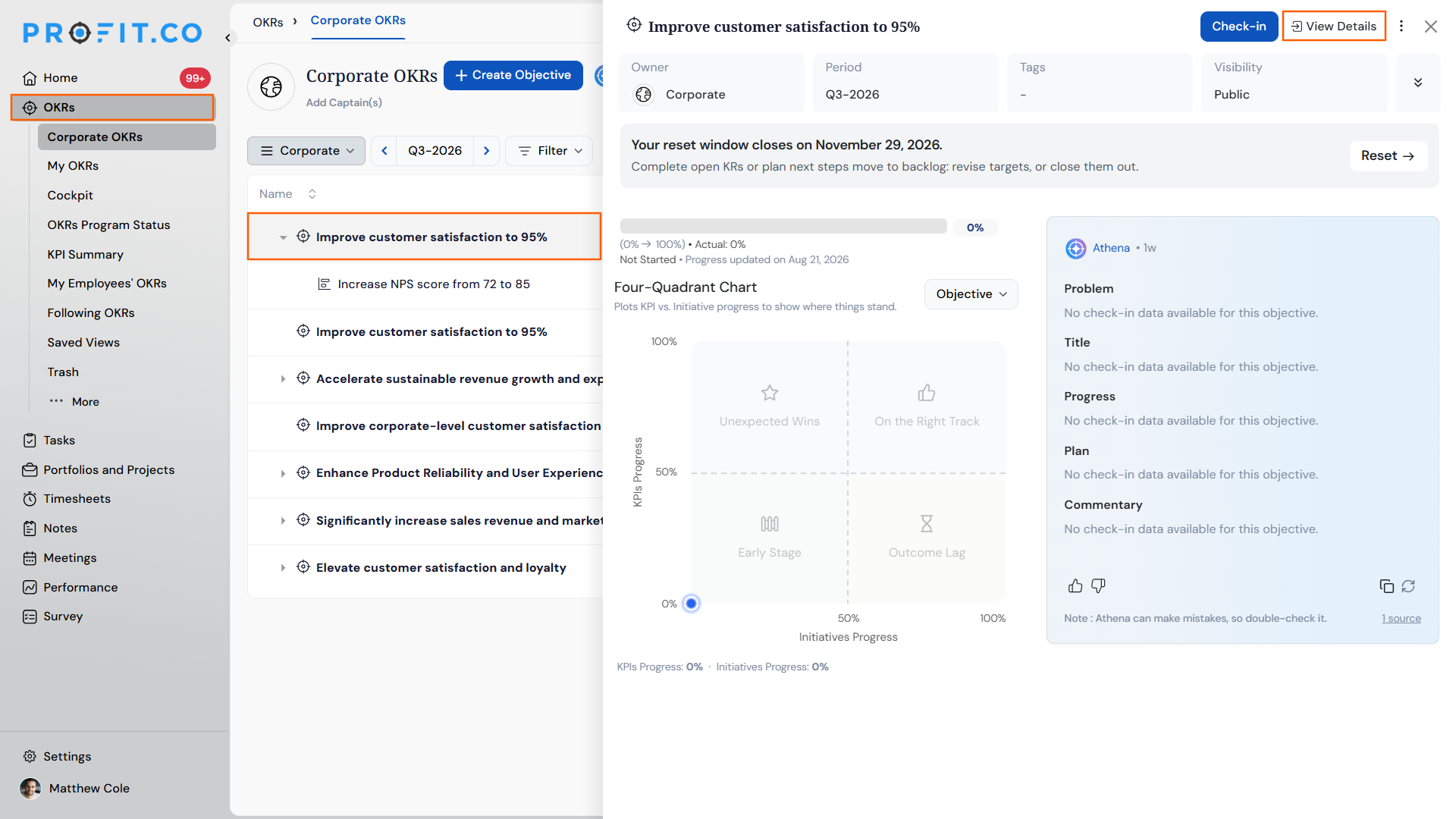
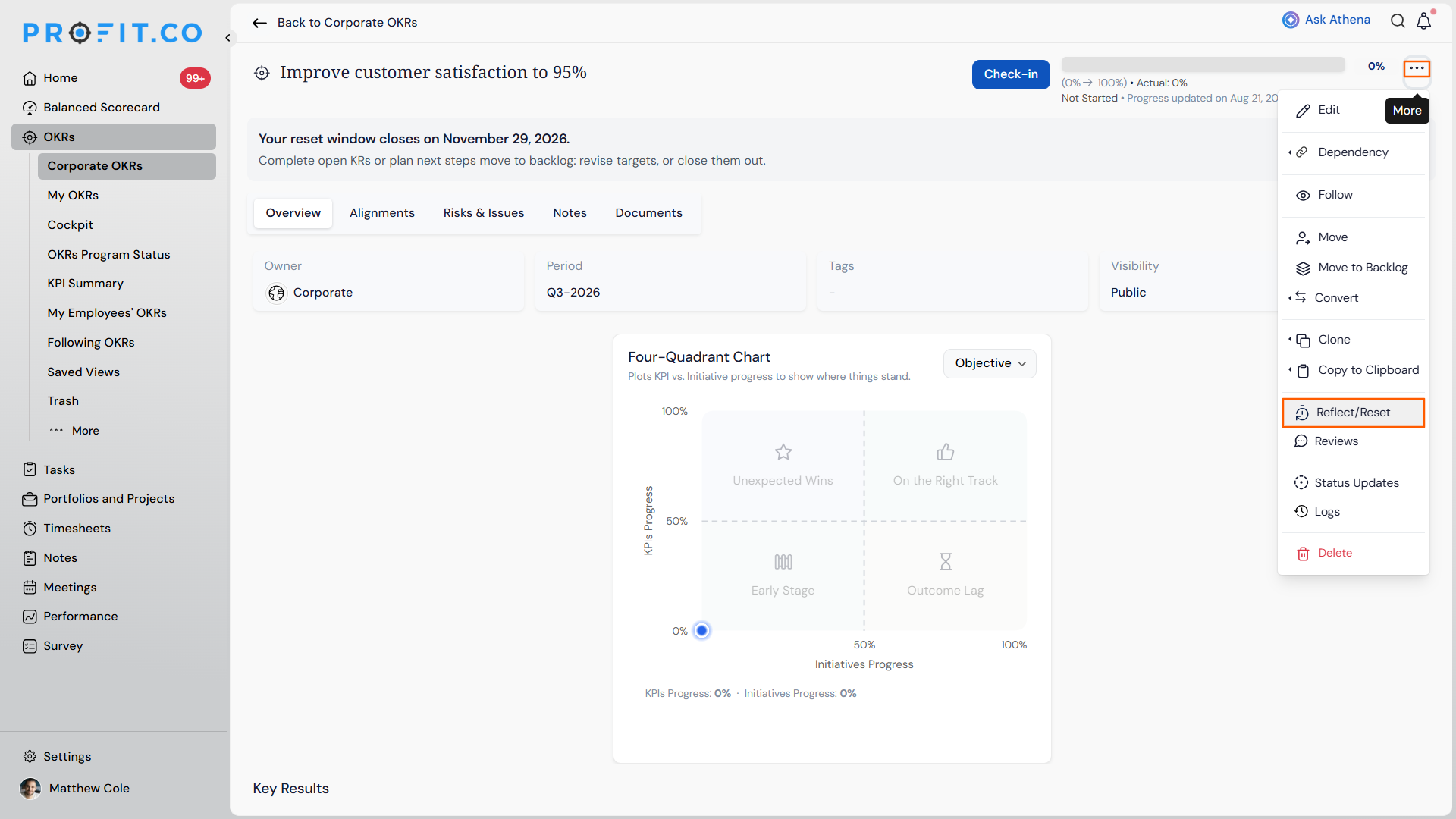
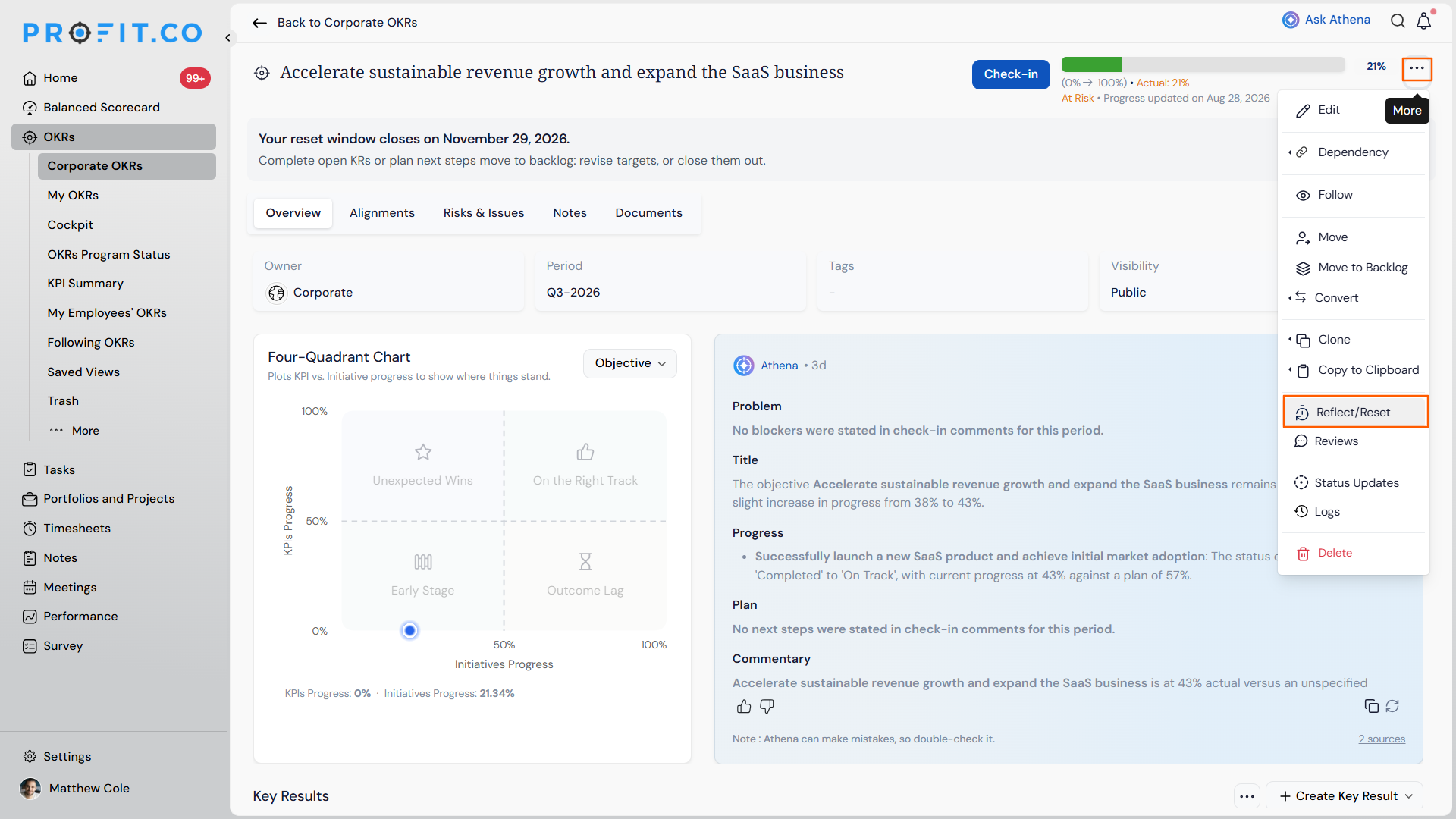
- Open the OKR, select the Objective, click View Details, then choose Reflect/Reset from the More option.
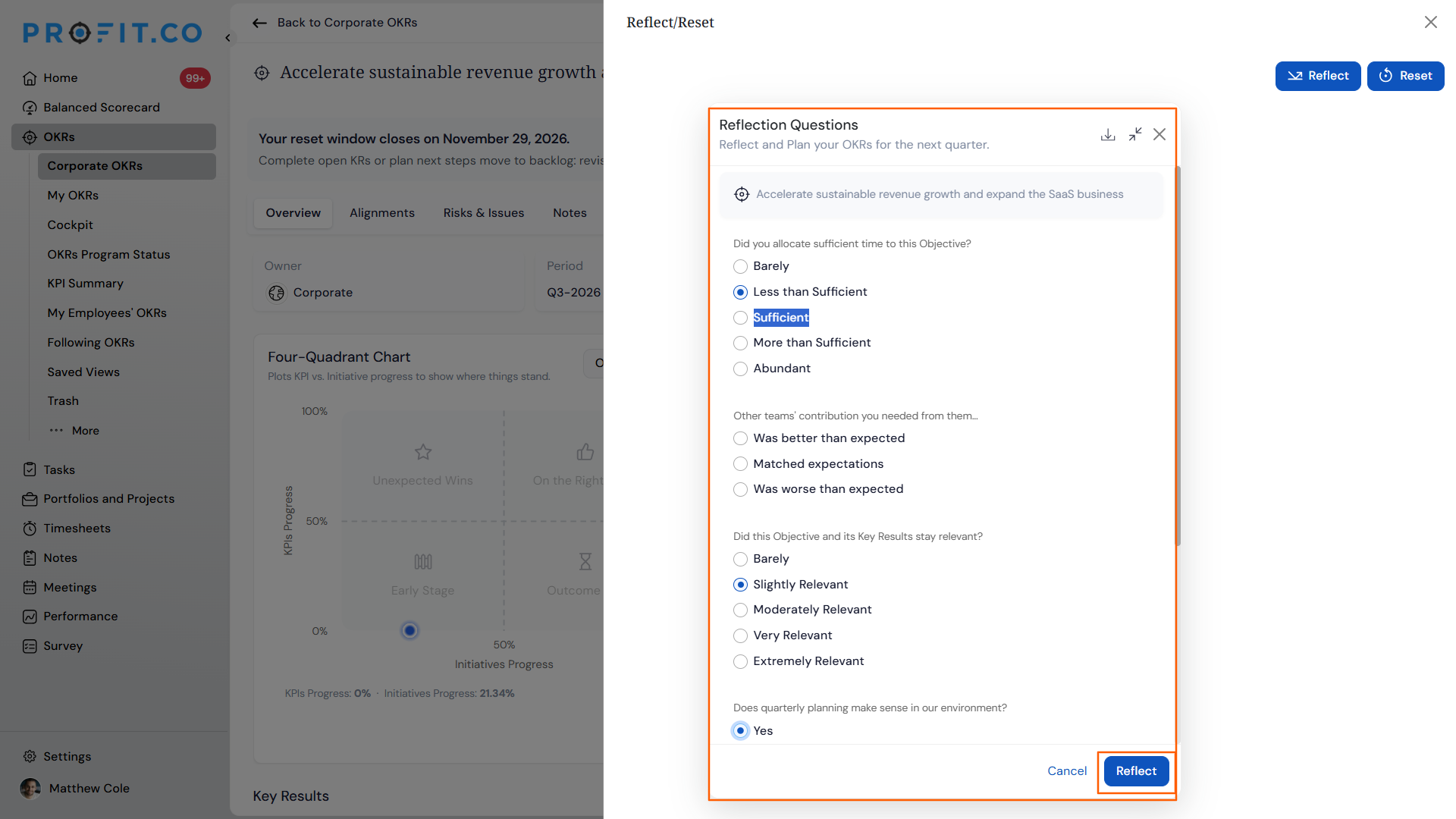
- The Reflect/Reset process tab opens, choose Reflect. The panel opens in a split view.
- Review the read-only OKR progress reference on the left, showing the objective and its key results with name, period, owner, and progress; expand a key result to see its linked initiatives.
- Answer the reflection questions on the right, informed by the visible data, and click Reflect to submit.
Note
You are not limited to the OKR progress reference during reflection. The panel lets you navigate to any other Profit.co module for additional context without leaving the screen.
Step 3
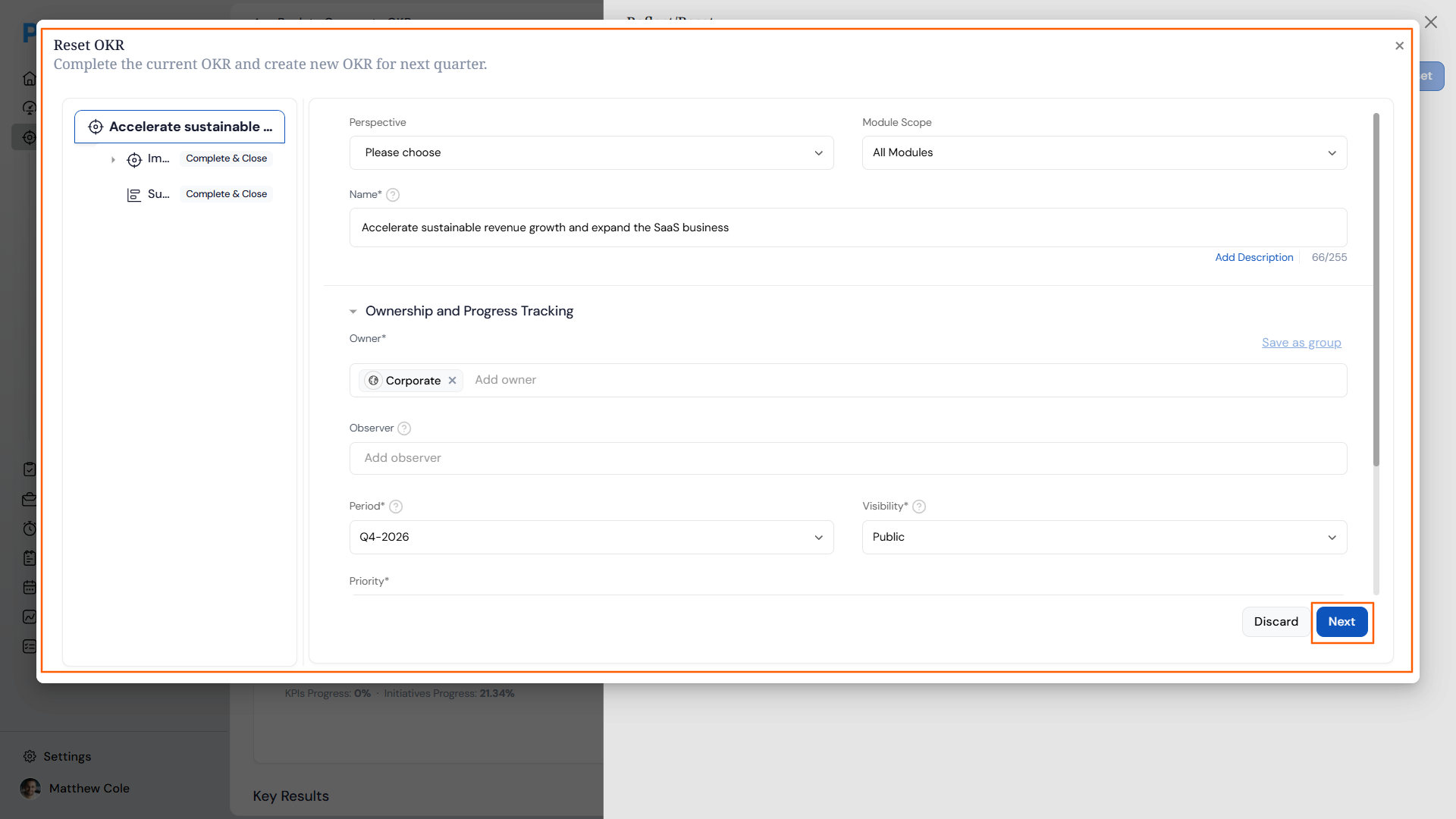
- Click Reset from the More Options Menu.
- Update the Objective's name, Period, Visibility, Tags, Owner, and OKR Category, then click Next.
- Choose a Reset Option for each Key Result to complete the reset.
Method 2: Exporting the Department Reflection PDF
Step 1
- Navigate to the required department and choose the OKR you want to export.
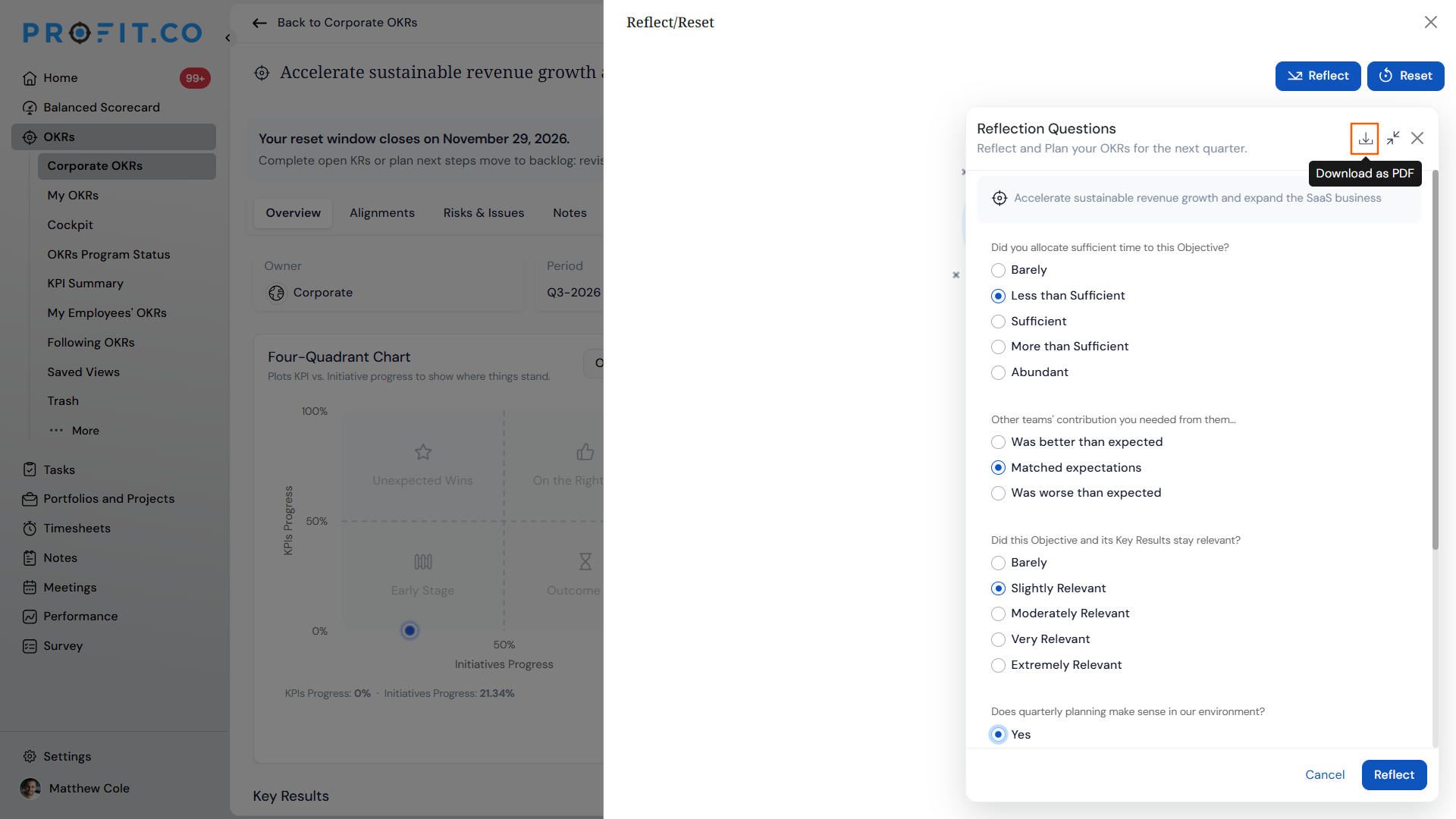
- Click View Details, then click More Options and choose Reflect/Reset.
- Click Download as PDF. This option is visible only to users with reset/reflect access to the department.
Method 3: Restricting Edits on Reset Key Results
Step 1
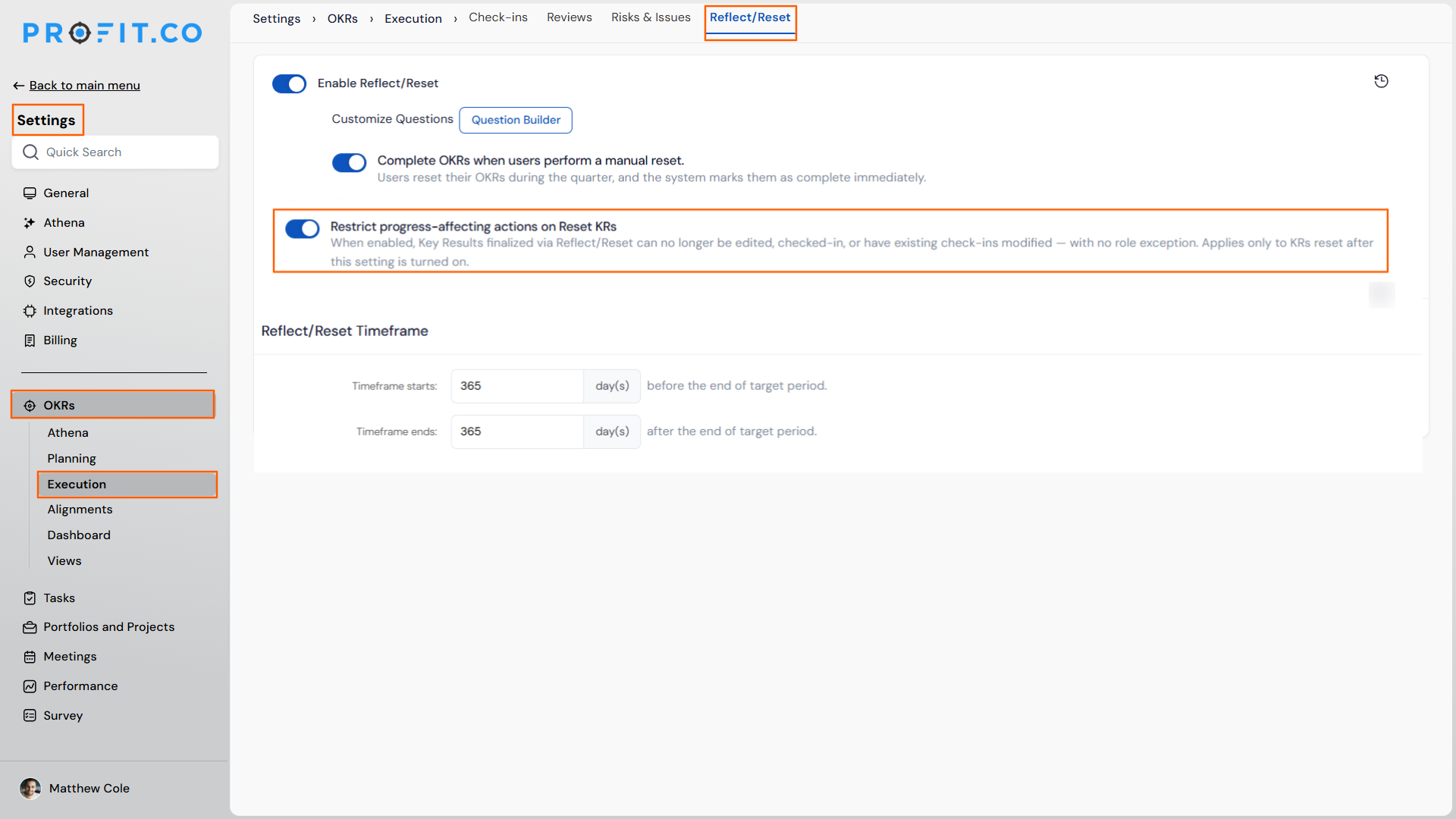
- Navigate to Settings → OKRs → Execution.
- Switch to the Reflect/Reset tab.
- Enable the Restrict progress-affecting actions on Reset KRs toggle.
Reflect/Reset Scenarios and Their Outcomes
| Scenario | What Happens |
|---|---|
| You open the OKR progress reference during reflection. | Profit.co displays it as read-only. You cannot edit the objective, key results, or check-ins from this panel. |
| You export a department's reflection cycle as a PDF. | Profit.co downloads a single PDF headed with the department name, period, exporter name, and timestamp. Profit.co also records the export in the audit log. |
| You export the PDF for a department where some OKRs sit outside your normal visibility. | Profit.co filters the exported content to match your existing OKR visibility. Items you cannot normally see are left out of the PDF. |
| You export the reflection cycle for an objective with no reset-linked OKRs for next quarter. | Profit.co shows an empty-state note in the Upcoming Quarter OKRs section for that objective. The rest of the PDF's sections are unaffected. |
| You enable the Restrict progress-affecting actions on Reset KRs toggle. | Profit.co locks only key results finalized through Reflect/Reset from that point forward. Key results reset before the toggle was enabled remain editable. |
| You or another user attempt to edit, check in to, or reposition a locked key result. | Profit.co blocks the action for every user, regardless of role. There are no role-based exceptions. |
Reset Options for Key Results
Profit.co provides five ways to carry forward or close a Key Result during Reset.
| Reset Option | What It Does |
|---|---|
| Complete & Close | Use when the key result is finished. It will not carry into the next quarter. |
| Extend as is | Use when the key result is not finished but is still relevant. It carries forward unchanged, though you can update its name, target date, and check-in frequency. |
| Modify & Continue | Use to adjust the key result's numbers before carrying it into the next quarter, including its name, target date, check-in frequency, and check-in values. |
| Add to Backlog | Use for a completed or incomplete key result you do not want to work on next quarter. |
| Do not carry forward | Use to stop carrying forward a partially completed key result. It stays open in the current cycle with its existing progress instead of being marked complete. |
Reflection PDF Structure
The exported PDF is organized by objective and contains four sections.
| Section | Contents |
|---|---|
| OKR Hierarchy Reflected On | Full OKR hierarchy for the selected department and period, including name, owner, progress, and status for each item. |
| Upcoming Quarter OKRs | Next-quarter OKRs linked to each objective through the reset process. Shows an empty-state note for objectives with no reset-linked OKRs. |
| Reflection Questions & Responses | Reflection responses recorded against each objective, attributed by name. |
| Newly Created OKRs | OKRs created independently for the upcoming quarter that are not linked to the current cycle through a reset. |
What Gets Locked on a Reset Key Result
Once a key result is locked, Profit.co blocks the following actions for every user:
- Editing the key result
- Adding new check-ins
- Modifying existing check-ins
- Moving the locked key result to a different position in the hierarchy
- Moving other key results into the locked key result
Best Practices for Reflect/Reset
- Drag the OKR progress reference panel to reposition it during reflection, since the split view lets you keep the objective's key results and progress visible without leaving the screen.
- Export the department reflection PDF before archiving or sharing a closed cycle with leadership, since it consolidates OKR hierarchy, next-quarter plans, and reflection responses that would otherwise require pulling from multiple screens.
- Turn on Restrict progress-affecting actions on Reset KRs before closing a cycle if you need an immutable record, since the lock applies universally with no role exceptions once enabled.
- Finish any pending Resets for the current cycle before enabling the restriction, since key results reset before the toggle is turned on stay editable and will not retroactively lock.
- Choose Reset Options deliberately instead of defaulting to Modify & Continue, since Add to Backlog and Do not carry forward preserve historical progress differently for key results you are not actively pursuing next quarter.
- Check a department's export against your own OKR visibility before treating it as a complete record, since the PDF only includes OKRs you can already see.
Related Articles
- How do you Reflect/Reset OKRs with Sub KRs?
- How to use the complete and close option during Reflect and Reset?
- How to enable and customize the reflection Dashboard?
Frequently Asked Questions
Any user with reset/reflect access to that department. View-only users do not see the Download as PDF option.
No. Only key results finalized through Reflect/Reset after the toggle is enabled are locked. Earlier resets remain editable.
No. The restriction applies to all users with no role exceptions, including Super Users.
Execute your strategy with confidence
Connect OKRs, tasks, and teams in one place with Profit.co
