












“Lean strategy” means at least three different things depending on who’s searching. This guide is about one of them: how organizations that run on lean management set direction and pursue it, and why the connection between strategy and daily improvement is where most of them struggle.
In this guide
Key Takeaways
- →Lean strategy here means strategy in organizations run on lean management.
- →Five parts: true north, breakthroughs, daily management, improvement, learning loops.
- →Strategy is a hypothesis to be tested, not a plan to be defended.
- →Improvement is everyone’s job, so a lot of capacity exists and can be pointed.
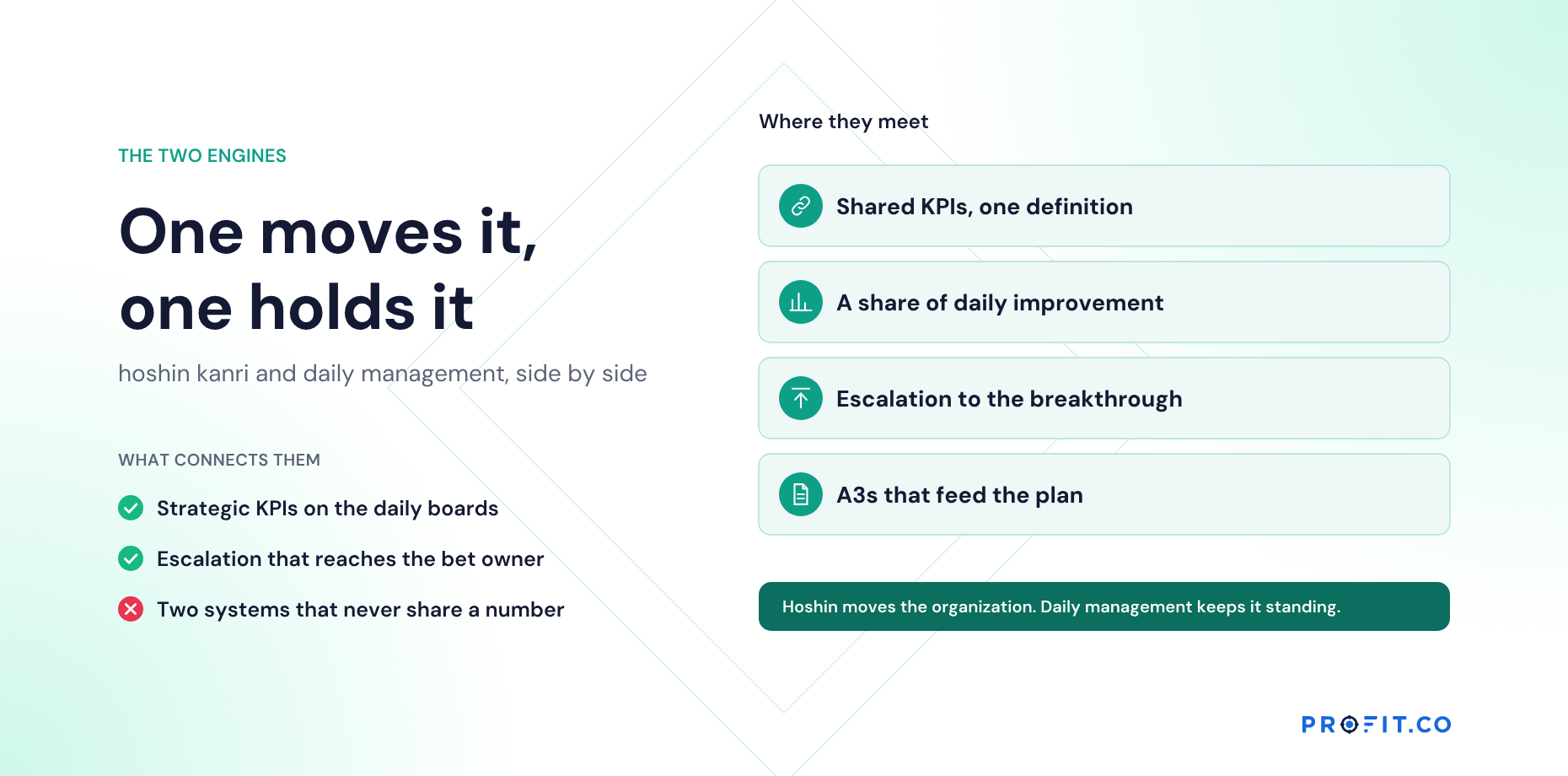
- →Most organizations run one engine well and never connect it to the other.
- →Same people, same tools, same effort. The difference is whether they connect.
Three meanings of “lean strategy”
| Term | What it means | Covered here? |
|---|---|---|
| Lean strategy in lean organizations | Setting and pursuing direction in organizations run on lean management | Yes |
| Lean startup | A method for testing new business ideas through quick experiments | No |
| Lean software development | Applying lean principles to building software | No |
The first meaning grew out of lean manufacturing and the Toyota Production System. It is used by operational excellence leaders, continuous-improvement teams and executives in organizations that have adopted lean as a management system, in manufacturing, healthcare, services and the public sector.
The parts of a lean strategy
Five parts recur across lean organizations, whatever they call them locally.
Most organizations already have several of these running well. What separates a lean strategy from a collection of good practices is whether the five are connected to each other.
| Part | What it is | Read more |
|---|---|---|
| True north | The long-term direction and ideal the organization steers toward | True North in Lean: Setting Direction in a Lean Organization |
| Breakthrough objectives | A few multi-year changes, deployed through hoshin kanri | Hoshin Kanri |
| Daily management | Huddles, standard work and problem-solving that keep the fundamentals improving | Hoshin Kanri and Daily Management: The Two Engines of Lean |
| Continuous improvement | Kaizen ideas, events and projects across the organization | Linking Kaizen and CI Projects to Strategic KPIs |
| Learning loops | PDCA at every level, and frontline evidence reaching the strategy | Strategy From the Gemba: Learning Upward From Frontline Improvement |
What makes it lean
Plenty of organizations have a strategy, objectives and improvement programs. Three ideas make the approach distinctly lean.
- Strategy is a hypothesis. Plans are tested through plan-do-check-act and corrected, not executed and defended.
- Problems are understood where the work happens. The gemba, the place where value is created, is where strategy meets reality.
- Improvement is everyone’s job. Not a department, but a daily habit, which means a lot of improvement capacity exists and can be pointed somewhere.
Michael Ballé, Daniel Jones, Jacques Chaize and Orest Fiume’s The Lean Strategy develops the second and third ideas into an argument that the strategy itself should be shaped by what frontline improvement reveals, not only deployed down to it.
In most organizations strategy goes down and reports come up. In a lean organization, learning is supposed to come up too.
Where lean strategies struggle
Most lean organizations are good at one engine. Some have excellent daily management and kaizen with a strategy that lives in a separate annual process. Others run a strong hoshin plan whose connection to the shop floor is a cascade of KPIs. In both cases the two engines don’t connect: improvement effort isn’t steered toward what the strategy needs, and what the front line learns doesn’t reach the strategy.
| Symptom | Missing connection |
|---|---|
| Kaizen counts high, strategic KPIs flat | Strategy isn’t steering improvement |
| Huddle escalations about a strategic problem go nowhere | Frontline evidence isn’t reaching the bet |
| Each tier measures its own version of a KPI | No shared definition to connect them |
| A3s solve problems that the strategy never hears about | Problem-solving isn’t connected to the plan |
A worked example: one KPI, two engines
Here is a hypothetical KPI handled two ways, with the engines disconnected and with them connected:
| Aspect | Disconnected | Connected |
|---|---|---|
| Strategic KPI | On-time delivery to 95%, on the X-matrix | Same KPI, same definition, on the matrix and every daily board |
| Improvement effort | 412 kaizens completed; 9% touched on-time delivery | Share of improvement on on-time delivery set at 30% and visible |
| Frontline signal | Line 3 huddle notes repeated late supplier parts for months | Escalated from the huddle to the KPI owner in week two |
| Result | On-time delivery 89%; noticed at the quarterly review | Supplier issue fixed by A3 in Q2; on-time delivery 94% |
Same people, same tools, same amount of effort. The difference is whether the two engines were connected.
Lean strategy across a year
| When | Strategy engine | Daily engine |
|---|---|---|
| Planning season | Reflection; breakthroughs confirmed; targets negotiated through catchball | Sites choose focus KPIs for the first quarter |
| Every day | — | Huddles at each tier; strategic KPIs on the board; problems flagged |
| Every week | Owners review flagged patterns | Site reviews; improvement effort by KPI |
| Every month | Bowler and exceptions; A3s on persistent gaps | Countermeasures reported at huddles |
| Every quarter | Bets kept, changed or retired on evidence | Focus KPIs rotated |
| Year end | Each bet judged; lessons into next plan | Improvement patterns summarized |
The two engines run at different speeds and meet at fixed points: daily on the board, weekly in patterns, monthly and quarterly in the reviews.
Common misconceptions
- “Lean strategy means cutting costs.” Lean is about creating value with less waste. Many lean strategies are about growth, quality or service.
- “Hoshin kanri is lean strategy.” Hoshin is the strategy engine. Without daily management connected to it, it is half of a lean strategy.
- “More kaizen means more strategy.” Only if it points at what the strategy needs.
- “Strategy is set at the top in lean too.” Direction is set at the top; much of what the strategy learns comes from the gemba.
- “Software replaces the boards.” Boards stay where they work; software connects and remembers. See Lean Management Systems: What to Digitize and What to Keep on the Board.
Key terms
| Term | Meaning |
|---|---|
| True north | The long-term direction and ideal the organization steers toward |
| Hoshin kanri | The strategy engine: a few breakthroughs deployed with catchball and review |
| Daily management | Huddles, standard work and problem-solving that keep the fundamentals improving |
| Kaizen | Continuous, usually small, improvement by the people doing the work |
| Gemba | The place where the work happens |
| Tiered huddles | Short daily meetings at successive levels that escalate problems upward |
| Focus KPI | A strategic KPI a site or team emphasizes for a quarter |
| Leader standard work | Leaders’ routines that sustain the management system |
What the disconnect costs
Go back to the worked example and read the two columns as one budget. 412 kaizens is a real year of a real workforce’s discretionary effort, already paid for and already spent. In the disconnected column, 9% of it touched the measure the plan was staked on, and the organization found out in a quarterly review. In the connected column the same people did the same amount of work and the KPI landed five points higher. Nothing was bought. The difference was where the effort pointed and how fast the floor could tell the strategy it was wrong.
That is the shape of the whole business case for lean strategy software, and it is worth being precise about it: the software does not create improvement capacity, and it does not improve anything by itself. What it does is make two things visible that are otherwise invisible until a quarterly review, which is where the five points came from.
Among published alternatives, OnStrategy lists $200 per month for unlimited users, which suits lean organizations because the people who need to see a strategic KPI include everyone at a huddle board. i-nexus publishes a free Starter tier for up to five users and $28 per user per month at its Standard tier, which prices for a strategy office rather than a shop floor. Against a year of misdirected improvement capacity, either number is small; the real question is whether the tool actually connects the engines, which is a capability test rather than a price one.
Profit.co publishes two plans, Essentials and Enterprise, quoting against modules and scale rather than a public seat rate, which is the usual arrangement when the tier 1 population is large and mostly reading. Hoshin Kanri, OKRs and Goals and Balanced Scorecard sit in Essentials, and the 30-day free trial covers a full monthly cycle of both engines, which is the shortest period in which the connection can be observed rather than described.
Lean strategy and software
A lean strategy can be run on boards and spreadsheets in one site. As sites, tiers and improvement volume grow, keeping the two engines connected by hand becomes a job nobody does. Lean strategy software should hold the strategy and its KPIs, run huddles at every cadence on the same KPIs, link improvement work to what it should move, and carry escalations and A3 findings back to the bets. The tests are in How to Evaluate Lean Strategy Software.
Profit.co connects the two engines: a hoshin X-matrix with catchball and the exception queue, customizable huddles from daily to quarterly on the same KPIs, improvement ideas linked to the KPIs they should move, and countermeasure A3s that write back to the plan. See the lean strategy software page.
Free Product Demo
See whether your two engines connect
A 30-minute walkthrough, tailored to your team.
Book a free demo
What happens in the call
How your teams set goals, track progress and review results.
Strategy, performance, projects and engagement on one platform, with AI.
A practical path to align teams, execute faster and drive results.
Questions this article answers
How organizations that practice lean management set and pursue direction: a true north, a few breakthrough objectives deployed through hoshin kanri, daily management, and learning that flows from frontline improvement back to the strategy.
No. Lean startup is a method for testing new business ideas. Lean strategy, in this sense, is strategy in organizations run on lean management.
Michael Ballé, Daniel Jones, Jacques Chaize and Orest Fiume argue that lean organizations should shape strategy from what frontline improvement reveals, not only deploy strategy down to it.
No. Lean is about creating value with less waste, and many lean strategies are about growth, quality or service rather than cost.
Hoshin is the strategy engine. Without daily management connected to it, it is half of a lean strategy, which is why so many hoshin plans stall at the shop floor.