Hiring the best employees from the market can give you the capability you need to have a successful company– but it’s certainly not the only thing you need to do. To have a successful company, you need to have employees that start strong and continue strong, so they don’t burn out or grow resentful of the company. That is why performance management system is so important. Yet, in the modern-day workplace performance management still is not as valued as it should be.
Performance management is a set of integrated practices to help maximize employees’ potential and increase employee satisfaction. You can see the traditional performance management still lingering in some companies, most commonly in the form of an annual review, a quarterly board meeting, or ranking scales.
When we make progress and get better at something, it is inherently motivating. In order for people to make progress, they have to get feedback and information on how they’re doing.

Traditional performance management tools are still good to use, but they are proving themselves ineffective if not paired with more personal and continuous tools. Because of this reality, companies are shifting from traditional tools to other types of performance management. However, some companies are still struggling to find the best fit. This is not meant to be an overnight fix, but it’s important for companies to adopt more modern performance management tools to better the relationship with their employees.
With that in mind, there are 5 modern practices in performance management that you can start adopting in your company:
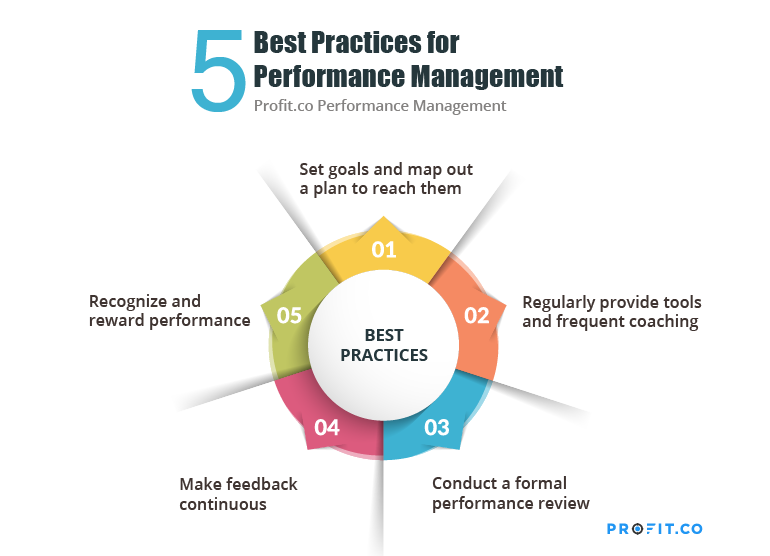
5 Best Practices for Performance Management
1. Set goals and map out a plan to reach them
Tell your employees what you expect from them, and set actionable items to help them reach those expectations. The best way to make sure your employees are engaged and producing their best work is to have well-developed and attainable goals. This is also a good opportunity to listen to your employees’ concerns: if they believe they won’t be able to achieve one of your desired goals, listen to their concerns and work with them to either shift the expectations or help them achieve what you want.
Once you have set goals, document your plan for future reference. This documents the agreed-upon goals, and will help facilitate any performance review you might set up with them in the future. Make sure your employees also have a copy of this document so they can use it to do their work. No employee will work to their full potential if they don’t have the right parameters or guidance.
2. Regularly provide tools and frequent coaching
Sometimes the best employee is not the one who knows everything, but the one who is ready to quickly learn the necessary tools and competencies for the job. For that to happen, Make sure you’re providing your employees the tools, time, and training they need to do their job well. Having the right tools and coaching helps the employee perform well on their assigned task, and you can assure their work will hold up to your standards.
Providing constant tools and training also increases the team’s morale and engagement– employees are usually more satisfied with their work if they realize their company cares about them. Employees who feel they’re not getting the necessary support from their company are not likely to stay working there for long.
3. Conduct a formal performance review
You probably already conduct one form of a performance review – an annual or quarterly review, rating scales, or forced ranking. As time goes on, these types of reviews are resulting in more drawbacks than advantages. If you use these types of reviews, chances are that your company needs to change so it doesn’t fall behind and your employees don’t become unhappy.
Here are a couple of modern systems you can put in place to make your performance reviews more productive and less prone to resentment:
Objectives and Key Results (OKRs)
Andrew Grove developed the OKR system in the 1970s and wrote about it in his book, High Output Management. He designed the system to focus on every employee’s output instead of seeing all the employees as a whole. He implemented this system on Intel in the 1970s. Now, companies can implement an online platform to manage their OKRs. Profit.co offers intuitive OKR Management, among other powerful features, that can help you optimize your business, motivate employees, and achieve more than you ever thought possible.
Employee self-evaluation
An employee self-evaluation is a helpful tool for both you and your employee, transforming their performance review into a two-way conversation. This encourages the employee to find areas of personal growth while also highlighting their contribution to the company.
4. Make feedback continuous
Apart from conducting formal reviews of their employee’s performance, companies are also shifting their feedback system to provide a more continuous stream of evaluation. This is translated to one-on-one meetings or overall immediate feedback on products or practices.
Opening the door for continuous feedback takes away the pressure of annual reviews and creates a better learning environment for your employees. This also allows you to hold your employees accountable for the goals they agreed upon. A study shows that companies who give continuous feedback experience a 15 percent lower turnover rate.
5. Recognize and reward performance
Even if you have a continuous feedback stream, it doesn’t matter if you’re not acknowledging your employee’s hard work. Reviews are meant to identify areas of improvement, but they are also made to recognize employees when they excel on their goals. Conducting performance reviews and only focusing on the bad aspects of performance can make your employees feel undervalued and resentful. A study shows that great feedback can increase performance by 5%-20%, and teams with managers who receive good feedback can experience up to 12.5% more productivity.
Providing a system to acknowledge and reward good performance can be extremely beneficial for your employees – and, by proxy, you. Give them a space to recognize theirs and others’ performances, and your employees will feel valued.
Not an easy change, but a rewarding one
Implementing these changes is not easy, and it’s not quick. It requires constant work and cooperation from every person from your company. However, implementing modern performance management tools opens a door of transparency and trust between you and your employees. This can reflect in better employee engagement, retainment, and satisfaction.