











Organizations rarely jump from a strategy document to a fully deployed strategy. They move through recognizable stages, each fixing the previous stage’s biggest gap. Knowing which stage you’re in tells you what to fix next, and what not to bother with yet.
In this guide
Key Takeaways
- →Level 1, a strategy document: nothing reaches the levels that do the work.
- →Level 2, cascaded goals: targets assigned rather than owned, progress mistaken for success.
- →Level 3, negotiated and reviewed: the reviews still track progress rather than effect.
- →Level 4, evidence of effect: the gap is visible, but the plan still changes only annually.
- →Level 5, a learning loop: bets tested and changed quarterly, verdicts feeding the next plan.
- →The jump most organizations need is from level 2 to level 4.
The five levels
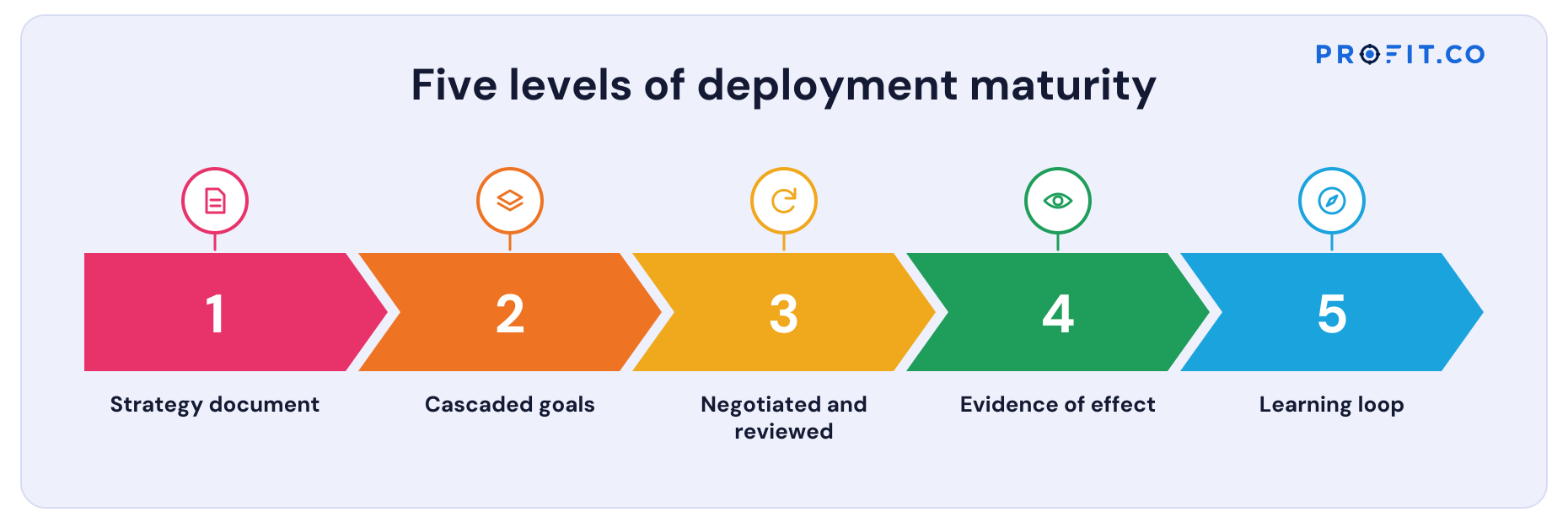
Each level fixes the gap the one before it leaves open, which is why skipping is rarely possible.
| Level | Name | What it looks like | Main gap |
|---|---|---|---|
| 1 | Strategy document | Strategy written and communicated; little connection to work | Nothing reaches the levels that do the work |
| 2 | Cascaded goals | Goals linked down; progress rolled up | Targets assigned, not owned; progress mistaken for success |
| 3 | Negotiated and reviewed | Targets negotiated; monthly reviews with corrective actions | Reviews track progress, not effect |
| 4 | Evidence of effect | Work progress beside results; exceptions flagged; dependencies agreed | Plan still changes only annually |
| 5 | Learning loop | Bets tested and changed quarterly; verdicts feed the next plan | Sustaining it |
Read the last column down the page. Each gap is the thing the next level exists to close.
Symptoms of each level
| Level | You’ll hear |
|---|---|
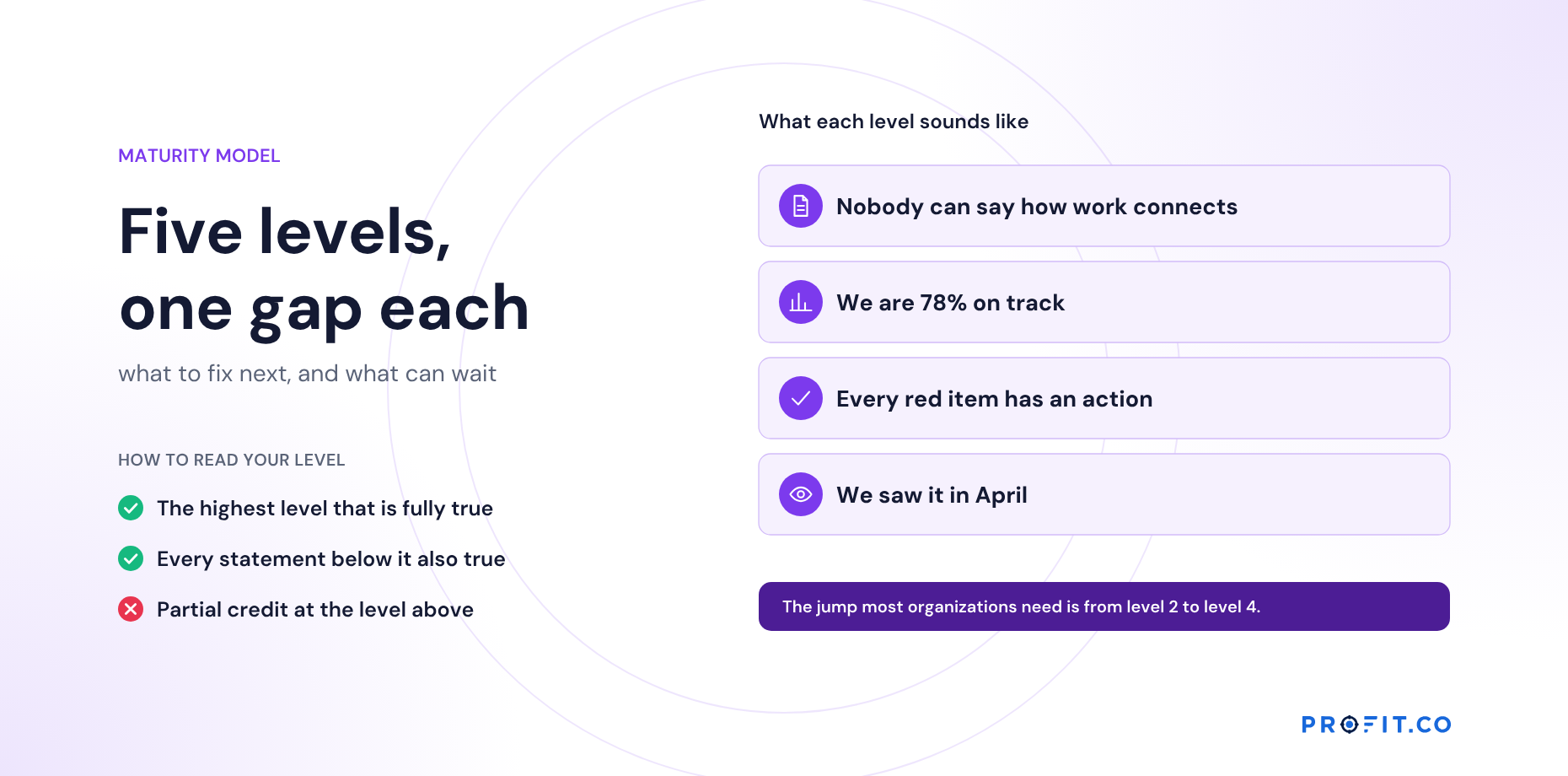
| 1 | “Everyone knows the strategy,” but nobody can say how their work connects |
| 2 | “We’re 78% on track,” while the board’s key results don’t move |
| 3 | “Every red item has an action,” while finished programs change nothing |
| 4 | “We saw it in April,” but the change waits for next year’s plan |
| 5 | “That bet didn’t hold, so we moved the team in Q2” |
The jump most organizations need is from level 2 to level 4: from tracking progress to testing effect.
Next steps by level
| From | Next step | Read |
|---|---|---|
| 1 to 2 | Connect each strategic objective to the next level’s goals | Deploying Down: Turning Strategic Choices Into Targets Each Level Owns |
| 2 to 3 | Negotiate targets; start monthly reviews with corrective actions | Cascading Goals vs Negotiating Them: Why Top-Down Cascades Fail |
| 3 to 4 | Link initiatives to the results they should move; flag exceptions | Reporting Up: Progress vs Evidence |
| 4 to 5 | Run quarterly reviews that change bets; judge every bet at year end | The Quarterly Strategy Review: Meetings That Change Decisions |
Self-assessment
- Level 2: every strategic objective connects to goals at the next level.
- Level 3: most targets were negotiated, and monthly reviews end with recorded actions.
- Level 4: initiatives name the result they should move, and exceptions are flagged without searching.
- Level 5: the plan changed at least once last quarter on evidence, and last year’s bets have verdicts.
Your level is the highest one where every statement below it is also true.
A worked example: an assessment
Here are one hypothetical organization’s answers, run against the statements above:
One organization’s answers, run against the statements above.
| Statement | True? |
|---|---|
| Objectives connect to the next level | Yes |
| Most targets negotiated | Partly: group level only |
| Monthly reviews end with recorded actions | Yes |
| Initiatives name the result they should move | No |
| Exceptions flagged automatically | No |
This organization is at level 3, with negotiation still to extend below group level. Its next step isn’t more reporting: it’s linking initiatives to results and flagging exceptions, the move to level 4.
What each level costs to leave alone
Staying at level 2 is the expensive one. The reporting machinery is already paid for, the roll-up looks healthy, and the bets that are not working keep their funding because nothing in the system contradicts the number. The cost is a year of budget on the wrong things, repeated.
Among published alternatives for making the move to level 4, OnStrategy lists $200 per month for unlimited users. i-nexus publishes a free Starter tier for up to five users and $28 per user per month at its Standard tier. For either, test the level 4 capability directly: can an initiative name the result it should move, and does a gap appear without anyone searching for it?
Profit.co publishes two plans, Essentials and Enterprise, quoting against modules and scale rather than a public seat rate, which suits an organization moving up a level at a time rather than buying everything at once. OKRs and Goals, Balanced Scorecard, Hoshin Kanri and Strategy Roadmap sit in Essentials, and the 30-day free trial covers one monthly cycle, which is enough to see whether level 4 would actually change your review.
Every level on one model
Profit.co supports every level on one model: goals and OKRs for level 2, catchball sessions and reviews for level 3, correlations with expected lags and the exception queue for level 4, and strength histories and A3 verdicts for level 5. See the strategy deployment software page.
That matters more than it sounds, because the usual failure of a maturity model is buying a tool for the level above and never reaching it:
- You start where you are. A level 2 organization uses goals and roll-ups, with nothing switched on that it cannot yet staff.
- The next level is a setting, not a migration. Linking an initiative to a result is a field, not a new system and a new set of records.
- Nothing is re-keyed on the way up. The objectives from level 2 carry the correlations added at level 4 and the verdicts added at level 5.
The process measures that tell you whether you have actually moved up are in Measuring Whether Strategy Deployment Is Working.
Free Product Demo
Find your level, and the next step
A 30-minute walkthrough, tailored to your team.
Book a free demo
What happens in the call
How your teams set goals, track progress and review results.
Strategy, performance, projects and engagement on one platform, with AI.
A practical path to align teams, execute faster and drive results.
Questions this article answers
A strategy document; cascaded goals with progress tracking; negotiated targets with regular reviews; evidence of effect with exceptions flagged; and a learning loop that tests and changes bets.
Many are at level 2, with cascaded goals and progress roll-ups. The most valuable step is usually to level 4, testing whether work moves results.
Fix the main gap of your current level: connect goals, then negotiate targets, then link work to results, then change bets quarterly on evidence.
Your level is the highest one where every statement below it is also true. Partial credit at one level does not move you up; it tells you what to finish.
Rarely, because each level fixes the gap the one before it leaves open. Evidence of effect is hard to act on when targets are still assigned rather than owned.