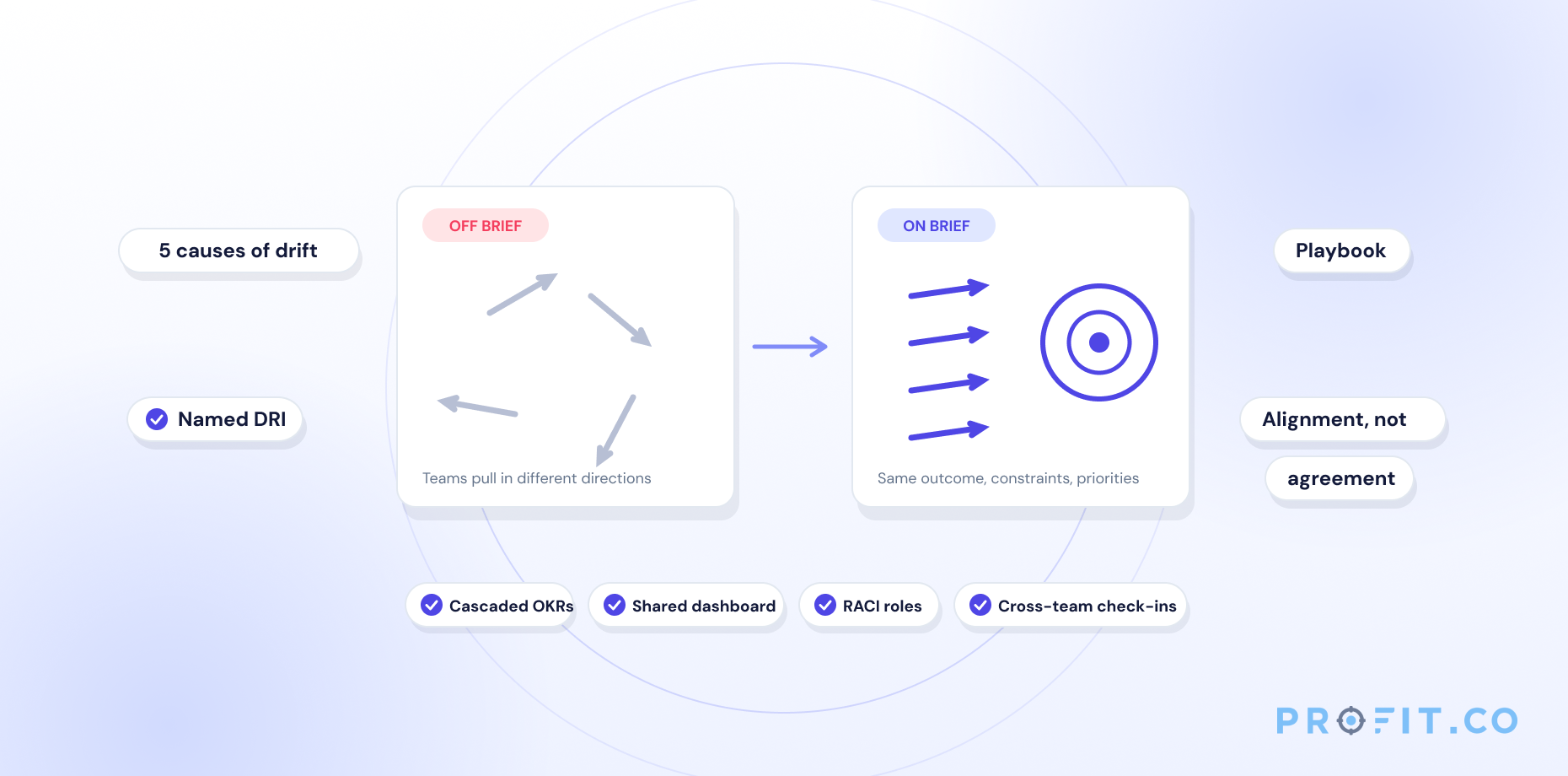
Strategic planning using OKR and PPM connects quarterly strategic intent to project-level delivery in one traceable system. OKRs define what success looks like each quarter. PPM determines which projects earn investment to reach it. Together, they close the execution gap that costs most organizations time, budget, and strategic focus.
In this guide
- What is Strategic Planning with OKR and PPM, and Why Does the Gap Exist?
- How do OKRs and PPM Work Together in Strategic Planning?
- Why does Stage-Gate Governance Fail Without OKR Alignment?
- How do OKRs Bridge Stage-Gate Governance and Agile Delivery?
- What does the Hybrid OKR + PPM Planning Model Look Like in Practice?
- What Platform Supports OKR and PPM Strategic Planning Natively?
- Frequently asked questions
What is Strategic Planning with OKR and PPM, and Why Does the Gap Exist?
Most organizations run two disconnected planning cycles. Strategy teams set OKRs in January. The PMO builds a project portfolio in Q1. Both teams then execute independently for eleven months, and wonder why results diverge from the plan by March.
This is the execution gap. It is not a people problem. It is a structural one. OKRs without connected projects are statements of intent with no delivery engine. Projects without OKR alignment are activities that may or may not move the strategy forward. Done right, the combination creates a closed loop: every funded project has a direct line of sight to a strategic outcome, and every OKR has at least one project working to deliver it.
The root cause is consistent across industries: projects get funded based on departmental priority, not strategic alignment. By the time the misalignment becomes visible, the quarter is already lost.
Strategy without projects is a wish list. Projects without OKRs are just activity.
OKR + PPM strategic planning solves this by treating the two frameworks as complementary layers of the same system. OKRs set the destination. PPM selects and funds the vehicles. The combined structure ensures execution never drifts from strategic intent, regardless of how complex the organizational chart becomes.
How do OKRs and PPM Work Together in Strategic Planning?
OKRs and PPM operate at different levels of organizational planning but they share a single integration point: Key Results become the success criteria that PPM uses to prioritize, evaluate, and when necessary, cancel projects mid-cycle.
| Dimension | OKR Framework | PPM Framework |
|---|---|---|
| Primary question | What does success look like this quarter? | Which projects should we fund to reach it? |
| Time horizon | Quarterly (with annual context) | Project lifecycle — weeks to multi-year |
| Output | Objectives + measurable Key Results | Prioritized portfolio with resource allocation |
| Success signal | Key Result scored 0.7 or above | Project delivered on time, in scope, on budget |
| When it breaks | OKRs set with no projects tied to deliver them | Projects running without a strategic rationale |
| Integration point | Key Results define acceptance criteria for project success | Portfolio filtered by active OKR alignment score |
This integration produces a decision rule that most organizations lack: if a project does not directly move at least one active Key Result, it does not get funded. Applied consistently, that principle forces a level of strategic discipline on resource allocation that departmental politics and seniority alone cannot produce.
Why does Stage-Gate Governance Fail Without OKR Alignment?
Stage-gate is a well-established project governance model. Projects move through defined phases, initiation, planning, execution, closure, with a formal review gate at each transition. The embedded assumption is that strategic alignment was confirmed at gate one, and the project runs from there.
This is where stage-gate breaks at scale. Strategy changes quarterly. A project that cleared gate one in January may no longer serve the organization’s priorities by March. Without OKR-linked gate criteria, there is no structural trigger to pause, reprioritize, or cancel projects whose strategic rationale has expired. Teams deliver, on time, on budget, against goals that nobody in leadership still cares about.
The assumption most organizations make is that stage-gate failure is a process execution problem: gates not enforced rigorously, reviewers not showing up, documentation incomplete. It is not. Stage-gate fails because its gate criteria are static while strategy is dynamic. Replacing fixed gate criteria with live OKR Key Results converts stage-gate from a compliance exercise into a responsive governance model, one that adapts as strategic priorities shift through the year.
Stage-gate governance is only as good as the strategy it reviews against. When strategy evolves quarterly and gate criteria are annual, the gap is structural, not accidental.
For a detailed look at how stage-gate can be redesigned for strategic agility, the stage-gate project governance framework explains how each gate can be structured around live strategic criteria rather than static compliance checkpoints.
How do OKRs Bridge Stage-Gate Governance and Agile Delivery?
The insight most planning frameworks miss: OKRs are the natural bridge between stage-gate governance and agile delivery. The quarterly OKR cadence is not just a reporting rhythm. It is the gate review cycle. Key Results are the gate criteria. Sprint goals are the execution units.
This reframes how all three layers interact:
01
OKRs set the quarterly gate
Each quarter’s Key Results define what the organization must achieve for the portfolio to advance. Projects that no longer contribute to active Key Results are paused or deprioritized at the quarterly gate review, not at next year’s planning cycle.
02
PPM allocates to OKR priority
Portfolio prioritization is driven by OKR alignment scores, not department politics or project age. Resources flow to projects that directly advance this quarter’s Key Results above all other candidates.
03
Sprints deliver the key results
Agile sprint goals connect directly to Key Results. Each sprint is measured not just by delivery completeness but by its contribution to quarterly Key Result progress, connecting daily work to strategic outcomes.
This is fundamentally different from what most organizations run today. The difference is not the frameworks themselves. Most organizations already use some version of OKRs, stage-gate, and agile. The difference is the integration layer. When all three operate in separate systems, the connections between them are manual, delayed, and incomplete. When they operate in a single platform, the connections are structural.
Teams managing agile delivery alongside strategic goals can explore the agile goal management framework for practical guidance on connecting sprint goals to quarterly OKR targets without adding reporting overhead to already stretched engineering teams.
See OKR + PPM working as one connected system
What does the Hybrid OKR + PPM Planning Model Look Like in Practice?
The hybrid model operates on a three-layer planning architecture. The OKR layer sets direction quarterly. The PPM layer funds and prioritizes delivery. The agile layer executes in two-week sprints. The integration points between layers are where the model works or breaks.
Set strategic OKRs at company and team level
Begin each quarter with Objectives anchored to the 3-year strategic direction. Write Key Results that are measurable, time-bound, and independently verifiable. These become the filter for every resource allocation decision that follows. A Key Result without a project attached is a wish, not a plan.
Map every project to at least one active Key Result
Tag every project in the portfolio to one or more active Key Results. Projects with no OKR connection are flagged for review. Portfolio prioritization score is driven by how directly a project moves a high-priority Key Result, not by department seniority or project age.
Run stage-gate reviews against OKR progress, not just project milestones
At each gate, the review question is not only “did the project hit its milestone?” but also “does this project still advance an active Key Result?” If the Key Result has been achieved or deprioritized, the project gate must reflect that shift immediately.
Connect sprint goals to Key Result progress
Each sprint defines which Key Result it advances and by how much. Sprint retrospectives include a Key Result contribution review alongside the standard delivery review, creating accountability at the task level for strategic outcomes, not just outputs.
Score all OKRs quarterly and reset the portfolio accordingly
At quarter end, score every OKR on a 0.0-1.0 scale. Run a portfolio review that cancels or reprioritizes projects based on what the scores reveal about strategic progress. Set the next quarter’s OKRs with lessons from the portfolio. The cycle restarts, tighter and better aligned each time.
Most planning frameworks fail at the seam between strategy and delivery. The hybrid model makes that seam the strongest joint in the system.
What Platform Supports OKR and PPM Strategic Planning Natively?
Most organizations evaluating OKR and PPM platforms make the same mistake: they assess each tool independently. The result is a best-of-breed OKR tool for the strategy team and a separate PPM tool for the PMO. The integration between them becomes a manual process: spreadsheets, CSV exports, or a fragile API maintained by an IT team with seventeen other priorities. The hybrid model collapses within 60 days.
A platform built for the hybrid model must provide four capabilities in one system:
Native OKR architecture. OKR management built into the platform, not added onto a task tool. This means proper cascading, check-in workflows, 0.0-1.0 scoring, and the quarterly Reflect/Reset cadence.
Bidirectional OKR-to-project linking. Every project connects to one or more OKRs. OKR progress pulls from project delivery data automatically, not through manual updates every Friday afternoon.
AI-assisted authoring and progress tracking. OKR quality degrades at scale without AI support. AI-powered workflows that write OKRs from strategy inputs, score quality before the quarter starts, and collect progress without manual reporting cycles are essential at the enterprise level.
Integration depth across delivery tools. Progress data should flow automatically from Jira, Salesforce, HubSpot, and Azure DevOps. Manual data entry between tools breaks the hybrid model inside 30 days.
The Connected OKR + PPM Architecture
Connect OKR management, PPM, and AI-powered tracking in one system
A platform built for this hybrid model natively connects OKR management, full project portfolio management, and AI-powered progress workflows in one system. Unlike standalone OKR tools that require separate project software, or PPM tools that treat OKRs as an afterthought, a unified platform connects strategy to execution without data leaving the system.
AI-assisted OKR authoring writes high-quality OKRs directly from strategy inputs. AI-powered quality review scores them before the quarter starts, catching vague Key Results before they waste 90 days of execution. Automated progress monitoring tracks project delivery against OKR targets in real time, surfacing misalignment before it compounds into a missed quarter.
With 100+ integrations including Jira, Salesforce, Azure DevOps, and Microsoft Teams, progress updates flow automatically from every delivery tool into the OKR and portfolio view. Explore how OKR-linked project portfolio management works in one connected platform.
How do you Close the Execution Gap Between Strategy and Project Delivery?
Organizations that run OKRs and PPM as separate systems are not making a tool choice. They are making a structural decision that produces a predictable structural outcome: strategy set in one place, delivered in another, and never reconciled in real time.
The hybrid OKR + PPM model, where quarterly Key Results serve as stage-gate criteria and sprint goals serve as execution units, is not a conceptual framework. It is an operational system that requires a platform built to hold all three layers together without data loss or manual translation between tools.
OKR University provides comprehensive guidance for teams building this model from scratch, including templates, scoring methodology, and implementation support across the full OKR planning and strategy execution lifecycle.
Speed without direction is faster failure. The OKR + PPM bridge gives every project both.
For organizations managing large project portfolios tied to OKR cycles, a connected OKR management platform links quarterly strategic goals to portfolio-level execution decisions, with AI-powered workflows that handle progress tracking, quality scoring, and review preparation automatically.
Connect OKR + PPM for Real Strategic Execution
Frequently Asked Questions
Strategic planning using OKR and PPM connects quarterly strategic intent, defined through Objectives and Key Results, with capital and resource allocation decisions in Project Portfolio Management, creating a single traceable path from strategy to execution.
OKRs define what success looks like each quarter. PPM determines which projects receive investment to deliver that success. OKRs act as the strategic filter for portfolio prioritization, with only projects tied to active OKRs earning priority resource allocation.
The hybrid model uses quarterly OKR Key Results as stage-gate criteria and sprint goals as execution units. Stage-gate reviews confirm projects still serve active OKRs. Agile sprints deliver incremental progress that advances Key Results each week.
Separate systems let projects continue even when the strategy shifts. Teams deliver outputs without knowing whether those outputs still move the strategic needle, creating activity without measurable impact on quarterly goals.
The best platform for OKR and PPM strategic planning connects native OKR management, full project portfolio management, and AI-powered progress automation in one system, eliminating the need for separate tools or manual progress updates between systems.