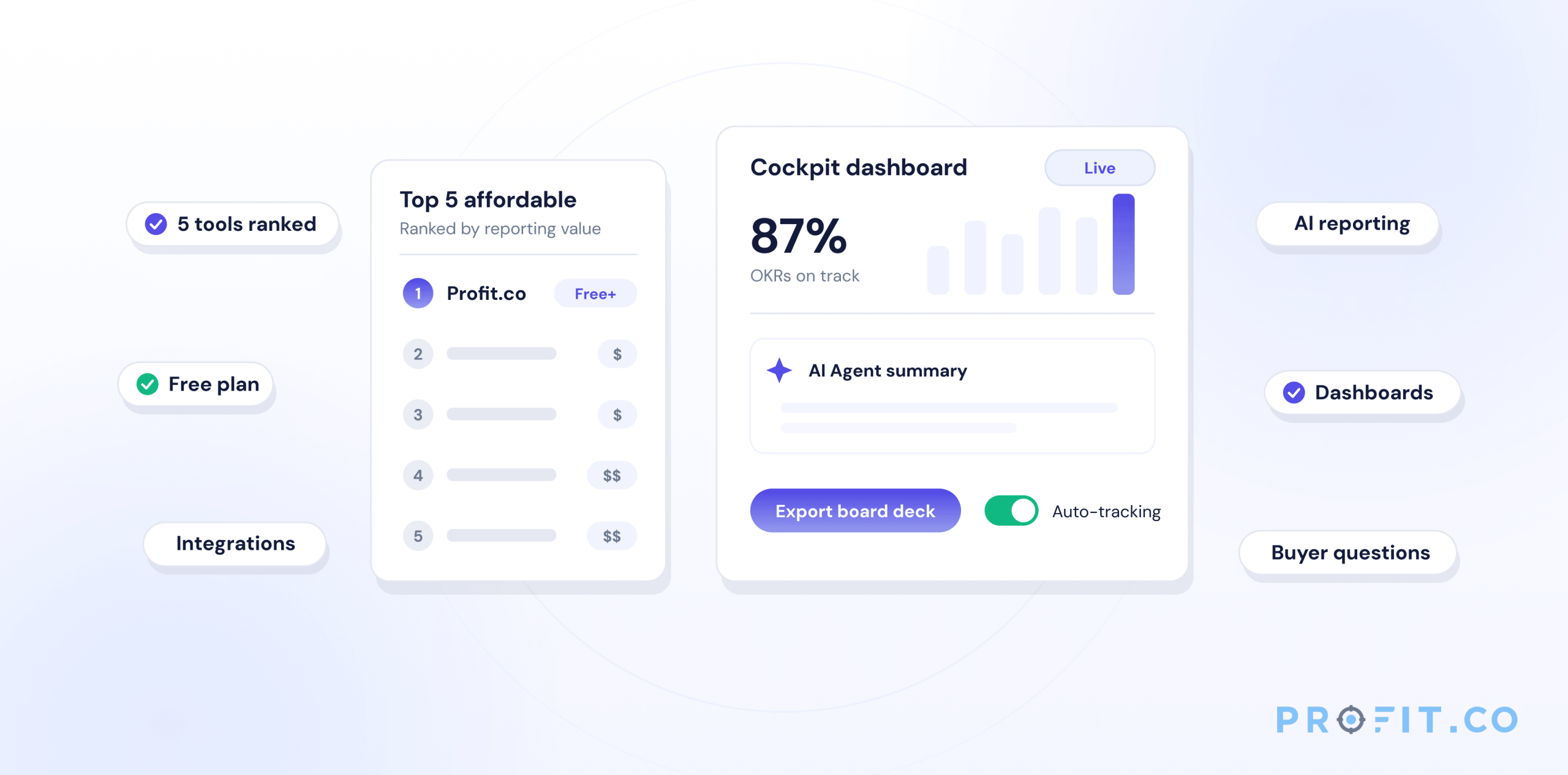
Goal-tracking software helps teams set, monitor, and follow through on objectives instead of letting them stall after the kickoff meeting. Most goal-tracking failures happen because progress gets buried in spreadsheets and Slack threads with no single owner checking in. This guide compares 17 platforms, from lightweight free tools to enterprise OKR systems, based on team size, methodology, and integration needs.
In this guide
- 17 Best Goal-Tracking Platforms at a Glance
- How to Choose the Right Goal-Tracking Software
- Why Enterprise Teams Consolidate on One Platform
- Conclusion
- Frequently Asked Questions
TL;DR
Looking for the best goal tracking software in 2026? Here are 17 top tools for OKRs, performance management, and strategic alignment, whether you’re a startup, mid-sized company, or enterprise.Top picks at a glance:
Profit.co
Best enterprise OKR & goal management platform
Lattice
Best for people-first performance management
Weekdone
Best for teams new to OKRs
Asana
Best for teams already using project management tools
Perdoo
Best for mid-sized European companies
Workboard
Best for strategic execution at scale
15Five
Best for continuous performance management
ClickUp
Best all-in-one workspace
Reflektive
Best for real-time feedback culture
Hirebook
Best for small businesses
Leapsome
Best for learning & development integration
Culture Amp
Best for analytics-driven HR teams
Tability
Best for lean teams running OKRs
Mooncamp
Best for visual goal tracking
Koan
Best for remote-first teams
OKR Board
Best free option for OKR experimentation
Trello (with Power-Ups)
Best for Kanban-style goal tracking
Choose based on team size, goal methodology (OKRs vs SMART goals), integration needs, and whether you need lightweight tracking or enterprise-grade governance.
You know what’s funny about goals? Everyone’s got them.
Ask any team lead what their Q1 priorities are and you’ll get an earful. But ask them in April how those goals are actually going, and suddenly it’s all crickets and awkward subject changes!
The uncomfortable truth is that most goals don’t fail because they’re bad goals. They fail because, somewhere between the kickoff meeting and execution, they lost momentum. They get buried under daily fires, get lost in endless Slack threads, or are simply abandoned when nobody’s looking.
Goal-tracking software is the annoying friend who remembers exactly what you said you would do and isn’t afraid to follow up.
The right tools make staying on track feel almost effortless. The bad stuff turns into digital clutter that everyone ignores by week three!
The thing is, the market’s completely bonkers right now. You’ve got stripped-down apps that basically amount to fancy to-do lists, and then you’ve got these massive platforms that probably have features even the people who built them don’t fully understand.
Some are perfect for freelancers tracking personal projects, while others are seriously built for massive corporations coordinating thousands of people across continents.
Let’s get into what some of the best options are.
1. Profit.co – Best Enterprise OKR, Project & Goal Management Platform
Alright, so when companies stop messing around and get genuinely serious about goal alignment, this is where a lot of them end up.Profit.co isn’t playing around with basic tracking. This is the full package…goals, performance reviews, engagement surveys, and strategic planning that are all talking to each other like they’re supposed to.
Key Features
You’ve got OKR management that actually cascades properly from the CEO’s vision all the way down to the intern’s quarterly plan. Performance reviews come with 360 degree feedback and continuous check-ins that don’t wait for some annual charade. And strong project capabilities help you identify and manage all stakeholders early on to minimise risks and increase the likelihood of delivering projects successfully.
Meanwhile, the employee engagement stuff includes pulse surveys, structured one-on-ones, and recognition tools that don’t feel forced. Strategic planning features let you map the big vision and connect it to actual work. The analytics dashboard shows real-time progress without needing a PhD in data visualization.
And it integrates with basically everything (think Slack, Teams, Jira, Salesforce, plus about 50 other tools your team’s probably already using).
What Makes Profit.co Stand Out
This is legitimately enterprise-grade stuff. AI-powered goal recommendations that don’t sound like they came from a random word generator. Custom workflows and approval processes for when you need actual governance.
Security and compliance that checks the boxes…SOC 2, GDPR, 99.99% Uptime, all that. Bigger customers get dedicated success managers who actually help. There’s even white-label options if you’re the kind of enterprise that wants everything under your own brand.
- Pros: Feature set that actually scales when you grow; Alignment tools that work even in complicated org structures; Implementation support that doesn’t ghost you
- Cons: Probably way too much if you’re a 12-person team; Pricing matches the enterprise positioning; Definite learning curve if OKRs are new territory
2. Lattice – Best for People-First Performance Management
Lattice showed up and said “what if performance management didn’t feel like corporate torture?” They built something that treats goal tracking as part of actual human development instead of just checking compliance boxes.- Pros: Interface that doesn’t make you want to cry; Fits naturally with HR workflows; Genuinely good for culture-focused companies
- Cons: You’ll pay for the premium positioning; Feature gates on lower tiers get annoying; Goal tracking isn’t as deep as platforms built specifically for OKRs
3. Weekdone – Best for Teams New to OKRs
If OKRs sound intimidating and you’re worried about drowning in methodology, Weekdone makes it digestible. Clean interface, gentle learning curve, and you can actually start using it without hiring a consultant or sitting through weeks of training.- Pros: Onboarding that doesn’t require a manual; Pricing that works for smaller teams; Weekly check-ins keep goals from getting stale
- Cons: Customization is limited; Integration list is shorter than the big players; Reporting isn’t going to blow anyone’s mind
4. Asana – Best for Teams Already Using Project Management Tools
Asana threw goal tracking into their project management platform, which makes total sense if you think about it. If your team’s already in Asana every day managing work, why add another tool to the rotation?- Pros: Your tasks and goals live in the same place; Everyone already knows how it works; Collaboration features are solid
- Cons: Goal stuff is newer and shows it; Gets messy if you’re trying to use it only for goals; Need premium tier for the good features
5. Perdoo – Best for Mid-Sized European Companies
Perdoo’s carved out a nice spot with European companies, partly because GDPR compliance was there from day one, and partly because the pricing model hits sweet for companies between startup and enterprise.- Pros: Interface that’s actually pleasant to use; Nice middle ground between simple and overwhelming; Customer support that responds
- Cons: Integration list isn’t winning awards; Less buzz in North America; Missing some bells and whistles
6. Workboard – Best for Strategic Execution
Workboard doesn’t call itself a goal tracker; it’s a strategic execution platform, which sounds like consultant-speak but actually means something. They’re focused on connecting boardroom strategy to what people actually do on Wednesday!In a significant industry move, WorkBoard acquired Quantive, consolidating two major players in the enterprise OKR and strategy execution space and expanding WorkBoard’s footprint in large-scale transformation initiatives.
- Pros: Strong flow from strategy to execution; Built for leadership teams; Quarterly business reviews are native
- Cons: Really designed for bigger orgs; Complexity can frustrate smaller teams; Needs buy-in across the company to work
7. 15Five – Best for Continuous Performance Management
15Five started with the simple idea of weekly check-ins (15 minutes to write, five to read…get it?) and grew into full performance and goal management. And the human element is still front and center.- Pros: Really emphasizes manager-employee relationships; Good for building feedback culture; Weekly rhythm becomes habit
- Cons: Goals feel like a supporting character and not the star; Customization options are meh; The costs climb with team size
8. ClickUp – Best for All-in-One Workspace Seekers
ClickUp has big ambitions; they want to be the only productivity tool you ever need. Goals are just one slice of that very large pie.- Pros: Ridiculous amount of features; Customize it until the cows come home; Pricing is actually reasonable
- Cons: Feature overload is real; Goal tracking isn’t their strongest suit; Learning curve is basically a cliff
9. Reflektive – Best for Continuous Feedback Culture
Reflektive built everything around the premise that annual reviews are dead and real-time feedback is the future. Goals fit into that ongoing dialogue.- Pros: Recognition and feedback happen in real-time; Mobile experience doesn’t suck; Ties feedback directly to goal progress
- Cons: Notification overload is possible; Looser goal structure (which you’ll love or hate); Pricing requires a phone call
10. Hirebook – Best for Small Business Simplicity
Sometimes you don’t need the enterprise monster. Hirebook keeps things dead simple for small businesses that want goal tracking without the complexity hangover.- Pros: Set it up in an afternoon; Won’t break the budget; Doesn’t overwhelm tiny teams with features they’ll never touch
- Cons: You’ll outgrow it eventually; Integrations are sparse; Reporting is basic
11. Leapsome – Best for Learning and Development Integration
Leapsome connects goals with learning paths, which is actually clever…since if someone’s missing targets, maybe they just need skills, and not just reminders!- Pros: Links goals to development; Great for growth-minded cultures; Review cycles are well thought out
- Cons: Learning stuff might be overkill for some; Pricing is mid-tier; Newer player still building features
12. Culture Amp – Best for Analytics-Driven HR Teams
Culture Amp made their bones with employee surveys, and the goal tracking pieces fit into that data-obsessed approach to managing people.- Pros: Analytics that actually impress; Engagement measurement is top-notch; Perfect for evidence-based HR teams
- Cons: Goals feel tacked on; Expensive if you’re only here for goal tracking, you need data chops to get the full value!
13. Tability – Best for Lean Teams Running OKRs
Tability stripped out everything except what you actually need to run OKRs. No fluff, no random features, just focused goal tracking.- Pros: Feature set that makes sense; Affordable; Gets up and running fast
- Cons: If you need more than core OKRs you’re out of luck; Smaller team means slower updates; Enterprise features aren’t there
14. Mooncamp – Best for Visual Goal Tracking
Some brains work in spreadsheets, others need visual dashboards. Mooncamp leans hard into visual progress tracking that makes updates actually interesting.- Pros: Interface is genuinely beautiful; Visual tracking is engaging; Creative teams dig it
- Cons: Relatively new; Smaller user community; Less proven at scale
15. Koan – Best for Remote-First Teams
Built specifically for distributed teams, Koan focuses on async goal updates and keeping remote folks aligned without Zoom fatigue.- Pros: Async workflows that respect time zones; Integrates with communication tools; Designed for remote reality
- Cons: Might lack what in-person teams expect; Smaller integration list; Customization is limited
16. Objectives and Key Results (OKR) Board – Best Free Option
Want to experiment with OKRs without spending a dime? OKR Board offers basic functionality at exactly zero dollars. You get what you pay for, but sometimes free is perfect.- Pros: Actual free tier exists; Interface is straightforward; Good for testing OKRs
- Cons: Features are bare bones; Support is minimal; Won’t support serious usage
17. Trello with Goal Tracking Power-Ups – Best for Visual Kanban Lovers
Trello isn’t technically goal software, but if you add the right power-ups and set up boards properly, teams who already love Trello can track goals without adding another app.- Pros: Use what you already know; Visual and flexible; Cheap
- Cons: Requires setup work and discipline; Wasn’t built for this; Reporting means DIY spreadsheets
How to Choose the Right Goal-Tracking Software
Here’s the thing about choosing goal-tracking software: it’s not like choosing which streaming service to subscribe to.This decision will literally ripple through how your whole organization thinks about priorities, tracks progress, and holds people accountable. Screw it up, and you’ve bought an expensive digital tool that nobody uses.
Start by being honest about team size and where you’re headed. A 10-person startup and a 500-person scale-up need completely different things.
Some tools are magic at certain scales and absolute disasters at others. Don’t pay for enterprise complexity you’ll never touch, but also don’t pick something you’ll need to replace in six months when you double in size.
Figure out your goal philosophy. Are you OKR purists, SMART goal devotees, or are you honestly making it up as you go? Some software is dogmatic about methodology, others are loose to the point of chaos. Pick the one that matches your actual approach, not the one you think you should have.
Also, take a look at what you’re already using. If your team primarily uses Slack or Teams, integration isn’t a nice-to-have; it’s make-or-break. The best software in the world is basically useless if nobody opens it because it’s one more tab to remember!
Why Enterprise Teams Consolidate on One Platform
Most companies start with two or three tools: one for tasks, one for goals, one for reviews. That works fine at 20 people. At 500, it breaks, not because any single tool is bad, but because nobody can see the whole picture in one place.
Profit.co’s advantage at that stage isn’t a longer feature list. It’s that OKRs, performance reviews, project portfolios, and recognition run on one data model, so a goal set in Q1 stays connected to the project work and review cycle tracking it, instead of living in three disconnected systems that drift apart by Q3.
Its 100+ integrations mean status updates pull in automatically from tools teams already use, rather than depending on someone remembering to log in and update a percentage.
A goal that isn’t connected to the work behind it isn’t a goal. It’s a wish with a due date.
Conclusion
The right goal tracking software isn’t about finding the shiniest features or the prettiest interface. It’s about finding what actually works for your specific team size and culture and ambitions.Something that turns those big strategic conversations into concrete progress without making everyone’s daily job more annoying.
The best goal tracking software is whichever one people actually open.
Connect Goals, Projects, and Performance in One Platform
Frequently Asked Questions
OKR software is just goal tracking software with a specific religion. OKRs follow a particular structure, like qualitative objectives paired with quantitative key results. Goal tracking software might support OKRs but also lets you do SMART goals, KPIs, or whatever weird hybrid your team prefers.
Anywhere from free to “please call for a quote.” Basic tools run free to $5 per user monthly. Small team stuff hits $5-15 per user. Mid-market solutions land around $10-20 per user. Enterprise platforms make you talk to sales.
Research says yes when it’s done right, but the software itself isn’t magic pixie dust. It’s the clarity, the alignment, and the accountability the tool enables that moves needles.
Maybe not. Project management tracks tasks and deliverables. Goal tracking connects those to strategic objectives and measures outcomes.
Simple tools with small teams? Maybe a week. Mid-sized rollouts usually take 4-8 weeks with goal setting, training, and integrations. Enterprise deployments can eat 3-6 months when you factor in customization, change management, and phased rollouts.
Treating it like an IT project instead of a behavior change project. Buying software and expecting people to just use it is fantasy. Success happens when leadership uses it first, and also when there’s clear communication about why it matters, and when it fits into existing workflows instead of creating new homework.