TL;DR
Dynamic Performance Management replaces outdated annual reviews with continuous feedback, real-time data, and coaching. Implementation works best in four phases: Assessment and Planning, Foundation Building, Pilot Implementation, and Full Deployment. The benefits include reduced admin time, real-time visibility, stronger engagement, and faster decision-making. Most organizations see ROI within 12–18 months, with greater long-term gains as adoption grows. Let’s walk through them step by step.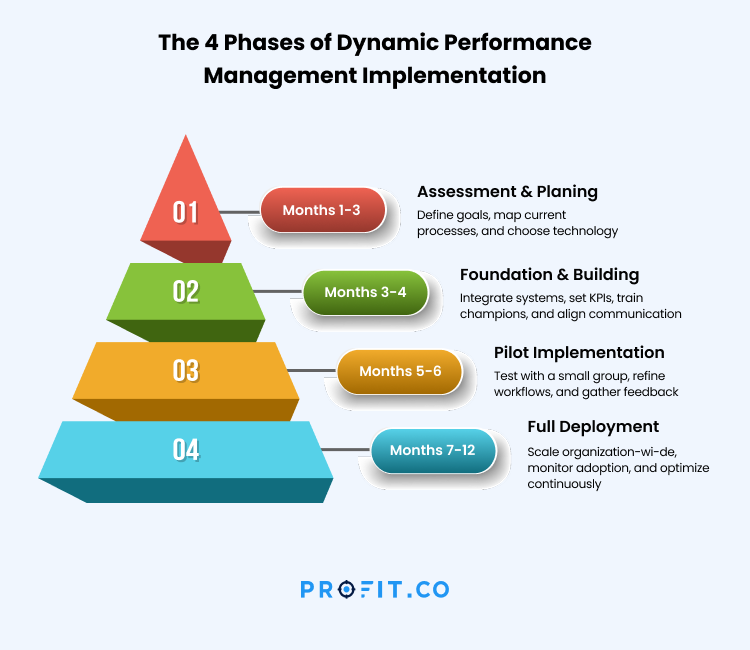
Phase 1: Assessment and Planning (Months 1–2)
Before you start building anything new, you need to know where you stand. This phase is all about clarity. First, review your current performance management process. What’s working? What’s frustrating? Where are the gaps? Next, look at readiness:- Why are we making this change now?
- What barriers might get in the way (culture, regulations, or tech limits)?
- How much data do we actually have to work with?
Phase 2: Foundation Building (Months 3–4)
Now that the plan is clear, it’s time to prepare the ground. Think of this as laying the data layer and the people layer. Both are equally important.On the data side:
- Integrate systems so data flows without friction
- Define role-based KPIs so everyone knows what success looks like.
- Put security and compliance measures in place.
On the people side:
- Train early adopters and champions who can model the new behaviors.
- Communicate the “why” clearly, so employees understand the purpose behind the shift.
- Create easy training materials and guides
- Open feedback channels so people can share input.
Phase 3: Pilot Implementation (Months 5–6)
This is where planning turns into action. But instead of launching everywhere at once, you start small. Choose a pilot group of around 50–100 employees. Give them focused training. Roll out the core features only, enough to test daily workflows but not so much that it overwhelms. Then, pay close attention. Collect usage data. Ask for feedback. Watch for patterns. When issues come up and they will, fix them quickly. Refine workflows. Adjust metrics. Document lessons. By the end of Phase 3, you’ll have proof that the system works, and you’ll have employee trust that this is a system built for them, not forced on them.Phase 4: Full Deployment (Months 7–12)
With the pilot complete, it’s time to scale. But scaling doesn’t mean rushing. Roll out department by department, team by team. Keep training and support strong. Monitor adoption rates closely. Ask employees what’s working and what’s not, then improve as you expand. Once the system is live across the organization, shift your focus to optimization. Fine-tune KPIs. Strengthen integrations. Use advanced analytics to give leaders better insights. By the end of Phase 4, Dynamic Performance Management is no longer a project. It’s simply how your organization manages performance every day.An empowered organization is one which individuals have the knowledge,shill,desire and opportunity personally succeed in a way that leads to collective organizational success

Why a Framework Works in Implementing Dynamic Performance Management
Many performance management initiatives fail because they lack structure. People fall back into old habits, and the new system never really takes off. This 4-phase framework solves that by creating momentum step by step:- Phase 1: You get clarity.
- Phase 2: You build trust.
- Phase 3: You prove value
- Phase 4: You embed change.
Benefits and ROI of Dynamic Performance Management
So why go through all this effort? Because the payoff is real. Here are the quantifiable and qualitative benefits:| Quantitative benefits | Qualitative benefits |
|---|---|
|
|
Schedule a strategy consultation
Dynamic Performance Management is a modern approach to managing performance that replaces annual reviews with continuous feedback, real-time data, and ongoing coaching. It helps organizations respond faster, improve visibility, and support employee growth.
To implement Dynamic Performance Management, follow a 4-phase framework:
- Assessment and Planning (Months 1–2): Map current processes and define success metrics.
- Foundation Building (Months 3–4): Prepare the data layer (integrations, KPIs) and the people layer (training, champions).
- Pilot Implementation (Months 5–6): Test with a small group, refine based on feedback.
- Full Deployment (Months 7–12): Scale across the organization and optimize.
Most organizations take 7–12 months to fully implement Dynamic Performance Management. The timeline depends on company size, technology readiness, and cultural change requirements.
Key benefits of Dynamic Performance Management include:
- less admin time for managers.
- Real-time performance visibility.
- Stronger manager–employee relationships.
- More agile responses to business changes.
- Higher employee engagement and retention.
Most organizations see ROI from Dynamic Performance Management within 12–18 months. Savings come from reduced admin tasks, lower turnover, faster decision-making, and better performance outcomes. In later years, ROI compounds as adoption and optimization improve.
Core technologies that enable Dynamic Performance Management include:
- AI-powered analytics for insights.
- Integrations with HR, project, and communication tools.
- Real-time dashboards for visibility.
- Automated feedback systems for continuous input