Everyone loves to be recognized for their hard work. And when that recognition comes in the form of a well-earned bonus? Even better. Performance bonuses have become more than just a “nice to have.” They’re quickly becoming essential tools for companies that want to attract, retain, and energize their best people.
Why? Because salaries alone aren’t cutting it anymore. Now that we have established that bonuses are important, let’s look into different things to consider.
Bonuses are supposed to motivate people, right?
But how you design them can light a fire under your team… or backfire.
If you’re wondering whether a linear bonus system or a range-based one works better, you’re in the right place.
What’s the Difference?
Linear Bonus Payouts:
Simple math. The better you perform, the more you earn, smoothly and step-by-step.
Example:
Hit 50% of your target? Get 50% of your bonus.
Hit 90%? Get 90% of your bonus.
It’s like turning the volume knob up slowly.
Range-Based Bonus Payouts:
This one’s chunkier. You must hit a specific range to earn anything, and payouts can jump suddenly.
Example:
90-100% achievement = 100% bonus
100-110% achievement = 120% bonus
Below 90% = maybe no bonus at all
It’s more like climbing stairs than sliding up a ramp.
Ready to redesign your bonus plan? Start creating a system that actually inspires results
So, Which One’s Better?
Honestly, it’s not a one-size-fits-all answer, but let’s look at why some companies lean toward performance-based bonuses tied to clear metrics and who others choose differently.
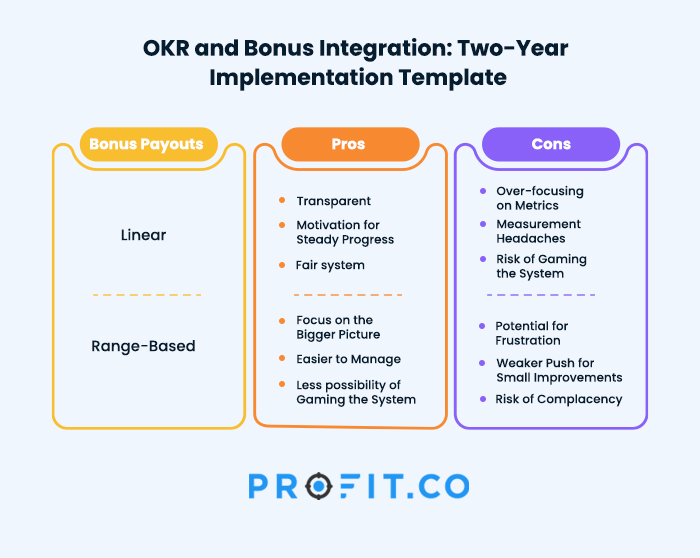
What are the Pros and Cons of a Linear Bonus Payout?
Here’s what’s great about Linear Bonus Payouts:
- Transparency:
- Motivation for Steady Progress:
- Fairness:
No guessing games. Employees can actually see how their efforts connect to their bonus. It’s clear, straightforward, and feels a lot more fair.
Every little improvement counts. Instead of feeling like it’s “all or nothing,” people stay motivated to get a bit better every day, because even small wins are rewarded.
Forget those frustrating “cliff moments” where missing a goal by 1% means losing half your bonus. With a more linear setup, the reward feels proportional to the effort, which just feels… right.
But (there’s always a but), it’s not perfect:
- Over-focusing on Metrics:
- Measurement Headaches:
- Risk of “Gaming the System”:
When the bonus is tied too tightly to numbers, people might start chasing stats instead of thinking about bigger-picture goals or living your company values.
For this to work, you need solid, consistent performance evaluations. If your ratings aren’t spot-on, things can get messy and people will notice.
If employees realize how the bonus formula works, a few might find sneaky ways to hit their numbers without actually driving real impact.
When Does It Actually Work Best?
This system works best when your company already has mature performance management processes in place.
If you can measure performance fairly and accurately and your teams trust the system then a clear, metric-driven bonus plan can be an absolute game-changer.
What About a Range-Based Payout Structure?
Alright, now let’s talk about the range-based approach — a little less exact, a little more flexible.
Here’s why some companies love this system:
- Focus on the Bigger Picture:
- Easier to Manage:
- Less “Gaming the System”:
Instead of obsessing over tiny rating differences, employees aim for meaningful outcomes. It’s less about “How can I nudge my score up by 0.1?” and more about “How can I do great work?”
No need to split hairs over super-detailed ratings. It makes bonus admin way less stressful for everyone.
Since tiny differences don’t make a huge impact, employees aren’t tempted to micromanage their performance scores just to edge up.
But of course, it’s not all smooth sailing:
- Potential for Frustration:
- Weaker Push for Small Improvements:
- Risk of Complacency:
If someone just barely misses a higher range like, one point away they might feel pretty bitter about it.
Once employees hit a range, they might coast a little, knowing they’ve already locked in their bonus tier.
If you’re safely sitting in the middle of a range, the drive to really stretch might fade away.
When Does This System Make Sense?
Range-based payouts are perfect if your company wants to keep bonus calculations simple and focus on bigger achievements rather than nitpicking small improvements.
It’s especially great for organizations that care more about broad, impactful results than tiny incremental wins.
But Here’s the Real Secret Most Companies Miss
Everyone gets caught up debating bonus structures, linear vs. range-based, cliffs vs. no cliffs. But honestly? That’s not what really moves people.
What actually makes a bonus matter is how it feels.
if the reward doesn’t feel meaningful, the brain just tunes it out. Small bonuses barely register. They get mentally filed under “nice to have” instead of “must win.” But once the stakes are big enough, once people can feel the reward making a difference in their lives, behavior starts to shift automatically.
That’s when bonuses become more than just personal motivation. They spark something bigger: social pressure.
When the reward feels real, teammates start holding each other accountable.
No one wants to be the person dragging the group down. No one wants to be the reason the team bonus shrinks.It stops being about “my bonus” and starts being about “our win.” That’s when work cultures catch fire not because managers say so, but because people genuinely care about the outcome.
So, forget chasing the “perfect” payout formula. Make the reward feel worth it and human nature will do the rest.
How to Minimize Risk (No Matter Which System You Pick)
- Be painfully clear about goals.
If targets aren’t obvious, people will feel cheated — and that’s game over. - Share progress regularly.
No surprises. Everyone should know exactly where they stand before the bonus season. - Avoid insane stretch goals without backup plans.
Stretch goals are reasonable. Suicidal targets are not. - Recognize effort, not just outcomes. Even if someone falls short, celebrate the hustle. The effort today builds results tomorrow.
- Test the incentive math.
Don’t launch a system without checking if the payouts make sense relative to your desired improvements.
Bottom Line
Bonuses are powerful. But the real magic isn’t just what you pay, it’s how you design the model.
Want steady growth? Linear might be your friend.
Want bold sprints? Range-Based could be your secret weapon.
Either way, keep it clear, keep it fair, and keep it human. Because people work harder when they know the rules — and believe the game is worth playing.