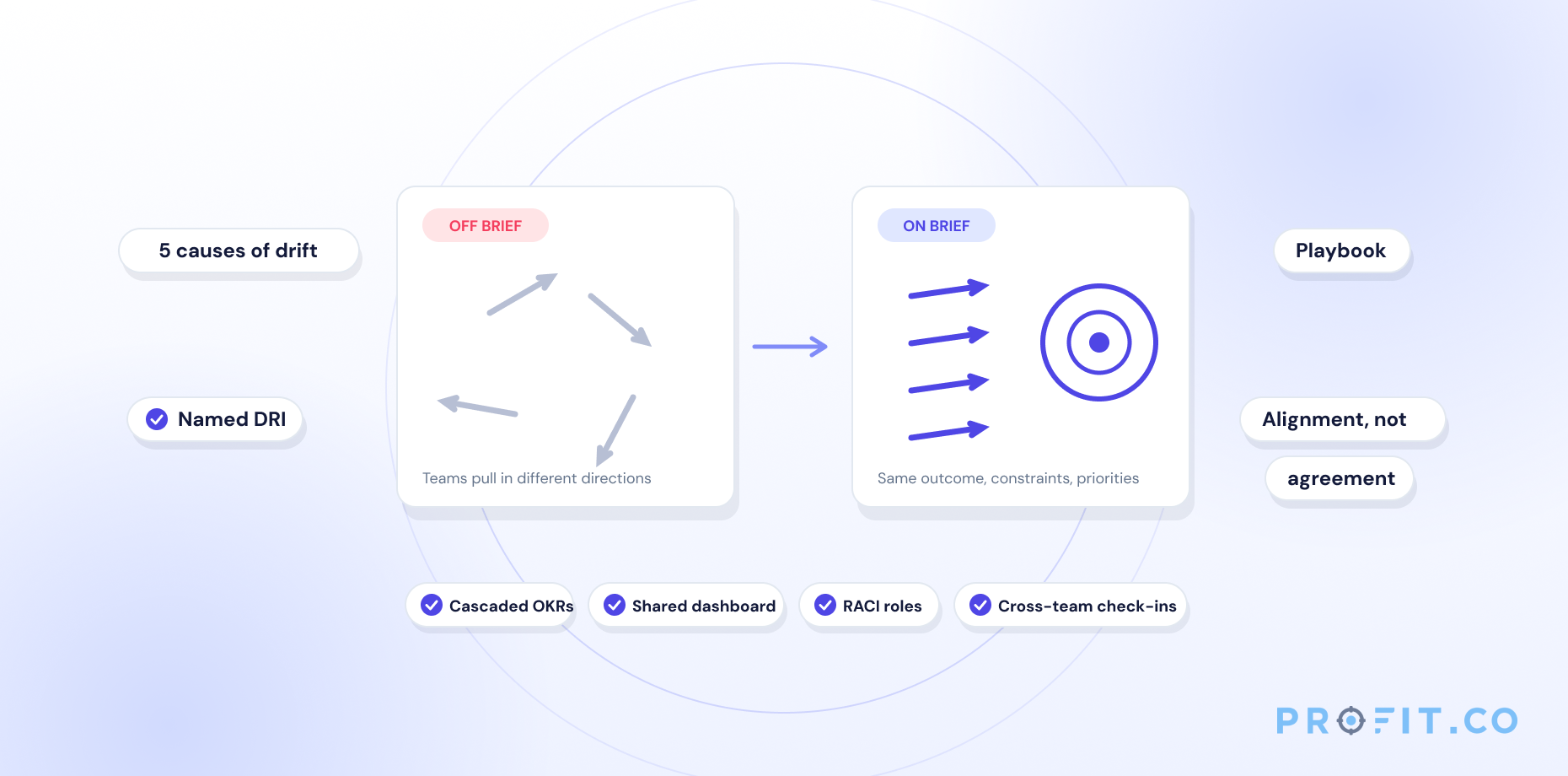
OKRs in agile portfolio management set the strategic boundaries within which sprints operate. Quarterly key results define what portfolio success looks like at the business level. Sprint goals deliver the increments that move those key results forward. This structure prevents the most common failure in agile portfolios: teams moving fast in directions that don’t match organizational strategy.
In this guide
- What is OKR in Project Management?
- Why do Agile Portfolios Lose Strategic Direction Without OKRs?
- How do Stage-Gate Governance and Agile Delivery Conflict, and What Resolves It?
- What are Agile OKR Examples in Portfolio Management?
- How do You Connect OKR Cycles to Agile Sprint Cadence?
- What does a Unified OKR and Portfolio Management Platform Change?
- Frequently asked questions
What is OKR in Project Management?
Traditional project management answers three questions: scope, time, and cost. OKRs answer a fourth question those frameworks ignore: did the project create the intended business outcome?
In project management, OKRs assign strategic intent to every project in the portfolio. The Objective is the strategic reason the project exists, not the deliverable. Each Key Result is a measurable business outcome the project must produce. Projects, sprints, and tasks are the execution units teams run to move those key results forward.
The practical implication at portfolio scale: without OKRs, projects compete for resources based on political visibility in planning meetings. With OKRs, every project in the portfolio carries a measurable link to a strategic objective, and prioritization becomes a data question, not a negotiation.
To understand how the full OKR lifecycle works end-to-end, from company objective to individual key result, explore the OKR management platform.
A project delivered on time with every feature shipped is still a failed project if none of those features moved a business metric.
Why do Agile Portfolios Lose Strategic Direction Without OKRs?
The common belief is that agile teams stay aligned because they deliver continuously and review frequently. This holds true at team level. It breaks at portfolio scale.
Sprint velocity measures how fast a team works. It does not measure whether that team is working toward the right outcomes. At portfolio scale, dozens of agile teams can each hit their sprint targets while the aggregate output barely moves a single strategic objective.
Only 16% of knowledge workers say their company effectively sets and communicates goals.That gap doesn’t close because teams adopt agile. It closes when agile delivery operates within a strategic goal structure, and that structure requires OKRs.
The failure pattern repeats across organizations:
Annual planning sets strategic objectives
Product owners translate objectives into backlogs — context gets lost in translation
Backlogs become feature lists, not outcome targets
By Q2, teams execute what was committed in January, not what the business now needs
Year-end retrospectives reveal the team shipped on schedule, but moved none of the strategic metrics that mattered
Agile execution without a strategic anchor is organized speed — you arrive faster at the wrong destination.
See how this maps to delivery in practice through agile OKR examples by department, including product, engineering, and operations portfolio teams.
How do Stage-Gate Governance and Agile Delivery Conflict, and What Resolves It?
Stage-gate governance was designed for predictability: define milestones upfront, get approval at each gate, proceed in phases. Agile was designed for adaptability: deliver incrementally, adjust scope based on feedback, iterate toward the outcome. These two models conflict because they measure entirely different things.
Stage-gate asks: “Did we complete phase 2 as defined?” Agile asks: “Are we delivering the highest-value increment this sprint?” Neither asks: “Are we moving the strategic metric this project was funded to move?”
OKRs resolve this by separating outcomes from outputs. Gate criteria become key results, outcome-based instead of output-based. Sprint goals execute within key result boundaries. The result: governance teams get outcome certainty, delivery teams keep execution flexibility, and leadership sees continuous strategic alignment rather than a snapshot at project initiation.
The assumption that stage-gate and agile are incompatible has cost organizations a decade of false tradeoffs. The conflict isn’t methodological — it’s definitional. Both frameworks fail for the same reason: neither measures outcomes.
| Dimension | Stage-Gate | Agile Sprints | OKR-Hybrid Model |
|---|---|---|---|
| Planning cadence | Annual or per project phase | 2-week sprint cycles | Quarterly OKR cycle + 2-week sprints |
| Success measure | Phase deliverable completed | Velocity and story points | Key result progress (scored 0.0-1.0) |
| Governance trigger | Phase gate review | Sprint review meeting | Weekly OKR check-in + quarterly review |
| Scope flexibility | Fixed at initiation | High — adapts each sprint | Outcome fixed, execution scope flexible |
| Strategic alignment | Checked at initiation only | Rarely verified mid-sprint | Continuous — each sprint maps to a KR |
| Failure definition | Missed deadline or deliverable | Incomplete sprint items | KR score below 0.4 at quarter-end |
What are Agile OKR Examples in Portfolio Management?
Example 1 — Technology Portfolio
Expanding a Platform to Enterprise Buyers
Objective: Expand platform to enterprise customers before Q3 sales cycle
Key Results
Sprint structure:
When sprint 4 surfaces a production incident that delays KR2 progress, the portfolio decision is immediate: reallocate capacity from KR3 prep to KR2 resolution. The key result score, not the project plan, drives the decision.
Example 2 — Operations Portfolio
Reducing Production Line Waste in Manufacturing
Objective: Reduce production line 3 waste rate by Q3
Key Results
Outcome-based gate criteria:
How do you Connect OKR Cycles to Agile Sprint Cadence?
The cadence structure that prevents Q2 drift and keeps sprint capacity anchored to portfolio outcomes:
A key result that scores 0.4 three quarters in a row isn’t a motivation problem. It’s a planning problem. OKR scoring surfaces this in week 6, not week 12.
For a complete guide to OKR scoring, cadence, and reflect-and-reset structure, see the OKR best practices guide, covering everything from how to set ambitious key results to how to run a quarter-end retrospective.
What does a Unified OKR and Portfolio Management Platform Change?
When OKR tracking and portfolio management run in separate tools, the bridge between strategy and execution exists only in someone’s spreadsheet, and it typically breaks within six weeks of the quarter starting.
Three specific gaps appear in disconnected systems:
Gap 1
Goal-to-Project Traceability Disappears
No one can answer which projects are advancing which key results. Low-value work continues because no one can prove it’s low-value.
Gap 2
Progress Reporting Becomes Manual Aggregation
Sprint boards update. OKR trackers update separately. Portfolio managers pull both into a status deck, already out of date before it’s shared.
Gap 3
Mid-Quarter Prioritization Loses Its Frame
New work surfaces mid-quarter with no shared decision frame. Resources get pulled by urgency, not strategic impact.
The Connected OKR and Portfolio Model
OKRs, project portfolio management, and task execution in one connected system
A connected platform links OKR management, project portfolio management software, and task-level execution in one system. Every project links directly to the key result it serves. Sprint and task updates flow into key result scores automatically, cutting the manual reporting cycle that breaks most hybrid OKR programs.
AI-powered progress tracking automates progress collection, flags at-risk key results before they miss targets, and surfaces portfolio alignment gaps. AI-assisted key result authoring catches vague key results before they absorb a full quarter of sprint capacity on unverifiable targets.
Connect Individual Goals to Company Results
Frequently Asked Questions
OKRs define the strategic outcome a project must achieve, not just what gets built. Each key result becomes the measurable success criterion for a project or workstream, connecting delivery activity directly to business impact, not just scope completion.
Quarterly OKR cycles set the strategic boundaries for portfolio work. Sprint goals operate within those boundaries, each sprint advances a specific key result. Portfolio reviews measure key result progress, not sprint velocity or story point completion.
Use key results as gate criteria instead of phase deliverables. Outcomes become fixed; execution scope stays flexible. This preserves governance accountability without forcing agile teams into upfront specification work that eliminates iterative learning.
A technology portfolio OKR: Objective — expand to enterprise buyers; KR1 — complete SOC2 certification; KR2 — achieve 99.9% uptime; KR3 — onboard five reference accounts with NPS above 40. Sprint goals deliver each KR incrementally across the quarter.
Agile sprint cycles optimize for delivery velocity. Without a strategic anchor, teams ship continuously but the aggregate output doesn’t move the strategic metrics the portfolio was funded to move. OKRs provide that anchor at portfolio level, not just team level.