
Project Management
Earned Value Management:
Catch Issues Before They Detail Projects
Profit.co gives your project teams a single view of Earned Value Management metrics — CPI, SPI, and TCPI — updated as work progresses. Your portfolio managers see every EVM metric in one place, without waiting for end-of-week reports.
Enterprise-Grade Security, Built In
Profit.co meets the security and compliance requirements of enterprise procurement – SOC 2 Type II audited, ISO 27001 certified, with a 99.9% uptime SLA and 24/7 live support included on every plan.
The core problem
Your team finds out about project problems
only after they become expensive
EVM is designed to flag cost and schedule problems before they compound. But when your metrics live in spreadsheets updated once a week, the warning arrives too late to act on.
EVM data lives in spreadsheets updated once a week.
Your project managers calculate CPI and SPI manually at the end of each week — which means every decision your governance team makes is based on last week’s numbers, not today’s reality.
Variance reports arrive after the sprint that caused the problem.
By the time a cost overrun appears in a weekly report, your team has already run another sprint in the wrong direction. The window to course-correct without disruption has closed.
Portfolio visibility requires stitching five reports together manually.
Every project has its own EVM export. Seeing your entire portfolio’s health means rebuilding a consolidated view by hand every week — a task that consumes hours before a single decision can be made.
How EVM works
Your project’s health – readable in
seconds.
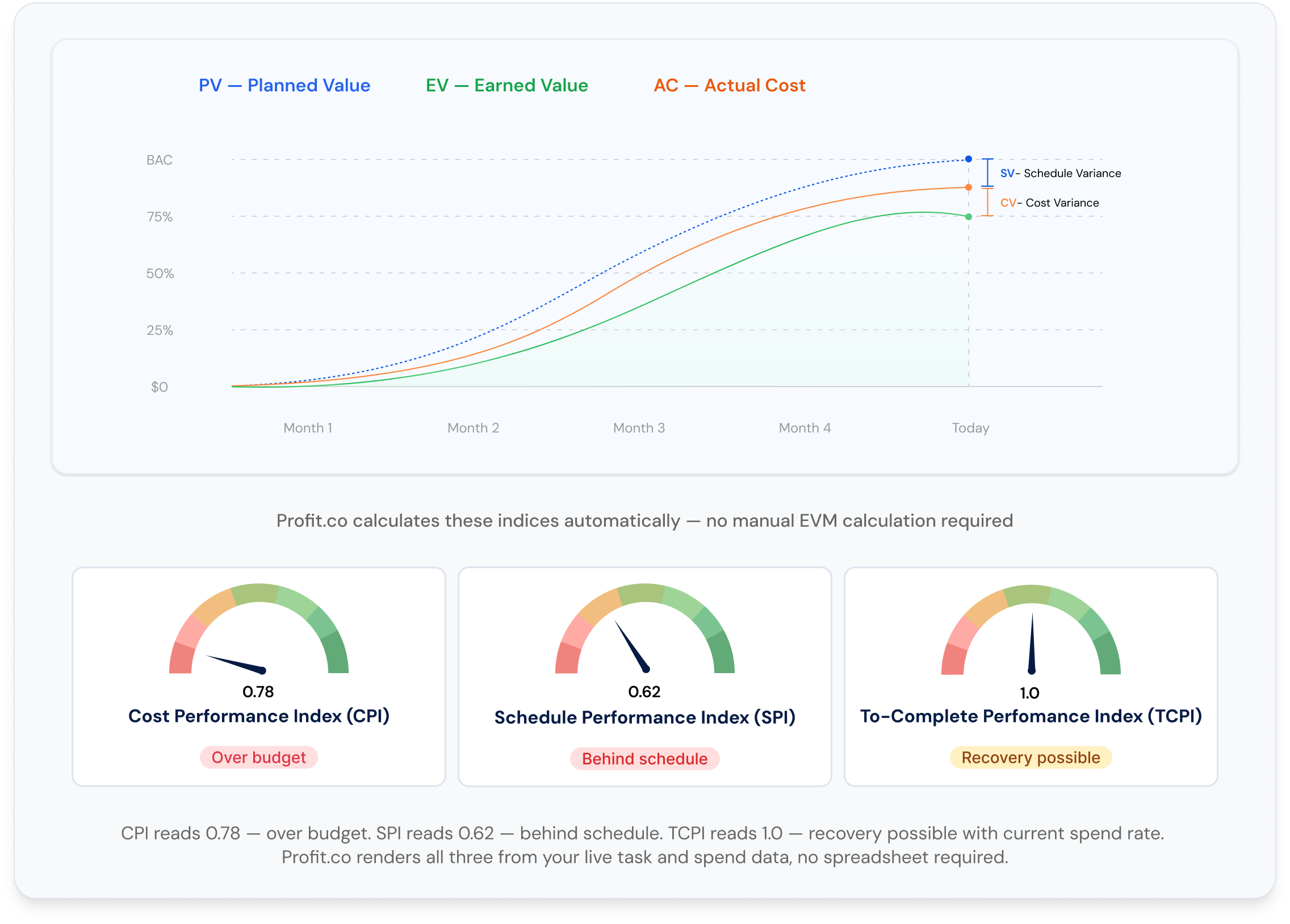
EVM tracks three values over time — Planned Value (PV), Earned Value (EV), and Actual Cost (AC). At any point in time, the difference between EV and PV represents Schedule Variance, while the difference between EV and AC represents Cost Variance. Profit.co automatically converts these into CPI, SPI, and TCPI as your team logs progress.
How Profit.co solves this
How Profit.co makes EVM work the way it should
Most EVM tools sit outside your project workflow — your team calculates metrics separately and pastes them into reports. Profit.co builds EVM directly into the place where work happens. Learn more about Profit.co’s project portfolio management capabilities.
EVM metrics visible where your team works
When your team marks a task complete or logs actual spend, Profit.co updates your EVM indices immediately – so variance surfaces the same week it occurs, not the week after.
Every project’s EVM health in one view
Profit.co surfaces CPI, SPI, and TCPI across all active projects in a single portfolio view — so your governance team spots which projects need attention instead of consolidating five separate reports by hand every week.
Delivery data with full project context
Profit.co connects EVM metrics to project scope, milestones, and team activity — so when CPI drops below 1.0, your team sees the exact task driving the overrun, without opening a second tool.
Platform comparison
Why standalone EVM tools are not enough
Profit.co is the only project management platform that calculates CPI, SPI, and TCPI inside your live project view – updated automatically as your team logs progress, with no data export or offline calculation cycle required. Standalone EVM tools calculate the same metrics, but they cannot display them alongside live task activity, milestones, and sprint progress. General project platforms track tasks without any EVM engine. Only Profit.co does both, in one view.
| Capability | Standalone EVM tools | General PM platforms | Profit.co |
|---|---|---|---|
| EVM metrics (CPI, SPI, TCPI, CV) |  |
Partial / manual | |
| EVM visible directly in project view |  |
|
|
| Portfolio-level EVM across all projects | |
Partial | |
| EVM linked to project scope and milestones | |
|
|
| No manual EVM calculation required | |
Partial | |
Earned Value Management Resource Library
Deep dives on Earned Value Management
Frameworks, definitions, comparisons, and practical guides — one article per question.
Project Success with Earned Value Management (EVM) in Project Portfolio Management (PPM)
Earned Value Management compares planned work against completed work and actual costs to give project managers a quantified view of whether projects are on time and on budget. EVM surfaces performance deviations before overruns compound. Read…
Read articleEVM Is Not Enough: The Case for Adding Business Value Management
The five core EVM formulas — CPI, SPI, CV, SV, and EAC — tell portfolio managers whether projects will finish on budget and on schedule, and what the projected final cost will be. Complete reference with interpretation thresholds. Read…
Read articleEVM Formulas and Metrics Explained
The five core EVM formulas — CPI, SPI, CV, SV, and EAC — tell portfolio managers whether projects will finish on budget and on schedule, and what the projected final cost will be. Complete reference with interpretation thresholds Read…
Read articleEVM vs OKR Progress Tracking: Why You Need Both
EVM measures project delivery — schedule, cost, and scope variance. OKR tracking measures strategic value — whether that work produces outcomes that matter. Together they create a closed loop: EVM validates execution efficiency; OKRs validate strategic relevance.
Read articleWhat Earned Value Management Actually Tells You And When to Use It
Earned Value Management tells you how much value projects produce per dollar spent, and whether current performance will cause a cost overrun or underrun. EVM separates portfolio reporting that tracks spending from reporting that tracks performance. Read…
Read articleThe Hybrid Portfolio Governance Gap
Hybrid portfolio governance fails when the same reporting and risk architecture is applied to both agile and waterfall programs. The fix is separating strategic governance from execution, so the investment committee reads one coherent portfolio view. Read…
Read articleHow to Choose a Project Portfolio Management Platform
Choosing a PPM platform requires evaluating three criteria before feature comparison begins: migration feasibility, financial integration depth, and governance enforcement capability. These determine whether the platform can be implemented in practice and whether it generates ROI through automated finance reconciliation. Read…
Read articleWhy Your Project Variance Report Is Blaming the Wrong Person
Project variance reports fail when the baseline is overwritten by the latest plan. Approved scope changes get misclassified as execution overruns. The fix is governed baseline management that preserves original commitments and isolates true execution performance. Read…
Read articleQuick Implementation
Get Started in 3 Simple Steps
Our proven implementation process gets your team up and running in weeks, not months.
1
Discovery & Setup
We understand your goals, configure your workspace, and set up the platform to match how your team works.
2
Guided Onboarding
Hands-on training for admins and team leads with dedicated customer success support.
3
Go Live
Launch to your full team with 24/7 support and run your first quarterly OKR cycle.
The Solution
Integrate With Your Favorite Apps
We integrate with Jira, Slack, G Suite, Zapier, Teams, Office 365, and 100+ Integrations. Connect with Profit.co OKR Software to integrate users, tasks, and also check in your key results within the apps.
View all integrations

Have questions?
We got answers.
Earned Value Management (EVM) integrates cost, schedule, and scope into CPI and SPI. Profit.co calculates these indices automatically inside your project view — so portfolio managers see whether each project is on budget and on schedule without manual calculation.
Profit.co’s EVM surfaces CPI and SPI across every active project on one screen. CPI below 1.0 flags cost overrun; SPI below 1.0 flags schedule slippage — so your governance team spots which projects need intervention before overruns become unrecoverable.
Profit.co calculates EVM metrics — CPI, SPI, and TCPI — directly inside your project view, updated as work progresses. Other tools require separate EVM software or manual spreadsheet calculations, so variance surfaces only after a weekly export cycle.
Your team is typically live within 2 to 3 weeks, with baseline budgets, milestones, and project connections configured through guided onboarding — and dedicated implementation support included.
Profit.co connects to 100+ tools including Jira, Salesforce, Azure DevOps, and Google Sheets. Actuals flow in automatically so EVM calculations update without manual input. See the full integrations list.
Can’t find your answers?
Get in touch with us we are happy to assist you!
Get started
See every project’s EVM health
in one view
Profit.co brings EVM tracking directly into your project view — so your team catches issues the same week they occur, not after the sprint that caused them.

Welcome to Profit.co 👋
How can I help you today?