

Adaptive Planning for OKRs
Adaptive planning means your goals survive contact with reality
Business conditions don’t wait for your quarterly review. Markets shift, priorities change, dependencies slip, and new opportunities emerge. Adaptive planning is the discipline of recognizing change early and modifying your operating plan before the gap between strategy and reality becomes a crisis — top-down, bottom-up, or both.
67%
of strategies fail due to poor execution, not poor strategy
3.2X
faster goal attainment in teams that modify plans within 2 weeks
41%
of OKR plans become misaligned within the first month of a quarter
$4.7M
avg. annual cost of delayed plan corrections in mid-market orgs
Understanding the inevitable
Six reasons your plan will change this quarter
Plan changes aren’t exceptions — they’re the norm. Adaptive planning starts with accepting that every plan is a hypothesis, and the data will tell you when the hypothesis needs revision.

Market conditions shift
A competitor launches a new feature, regulatory policy changes, or macroeconomic headwinds alter demand. The targets you set assuming steady-state conditions no longer reflect reality.

Resource reallocation
Engineering capacity gets redirected to a critical bug. A key hire doesn’t start on time. Budget gets pulled for a higher-priority initiative. Your plan’s capacity assumptions are now invalid.

Strategic pivot
Leadership shifts from acquisition to retention. A product-led motion replaces enterprise sales. The objectives stay, but the distribution of effort and the plan behind it changes entirely.

Early data reveals miscalibration
Three weeks in, check-in data shows your target was wildly optimistic — or surprisingly conservative. Adaptive planning means recalibrating immediately, not at the quarter-end review.

Cross-team dependencies slip
Your KR depends on another team’s deliverable by week 4 — they’re now estimating week 8. In a hierarchy of cascaded plans, one slip reshapes every downstream plan.

New opportunity emerges
A partnership materializes, a beta outperforms, or a customer segment responds better than modeled. Adaptive plans accelerate when conditions favor it — not just correct when they don’t.
The compounding problem
Every week you delay a plan change, the cost doubles
Plan misalignment doesn’t sit quietly. It compounds. Teams keep executing against outdated targets, reporting misleading progress, and making downstream decisions based on a plan that no longer reflects reality. In hierarchical organizations, the damage cascades — one unmodified parent plan quietly misaligns every child KR beneath it.
“The most expensive sentence in business isn’t ‘we failed.’ It’s ‘we knew the plan was wrong but kept going anyway.'”

Week 1–2
Signal appears
Check-in data deviates from plan. The gap is small. One person notices but assumes it’ll correct itself. The plan stays untouched.
Week 3–5
Gap widens silently
Status turns yellow, then red. Downstream teams are still planning around the original targets. Child KRs that aggregate bottom-up are now reporting phantom progress against a misaligned parent.
Week 8+
Cascading misalignment
The QBR reveals what everyone already knew. The real cost isn’t the missed number — it’s the weeks of effort optimized against the wrong plan, multiplied across every level of the hierarchy.
Built for adaptive planning
Profit.co makes plan modification instant, not agonizing
Most OKR tools treat the plan as a set-it-and-forget-it artifact. Profit.co treats it as a living document — one that flows down through your hierarchy and aggregates back up as conditions change.
Inline baseline & target editing
Change your From and To values directly inside the plan view — no navigating back to the Key Result. Edit the range, and the plan recalculates proportionally in real time. The KR stays in sync automatically.
AI-powered plan import
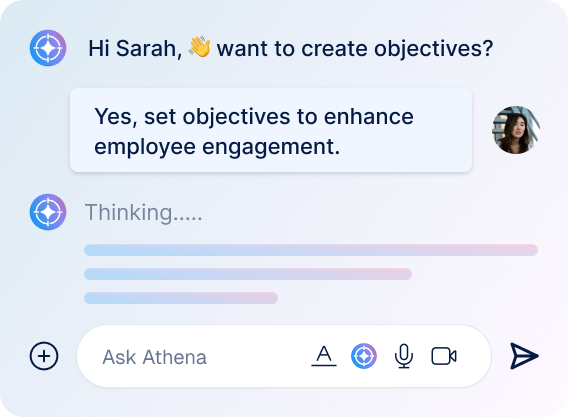
Paste from a spreadsheet, upload an Excel file, share a screenshot from another tool, or describe the plan shape you want in plain language. The AI assistant interprets your input, maps it to your KR’s check-in schedule, and generates a complete plan for review.
Conversational plan adjustments
Tell the AI what to change: “shift 10% from February into March,” “back-load into Q3,” or “double the pace for week 1–4.” The assistant shows you a diff before applying — old values struck through, new values highlighted.
Plan integrity safeguards
If someone changes a KR’s baseline or target after a custom plan exists, Profit.co doesn’t silently break the distribution. A reconciliation prompt surfaces immediately — adjust the plan or reset to auto-calculated distribution.
Fast manual editing
Tab navigation between cells, bulk fill across periods, linear interpolation, and undo/redo. A spreadsheet-grade editing experience without leaving the OKR platform.
Plan in every direction
Plans that flow down and aggregate back up
Real organizations don’t plan in isolation. A VP sets a quarterly target, distributes it across directors, who break it into team-level KRs. Or teams build bottom-up plans that roll into a single organizational view. Profit.co supports both — and keeps them synchronized when plans change at any level.
Top-down distribution
Leadership defines the high-level target and plan shape. Profit.co distributes the plan downward through the OKR hierarchy — from company objectives to department KRs to team-level targets — preserving the distribution curve at each level.
- Set the parent plan — define the target distribution at the organizational or department level.
- Distribute downward — Profit.co cascades proportional targets to child KRs, respecting each team’s check-in frequency.
- Modify at any level — when a parent plan changes, child plans can auto-adjust or flag for manual review.
OR
Bottom-up aggregation
Teams build their own plans based on ground-level knowledge. Profit.co aggregates these plans upward, giving leadership a real-time view of what the organization is actually committing to — not what was assumed from the top.
- Teams plan independently — each team sets its own realistic plan based on capacity and conditions.
- Aggregate upward — Profit.co rolls up team plans into department and organizational views automatically.
- Identify gaps early — if aggregated bottom-up plans don’t meet the top-level target, the gap surfaces immediately for negotiation.
Both modes work together. Many organizations use top-down distribution to set initial targets and then allow teams to modify their plans bottom-up as execution reality becomes clearer. Profit.co keeps the hierarchy synchronized — when a team-level plan changes, the aggregated parent view updates in real time, surfacing gaps or overcommitments before the next review cycle.
